Every figure below comes from our verified state data and links to its official source.
Quick answer
A property owner can usually have your car towed if you parked without permission, but only by following state rules: posted signs, notice to the police, and fee limits in some states. If those rules weren't followed, you may be able to get your money back. Act fast, because storage adds up every day.
Private property towing: when a car can be towed
A tow from private property happens when the owner or manager of a parking lot, an apartment complex, a store or an office building has a car removed without the car owner's consent. Tows like these are sometimes called private property impounds.
The property owner doesn't tow the car themselves. They hire a towing company for private property, usually under a written agreement, and the company removes cars that break the posted rules.
State private property towing laws usually set conditions before a car can be towed. Common ones in our data are signs at the entrances, the owner's written authorization for the tow, and a report to the police. Here is how some states describe the rules:
- Wisconsin: Removal of a vehicle parked on private property where it is not authorized to park. If the property is properly posted (clearly visible notice that the area is private property and that unauthorized vehicles may be immediately removed), the vehicle may be removed immediately at the owner's expense. If the property is not properly posted, the vehicle may be removed only upon a repossession judgment or a citation for illegal parking. Only a towing service may remove the vehicle, at the request of the property owner or the owner's agent, a traffic officer, or a parking enforcer, and it may not remove a vehicle that has been reported stolen. Before removing the vehicle, the towing service must notify local law enforcement (the police department for the municipality, or the county sheriff if there is none) of the vehicle's make, model, vehicle identification number and plate number and where it will be taken. Wis. Admin. Code ch. Trans 319 sets maximum charges for these tows.[1]
- Virginia: The owner or operator of a parking lot or other property may have a vehicle parked without permission towed to a licensed garage for storage, if signs are posted at all entrances saying unauthorized vehicles will be removed, towed or immobilized. The signs must give the police non-emergency number or the towing company's number. These sign requirements do not apply in localities whose governing body has adopted a towing ordinance under Va. Code § 46.2-1232. The tow company must report the tow to the State Police or local police right away. If a landlord's tow company plans to tow a resident's vehicle from an apartment lot for expired registration or inspection, it must first post a notice on the vehicle and wait 48 hours. For passenger cars, state law caps the hookup and initial towing fee unless the locality has set different limits by ordinance. These rules do not apply to police, fire or public health vehicles, or where a vehicle is left temporarily on someone else's property because of a wreck or other emergency.[2]
Cities and counties often add their own rules on top. Your private property towing rights depend on where the car was parked, so check your state page and, for local rates, your city.
What the tow and storage can cost
Some states cap what a towing company can charge for a tow from private property. Others leave it to cities and counties, or set no figure at all. The map shows which is which for a light-duty car.
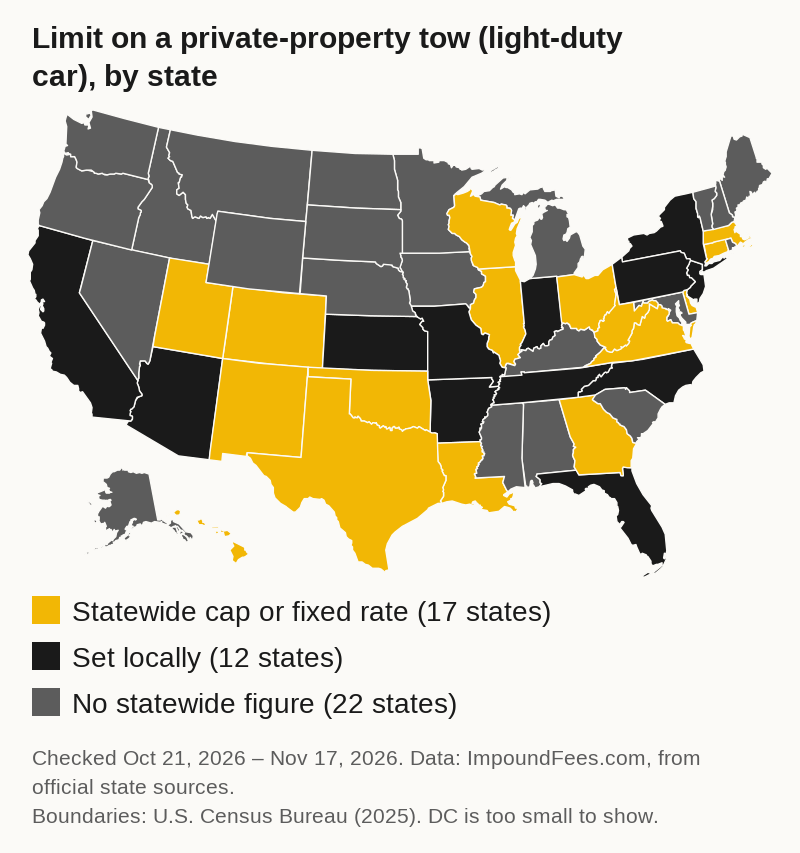
Of the 51 states we publish, 17 have a statewide figure for this tow, 12 leave it to local rules, and 22 have no statewide figure we could find.
Texas is a good example of a state that sets one maximum for the whole state. The TDLR private property towing rules work like this:
- Texas: A tow from a parking lot or other private property, authorized by the parking facility owner without the vehicle owner's consent. TDLR sets statewide maximum tow and drop fees for these tows. Cities or counties may set lower rates.[3]
Here is what a short stay can add up to there, worked out the same way as our calculator:
| Private-property tow, light-duty vehicle | $272[4] |
|---|---|
| Daily storage fee, vehicle 25 ft or shorter: 3 days × $22.85 | $68.55[5] |
| Notification fee (VSF notice to owner/lienholder) | $50[6] |
| Maximum under state rules (sum of the lines above[4][5][6]) | $390.55 |
The full table of tow and storage limits is further down this page. For a full breakdown of a bill, see our guide on how much to get a car out of impound, or use the towing and impound calculator.
Signs and notice rules
Signs are the heart of most of these laws. Many states require a sign at each entrance that says unauthorized vehicles will be towed and names the towing company with a phone number. Some require the fees and the lot's hours too. In New York, the sign decides whether a tow is allowed at all:
- New York: Towed from a private lot: look at the lot's posted sign, which must give the name, address and phone number of the tow company. Outside New York City, a lot without that sign may not tow.[7]
The second common rule is notice to the police. In many states, the towing company must tell the local police about the tow soon after, so that you can find the car by calling them. Kentucky's rule is typical:
- Kentucky: Find out who towed the car. After a private-property tow, the towing company must notify the police agency for that location no later than two hours after the tow, so call the local police.[8]
Before you leave the lot, take photos of every sign, or of the spots where a sign should be. They are your best evidence if you dispute the tow.
If you live in an apartment complex, read the parking rules in your lease too. Many tows there involve parking permits, guest spaces or expired registration, and some states add extra notice rules for residents' cars, as the Virginia rule above shows. Ask the manager for the parking rules in writing, and keep a copy in the car.
Getting your car back
If you catch the tow truck before it leaves, ask the driver to stop. In many states the company must let the car go on the spot, for a reduced fee or none:
- Florida: If you find your car being towed from a private lot, ask the tow operator to stop. The operator must release it for a fee of no more than half the posted towing rate.[9]
If the car is already gone, call the number on the tow-away sign, or the police non-emergency line. Our guide to finding a towed car explains each step.
At the storage lot, bring a photo ID, proof of ownership and a way to pay. Ask for an itemized invoice before you pay, and check each line against your state page. If the lot has a posted rate sheet, photograph it. To understand how the lot itself works, read what an impound lot is.
How to dispute a private-property tow
Start with the facts: photos of the signs, your receipt, the time you parked and the time you came back. Write down who you spoke to at the lot and what they said, while you still remember. Then use the process your state offers. Depending on the state, that can be a court hearing, a complaint to a state agency, or a court case.
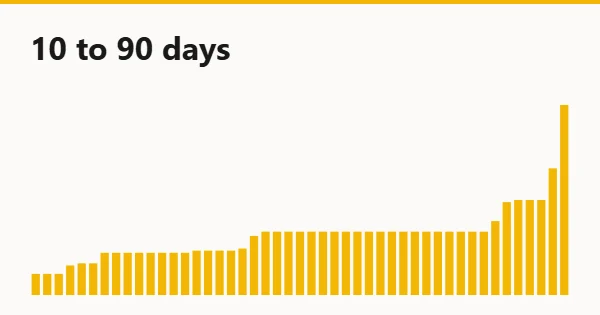
Some states set a deadline to ask for a hearing. Where we found one, it ranges from 5 business days[10] (Oregon) to 30 days[11] (Pennsylvania), so don't wait.
When a tow broke the rules, some states take the charges away entirely:
- Massachusetts: If a private-property tow did not fully follow c. 266, § 120D (for example, the police were not notified first, or there was no direct warning or posted notice), the law says the vehicle must be released to you without charges for removal or storage.[12]
The table below shows the private-property tow limit, the storage limit and the hearing deadline for each state we publish. Each figure links to its source.
| State | Private tow, light-duty | Storage, private tow | Deadline to request a hearing |
|---|---|---|---|
| Alabama | No statewide figure | No statewide figure | Not found statewide[13] |
| Alaska | No statewide figure[14] | No statewide figure[15] | Not found statewide[16] |
| Arizona | Set locally[17] | Set locally[18] | 10 days[19] |
| Arkansas | Set locally[20] | No statewide figure | 30 days to file in court[21] |
| California | Set locally[22] | Set locally[22] | 10 days[23] |
| Colorado | Up to $250.91[24] | Up to $48.19 / day[25] | Not found statewide[26] |
| Connecticut | Up to $130.63[27] | Up to $30 / day[28] | 10 days[29] |
| Delaware | Up to $250[30] | Up to $50 / day[30] | Not found statewide[31] |
| District of Columbia | Up to $100[32] | Up to $20 / day[33] | Not found statewide[34] |
| Florida | Set locally[35] | Set locally[35] | Not found statewide[36] |
| Georgia | Up to $228[37] | Up to $33 / day[38] | 10 business days to file in court[39] |
| Hawaii | Up to $75[40] | Up to $25 / day[41] | Not found statewide[42] |
| Idaho | No statewide figure[43] | No statewide figure | 10 days[44] |
| Illinois | Up to $238.20[45] | Up to $45 / day[46] | Not found statewide[47] |
| Indiana | Set locally[48] | No statewide figure[49] | 30 days to file in court[50] |
| Iowa | No statewide figure[51] | No statewide figure | 20 days[52] |
| Kansas | Set locally[53] | No statewide figure | Not found statewide[54] |
| Kentucky | No statewide figure | No statewide figure | 10 days[55] |
| Louisiana | $152.50[56] | $34 / day[57] | 10 days[58] |
| Maine | No statewide figure[59] | No statewide figure | Not found statewide[60] |
| Maryland | No statewide figure | No statewide figure | Not found statewide[61] |
| Massachusetts | Up to $132[62] | Up to $35 / day[63] | Not found statewide[64] |
| Michigan | No statewide figure[65] | Set locally[66] | 20 days to file in court[67] |
| Minnesota | No statewide figure | No statewide figure | Not found statewide[68] |
| Mississippi | No statewide figure[69] | No statewide figure[69] | Not found statewide[70] |
| Missouri | Set locally[71] | No statewide figure | 10 days to file in court[72] |
| Montana | No statewide figure[73] | No statewide figure[73] | Not found statewide[74] |
| Nebraska | No statewide figure[75] | No statewide figure | Not found statewide[75] |
| Nevada | No statewide figure | No statewide figure | 21 days to file in court[76] |
| New Hampshire | No statewide figure[77] | No statewide figure | 15 days[78] |
| New Jersey | Set locally[79] | Set locally[80] | Not found statewide[81] |
| New Mexico | Up to $100[82] | $10–$20 / day[83] | Not found statewide[84] |
| New York | Set locally[85] | Set locally[86] | 10 days to file in court[87] |
| North Carolina | Set locally[88] | Set locally[88] | 10 days to request a hearing on the lien, before a sale[89] |
| North Dakota | No statewide figure[90] | Up to $50 / day[91] | Not found statewide[92] |
| Ohio | Up to $144[93] | Up to $22 / day[94] | Not found statewide[95] |
| Oklahoma | Up to $108.06[96] | Up to $23.94 / day[97] | 10 days[98] |
| Oregon | No statewide figure | No statewide figure | 5 business days[10] |
| Pennsylvania | Set locally[99] | Up to $25 / day[100] | 30 days[11] |
| Rhode Island | No statewide figure[101] | No statewide figure | Not found statewide[102] |
| South Carolina | No statewide figure | No statewide figure | Not found statewide[103] |
| South Dakota | No statewide figure[104] | No statewide figure[104] | Not found statewide[105] |
| Tennessee | Set locally[106] | Set locally[106] | Not found statewide[107] |
| Texas | Up to $272[4] | Up to $22.85 / day[5] | 14 business days[108] |
| Utah | Up to $211[109] | Up to $42 / day[110] | Not found statewide[111] |
| Vermont | No statewide figure[112] | No statewide figure | Not found statewide[113] |
| Virginia | Up to $210[114] | Set locally[115] | Not found statewide[116] |
| Washington | No statewide figure[117] | No statewide figure[117] | 10 days[118] |
| West Virginia | Up to $102 / hour[119] | Up to $27 / day[120] | Not found statewide[121] |
| Wisconsin | Up to $150[122] | Up to $25 / day[123] | Not found statewide |
| Wyoming | No statewide figure[124] | No statewide figure[125] | Not found statewide[126] |
Common mistakes
Driving away without photos. Once the signs change or the lot is repainted, your evidence is gone.
Paying without a receipt. You need the itemized invoice to dispute anything.
Missing the hearing deadline. In some states it is short, and it can be counted in business days.
Assuming every tow is legal. If the sign was missing, the fee was above the state cap or the police weren't told, you may have a claim.
Assuming every tow is illegal. If you parked where the signs said you couldn't, a dispute over the tow itself is unlikely to succeed. Still check the fees against your state's limits.
Questions people ask
Can my neighbor get my car towed?
Only from their own property, and only by following the same rules as any property owner. On a public street, a neighbor can't order a tow. They can call the police or parking enforcement, who decide whether the car breaks a parking rule.
How long can someone leave a car on your property before it becomes yours in Georgia?
A car doesn't change hands just because it was left somewhere. In the state rules we track, an unclaimed car goes through a process: a tow, notices to the owner and, if nobody claims it, a sale or a transfer of title. For Georgia, the earliest sale is listed in our data as: Not found statewide[127]. The Georgia page has the rules we did find.
What is the "80/20 rule" for towing?
None of the official sources behind our state pages mentions an "80/20 rule" for towing. If someone cites it to justify a tow or a fee, ask which law they mean, and check your state page.
What are common illegal practices by tow companies?
Charging more than the state maximum, towing from a lot without the required signs, and refusing to release the car unless you sign away your rights are among the problems state laws address. Illegal towing from an apartment complex, such as towing a resident's car without the notice a state requires, is another. For example:
- North Carolina: At a private-lot tow covered by G.S. 20-219.2, the company must tell you in writing that you can pay, take the vehicle and still contest the charges. It cannot make you sign a waiver to get your vehicle back; you only need to sign a form acknowledging the release and receipt of the vehicle.[128]
- Virginia: If you only need your belongings, you can show proof of ownership and take your personal items out of the car without paying any fee.[129]
How do towing companies get private property towing contracts?
They sign an agreement with the property owner or manager, who authorizes the company to remove cars that break the posted rules. Some states require that authorization in writing or regulate what the contract must say; your state page lists the laws we found.
Who pays for towing on private property?
The car's owner pays the tow and storage to get the car back, unless the tow broke the rules. If it did, you may be able to get your money back from the towing company through your state's dispute process. See also: illegal towing laws. See also: car towed for illegal parking. See also: can your car get towed for expired tags.
Related state pages
- Florida towing & impound fees · City pages: Jacksonville
- Georgia towing & impound fees
- Massachusetts towing & impound fees · City pages: Boston, Brockton
- New York towing & impound fees · City pages: New York City
- Texas towing & impound fees · City pages: Austin, Corpus Christi, Dallas, Irving, Pasadena
- Virginia towing & impound fees · City pages: Norfolk
- Wisconsin towing & impound fees · City pages: Madison
Related guides
-

Find my towed car: where to look first, state by state
Find my towed car: call the police non-emergency line or the number on the lot's tow-away sign, then try your state's official lookup if it has one.
Updated
-
What is an impound lot? How it works and what it costs
An impound lot is a storage yard that holds towed cars until the owner pays. Here is who runs them, how storage is charged and each state's rules.
Updated
-
How much to get a car out of impound? Costs by state
How much to get a car out of impound: the tow, a daily storage charge and any release fees. See each state's limits and a worked example.
Updated
-
Can a tow company keep my personal belongings? State rules
Can a tow company keep my personal belongings? What each state's law says about getting them back, which items are free and the deadlines.
Updated
-
Tow company lien process: when an unclaimed car is sold
The tow company lien process: a notice to the owner, a waiting period, then a sale. See each state's deadlines and what you may still owe after.
Updated
-
Illegal towing laws: your rights after a wrongful tow
Illegal towing laws explained: when a tow breaks the rules, how to dispute it, if you can sue, and what a tow company may owe you if it was wrong.
Updated
-
Car towed for illegal parking: what to do next
Had your car towed for illegal parking? Learn how to find the car, what to bring to the lot, how to pay, and how to dispute a tow you think was wrong.
Updated
-
Can your car get towed for expired tags? What states say
Can your car get towed for expired tags? See which state rules let police tow for expired registration, the limits on private lots, and what to do next.
Updated
Sources (129)
- Wis. Admin. Code Trans 319.01(1) Purpose and scope
- Va. Code § 46.2-1231(F) Exclusions
- Tex. Occ. Code §2308.002 Definitions (private property tow)
- 16 TAC §86.455(b) Private Property Tow Fees
- 16 TAC §85.722(d)(1) Daily storage fee (adjusted)
- Tex. Occ. Code §2303.155(c) Notification fee cap
- N.Y. Gen. Bus. Law §399-v(2) required parking-facility sign
- KRS 281.924(6) Notice to police within two hours (Private property towing -- Signage required for tow-away zone -- Duties of towing company)
- Fla. Stat. §715.07(2)(a)3. Tower must stop
- ORS 819.190 Hearing request deadline
- 75 Pa.C.S. § 7305(b)(5) Right to a hearing within 30 days
- M.G.L. c. 266, § 120D (non-complying tow: release without charges)
- Ala. Code § 32-13-4 (a) contesting the sale
- AS 28.10.502(b) lien limited to towing and storage charges and mailing fees
- AS 28.10.502(b) storage drops out of the lien after 60 days without notice
- AS 28.05.131(a) hearing before a department impounds a vehicle
- A.R.S. 9-499.05(A) City authority to set private-tow rates
- A.R.S. 28-4837(B) Owner liable for reasonable costs
- A.R.S. 28-3514(E)(5) Ten days to request a poststorage hearing
- Act 1319 of 2013, § 1, Ark. Code § 27-50-1101(a)(1)(B)(i) (county and city ordinances)
- Act 1025 of 2011, § 7, Ark. Code § 27-50-1207(e)(1) (30 days to seek review of a removal or hold)
- Cal. Veh. Code §22658(i)(1)(A) - private-property tow/storage charge is excessive above the local police or CHP rate
- Cal. Veh. Code §22852(a) - poststorage hearing right
- 4 CCR 723-6, Rule 6511(b)(II) annual inflation adjustment of PPI base rates
- 4 CCR 723-6, Rule 6511(d)(I) storage maximums (2022 base amounts, weight classes)
- 4 CCR 723-6, Rule 6511(f) noncompliance - no fees
- C.G.S. 14-66d(b) DMV schedule for private-property trespass towing and storage, effective January 1, 2026
- C.G.S. 14-66d(d) the storage rates and after-hours fee apply to all nonconsensual tows
- PA 26-24, S. 42 (C.G.S. 14-150(e)(4)) 10 days to apply for a hearing
- 21 Del. C. § 6907A(c) Towing fee up to $250 and daily storage up to $50 (noncommercial and rental vehicles)
- 21 Del. C. § 6908A(d) Violation is an unlawful practice under the Consumer Fraud Act
- 16 DCMR § 406.7 Tow from private property without the vehicle owner's consent
- 16 DCMR § 408.1 Maximum rates for public tows (lead-in)
- D.C. Code § 50-2459 Owner's remedy: fair market value
- Fla. Stat. §125.0103(1)(c) Counties must set maximum towing rates
- Fla. Stat. §713.78(5)(a) Court challenge
- DPS Tariff No. 5 Sec. 2.A items 1-2 (removal fee weight classes)
- DPS Tariff No. 5 Sec. 2.B items 3-4 (daily storage, light and medium)
- O.C.G.A. 40-11-19.1(c) (HB 307, 2019) - owner's answer deadline
- HRS 290-11 Vehicles left unattended on private and public property
- HRS 290-11 Vehicles left unattended on private and public property
- HRS 290-11 Vehicles left unattended on private and public property
- Idaho Code 49-1814(2) rate sheet for law enforcement-directed tows, filed with ITD and posted
- Idaho Code 49-1809(1) tow procedure hearing for officer-initiated tows
- ICC Police - Frequently Asked Questions (Relocation Towing)
- 625 ILCS 5/18a-200 General powers and duties of Commission
- 625 ILCS 5/18a-200(6) Refunds
- IC 24-14-5-2(5) Fees for private property towing (towing agreement)
- IC 24-14-8-1 Towing, clean-up, and storage fees
- IC 24-14-10-2 Jurisdiction of attorney general
- HF 2617 (2026) sec. 3, Iowa Code 321.89(3)(b)(3): persons may reclaim the vehicle within twenty days of the notice
- Iowa Code 321.89(3)(d) hearing notice: police custody or entity hired by police
- K.S.A. 8-1103(c)(1) Towed motor vehicles, lien created thereon; procedure; personal property; notice of fee; city ordinance or county resolution
- K.S.A. 61-2703(a) Definitions; small claim, amount
- KRS 82.625(4) Written request for a hearing (Impoundment -- Charges for towing, handling and storage -- Hearing -- Appeal)
- LPSC Schedule of Prescribed Rates (G.O. 12-20-2024, R-35595, amended for 2025 PPI, eff. 4-1-2026), § II.A Private Property Tow, light duty
- LPSC Schedule (eff. 4-1-2026), § II.C Storage rates
- La. R.S. 32:1727(A) Hearing right (vehicles stored by a public agency)
- 29-A M.R.S. §1852 when a vehicle counts as abandoned
- 29-A M.R.S. §1856 refusing release after payment is a Class E crime
- Md. Code, Transp. §21-10A-06(2) Triple the amount paid
- 220 CMR 272.03(1) Passenger vehicles: $132 maximum, up to five miles
- M.G.L. c. 159B, § 6B ($35 maximum storage per 24-hour period)
- File a complaint against a bus, moving, or towing company
- MCL 257.252a (14) contract-rate exception, private property
- MCL 257.252a (6) contest and bond
- MCL 257.252a (6) hearing petition deadline
- Minn. Stat. 168B.035, subd. 6 Damages
- SB 2848 (2026), Sec. 1, Miss. Code Ann. 85-7-251, (1)(c)
- SB 2635 (2024), Miss. Code Ann. 63-37-1 to 63-37-15 (commercial vehicles), Sec. 3(1)(d)(iv), 63-37-5
- RSMo 304.155.5 Owner responsible for reasonable towing and storage charges
- RSMo 304.156.5(1) Petition deadline and court
- MCA 71-3-1201(2)(a) lien limited to the reasonable cost of towing or storage
- MCA 61-8-912(1) tow truck complaint resolution committee
- Neb. Rev. Stat. § 60-2410 (1) reasonable cost of towing and storage (Towing and storage fees; liability; lien; notice)
- NRS 487.039 (1) complaint for expedited relief in justice court
- RSA 262:40-a IV Last registered owner pays reasonable towing and storage costs
- RSA 262:33 II (in force until Jan. 1, 2027) Pay to release, then request a hearing within 15 days of the tow
- N.J.S.A. 56:13-14 Schedule of services eligible for charging a fee; reasonable fees - (b) reasonable fees [source note: L.2007, c.193, s.8; amended 2009, c.39, s.4]
- N.J.A.C. 13:45A-31.4(d) storage in full 24-hour periods [Division of Consumer Affairs posted copy of subchapter 31; no amendment history shown; match with the official current text unconfirmed (official N.J.A.C. not reachable)]
- N.J.S.A. 2A:44-23 Statement of amount claimed; offer by owner; demand for possession - demand statement [source note: L.1951 (1st SS), c.344; amended 1991, c.91, s.92; 1998, c.122, s.2]
- New Mexico Statewide Wrecker Tariff (effective February 1, 2017), Rate table
- New Mexico Statewide Wrecker Tariff (effective February 1, 2017), Rate table
- 18.3.12.24(C) NMAC (Towing Services)
- N.Y. Gen. Bus. Law §399-v(7) localities may regulate private-lot tow and storage charges
- N.Y. Veh. & Traf. Law §1640(a)(14) cities and villages: removal, storage and reasonable charges
- N.Y. Lien Law §201-a proceeding to determine validity of lien (ten days)
- N.C.G.S. 44A-2(d) Towing and storage lien
- N.C.G.S. 20-219.11(c) Request for probable cause hearing
- NDCC 23.1-15-06(2) reclaim from a towing service on payment of towing and storage
- NDCC 23.1-15-06(3) storage charges may not exceed $50 per day
- NDCC 27-08.1-01 small claims court: claims up to $15,000
- Ohio Adm.Code 4901:2-24-03(A)(1) Tow fee cap, GVWR under 10,001 lbs
- Ohio Adm.Code 4901:2-24-03(B)(1) Storage fee cap, GVWR under 10,001 lbs
- R.C. 4513.611(B)(1) Civil action by vehicle owner
- 47 O.S. § 953.1 (A) no fee above the Commission's maximum (Maximum fees and charges for wrecker or towing services)
- 47 O.S. § 954A (G) no storage if notice rules not followed (Abandoned motor vehicle - removal (private property))
- 47 O.S. § 903A (A) written request for a hearing (Contesting validity of removal or storage - request for hearing)
- 75 Pa.C.S. § 3353(c) Property owner may remove vehicle (reasonable expense)
- 75 Pa.C.S. § 3353(c) Default storage maximum
- R.I. Gen. Laws § 39-12.1-12(b) Towing charges per the published tariff, borne by the vehicle owner
- R.I. Gen. Laws § 39-12.1-4(b)(7) Right to file an administrative complaint to contest the original taking
- S.C. Code Regs. 38-600(C)(6) Written notice of a fee dispute (rotation)
- SDCL 32-30-18 possessory lien for reasonable costs; contents lien up to $500
- SDCL 15-39-45.1 small claims limit $12,000
- Pub. Ch. 457 (2025), Tenn. Code Ann. § 55-31-207(e)(1) Fees tied to the THP district maximum
- Pub. Ch. 457 (2025), Tenn. Code Ann. § 55-31-103(a)(1)(A) Violations are Consumer Protection Act violations
- Tex. Occ. Code §2308.452 Right to hearing
- Utah Admin. Code R909-19-13(1) charges up to the Towing Fee Schedule
- Utah Code § 72-9-603(16)(a)(ii) UDOT sets maximum storage rates
- Utah Code § 72-9-603(20)(a) failure to release within the 24/7 one-hour rule: person acting for the company may be charged
- 23 V.S.A. § 2155(a) Reasonable fee for towing an abandoned vehicle from private property
- 9 V.S.A. § 2453(a) Unfair or deceptive acts in commerce are unlawful
- Va. Code § 46.2-1233.1(A) $210 hookup and initial towing fee
- Va. Code § 46.2-118(B)(11) Excessive fees prohibited
- Va. Code § 46.2-119(A) Complaints to the Attorney General
- RCW 46.55.063 (1) Fee schedule filed with the department
- RCW 46.55.120 (2)(a) Notice of redemption and hearing rights at redemption
- W. Va. Code 24A-2-2a(c): no charge above the rates established under the section
- 150 CSR 9 r. 6.4: inside storage only if stored inside a roofed building
- W. Va. Code 24A-2-2b(b)(2): burden of proof on the carrier in a third-party tow complaint
- Wis. Admin. Code Trans 319.03(1) Towing service fees (intro)
- Wis. Admin. Code Trans 319.03(1) (intro) individual total amounts
- W.S. 29-7-101(a) lien for reasonable charges
- W.S. 29-7-102(e)(ii) storage fees limited to 180 days
- WYDOT ch. 1 App. B sec. 15(a): complaint on form T/R-8
- O.C.G.A. 40-11-19.1(a) (HB 307, 2019) - when the foreclosure petition may be filed
- N.C.G.S. 20-219.2(a2) Written notice of right to contest lien
- Va. Code § 46.2-118(B)(19) Personal items without fee
General information, not legal advice. See how we verify figures.