
Rhode Island towing laws and impound fees
We haven't covered a city in Rhode Island yet.
Informational only, not legal advice. Fees change and many are set by cities or counties. Confirm the current amount with the tow lot or the agency that ordered the tow.
On this page
At a glance
- Earliest lien sale
-
30 days after the mailing of the tower's first notice; a second, foreclosure notice must then give 10 more days before the sale
Sources: State of Rhode Island General Assembly, Rhode Island General Laws [65] [67] [68] [69] [70] [71] [72] [73] [74] [75] [76] [77] [78] [79] [80] [81] [82] [83] [17] [84] [85] [86] [58] [59] [60] [61] [62] [63] [64]; Rhode Island Department of State, Rhode Island Code of Regulations (Division of Public Utilities and Carriers) [66] · verified Oct 28, 2026
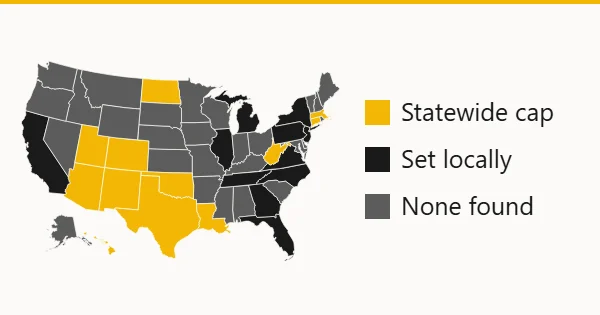
We found no statewide limit on towing or storage fees in Rhode Island's laws and official sources. Sources: [33] [36] [34] [40] [41] [44] [45] [46] [47] [48] [49] [13] [39] [42] [43] · verified Oct 28, 2026
We also found no statewide deadline to request a hearing. Sources: [92] [93] [1] [2] [34] [35] [94] · verified Oct 28, 2026
Statewide fees that do apply are in the fee table below.
- Regulator
- Rhode Island Division of Public Utilities and Carriers (Motor Carriers Section) Sources: State of Rhode Island General Assembly, Rhode Island General Laws [1] [2] [3] · verified Oct 28, 2026
- Key laws
- R.I. Gen. Laws ch. 39-12.1 The Towing Storage Act: certificated towers, removal of abandoned and unattended vehicles, owner and police notice, possessory lien under the tower's published tariff, foreclosure and auction, private trespass towing, complaints
- 815-RICR-50-05-1 Division of Public Utilities and Carriers rule on motor carriers of property: tariffs, tow bills of lading, owner and lienholder notice (7 and 14 days), private trespass towing, immediate release of pets and personal items
- R.I. Gen. Laws §§ 39-12-4, 31-22-23 Division powers over towers under chapter 39-12.1; tow trucks without a Division towing certificate must be marked Limited Towing
- R.I. Gen. Laws § 39-12-12 Carriers must charge the rates in their filed tariffs, no more and no less
- 815-RICR-50-00-1 Division of Public Utilities and Carriers rule on fuel surcharges: $0.50 per towing job in months the Division authorizes it, with a notice in the tow truck
- R.I. Gen. Laws §§ 31-22-13 to 31-22-18 Owner liability for abandoned vehicles and for towing after violations, accidents, breakdowns and the detention of unlicensed or suspended drivers; licensed wrecker's lien and sale after 60 days, with mailed notice and newspaper advertisement
- R.I. Gen. Laws ch. 31-42 Abandoned motor vehicles taken by police: 48-hour notice, owner notice within 15 days, three weeks to reclaim, public auction; garage keepers
- R.I. Gen. Laws §§ 31-27-2, 31-27-4.3, 31-27-22 Seizure and sale after a third DUI in ten years; forfeiture for eluding police in a high-speed pursuit; impoundment for street racing
Estimate your bill in Rhode Island
The most a lot can legally charge you under Rhode Island's statewide rules, line by line. Where a fee is set locally, enter the rate the lot quoted.
Fees in Rhode Island
| Fee | Applies to | Amount | Conditions and source |
|---|---|---|---|
| Police-ordered tow fee | Police / non-consent | No statewide figure foundNo statewide rule found | Rhode Island sets towing charges through each certificated tower's tariff approved by the Division of Public Utilities and Carriers, not through a dollar figure in the statute or rule. The owner is liable for reasonable recovery, towing and storage costs under the tower's tariff, and the tower's lien is limited to the amount its published tariff allows. A tariff is invalid unless the Division has stamped and dated it, and towers must post their approved tariffs at each office. We could not read the Division's current rate sheet. By law, the tower must charge the rates in its tariff on file with the Division of Public Utilities and Carriers, no more and no less, so ask to see the tariff, and keep the bill, which must list every charge. In months when the Division authorizes it, a tower may choose to add a fuel surcharge of $0.50 per tow; in those months tow trucks must display a notice of the surcharge.Sources: State of Rhode Island General Assembly, Rhode Island General Laws [13] [39] [44] [45]; Rhode Island Department of State, Rhode Island Code of Regulations (Division of Public Utilities and Carriers) [40] [41] [42] [46] [47] [48] [49]; Rhode Island Division of Public Utilities and Carriers (committee document on the General Assembly's website) [43] · verified Oct 28, 2026 |
| Private-property tow fee | Private property | No statewide figure foundNo statewide rule found | Charges for a tow from private property follow the certificated tower's published tariff approved by the Division of Public Utilities and Carriers, and are paid by the vehicle owner (the property owner pays if a court finds the car was not trespassing). We could not read the Division's current rate sheet. By law, the tower must charge the rates in its tariff on file with the Division of Public Utilities and Carriers, no more and no less, so ask to see the tariff. In months when the Division authorizes it, a tower may choose to add a fuel surcharge of $0.50 per tow; in those months tow trucks must display a notice of the surcharge.Sources: State of Rhode Island General Assembly, Rhode Island General Laws [33] [34] [44] [45]; Rhode Island Department of State, Rhode Island Code of Regulations (Division of Public Utilities and Carriers) [36] [40] [41] [46] [47] [48] [49] · verified Oct 28, 2026 |
| Daily storage fee | Police / non-consent, Private property | No statewide figure foundNo statewide rule found | Storage is charged under the certificated tower's tariff approved by the Division of Public Utilities and Carriers; we could not read the current rate sheet. If the tower does not notify the registered owner within seven days, it may not charge the owner storage for the time between that deadline and the day it actually gives notice (the same rule protects lienholders after 14 days). A commercial garage or storage facility that holds an abandoned vehicle and does not report it to the police within 10 days loses its claim for storage.Sources: State of Rhode Island General Assembly, Rhode Island General Laws [13] [39] [53] [54]; Rhode Island Department of State, Rhode Island Code of Regulations (Division of Public Utilities and Carriers) [50] [51] [52] · verified Oct 28, 2026 |
Local rates. Towing rates in Rhode Island are set statewide, through tariffs approved by the Division of Public Utilities and Carriers, rather than by cities. Cities and towns regulate parking on their own streets, and some have special state authority: for example, Woonsocket may boot or impound vehicles with five or more parking notices, with a hearing within seven days. Ask the local police department about its parking rules and the tow companies it calls. Sources: State of Rhode Island General Assembly, Rhode Island General Laws [13] [95] [96]; Rhode Island Division of Public Utilities and Carriers (committee document on the General Assembly's website) [43] · verified Oct 28, 2026
Major cities (largest cities in the state, Census Bureau Vintage 2025 estimates): Providence, Cranston, Warwick, Pawtucket, East Providence. Where a fee above is set locally, the city or the agency that ordered the tow sets the rate.
Cities we cover
We haven't covered a city in Rhode Island yet.
Police tow vs. private-property tow
Police-ordered (non-consent) tow
Rhode Island's Towing Storage Act lets any police officer order the removal of an abandoned or unattended vehicle by a certificated tower, a towing company holding a certificate from the Division of Public Utilities and Carriers. An unattended vehicle includes one left where or when the law or a local ordinance prohibits it, or causing congestion or a hazard, and one whose driver or owner has been removed by police. A vehicle is abandoned if it is inoperable, more than eight years old and left on public property for more than 48 hours, has stayed illegally on public property for more than three days, or has stayed on private property without consent for more than three days. Police normally tag a vehicle 48 hours before removal, but may have it removed at once if it is parked illegally, causes congestion or a hazard, or its driver has been detained. You may ask for the certificated tower of your choice, unless that would prolong congestion or a hazard. The police order the tow, but the vehicle owner pays: the owner is liable for reasonable recovery, towing and storage costs under the tower's tariff, including after a tow for a violation, an accident or breakdown, or the detention of an unlicensed or suspended driver. Police may also take abandoned vehicles into custody and sell them at auction under the abandoned-vehicle chapter. A vehicle used in street racing may be impounded at the registered owner's expense for one to 30 days; a vehicle used to elude police in a high-speed pursuit may be seized and forfeited on conviction (not from an owner who did not know of and consent to the act); and after a third DUI conviction within ten years, the judge may order the violator's vehicle seized and sold. An owner who does not pay the towing and storage costs within 30 days of written notice from the tow company, police or demolisher can be fined up to $200 on conviction; for an abandoned vehicle, the Division of Motor Vehicles then suspends the owner's license and registration until the costs are paid. The state Department of Transportation may move a disabled vehicle blocking a state highway, bridge or tunnel to the nearest garage or safe place, with no charge to the owner for the removal itself. Sources: State of Rhode Island General Assembly, Rhode Island General Laws [4] [5] [6] [7] [8] [3] [9] [10] [11] [12] [13] [14] [15] [16] [17] [18] [19] [20] [21] [22] [23] [24] [25] [26] [27] [28] · verified Oct 28, 2026
Private-property tow
The owner or person in control of private property may have a trespassing vehicle removed, without going to court, by retaining a certificated tower in writing; the tower may tow from private property only on written direction, which it must keep in its records. The tower must take the vehicle to its own impound lot within 10 miles of where it was towed from, the lot must be open to release vehicles during the same hours it is open to receive them, and its business hours must be posted outside the lot office. Charges follow the tower's published tariff and are paid by the vehicle owner, but if the owner proves in court that the vehicle was not trespassing, the property owner who ordered the tow bears the charges; the vehicle owner must first pay the tower in full. The tower must notify the police department within two hours and must send the owner and lienholders the same notices as for a police-ordered tow. We found no statewide rule on warning signs in private lots. Sources: State of Rhode Island General Assembly, Rhode Island General Laws [29] [30] [31] [32] [33] [34] [35] [37] [4]; Rhode Island Department of State, Rhode Island Code of Regulations (Division of Public Utilities and Carriers) [36] [38] · verified Oct 28, 2026
How to get your car back, step by step
- Find out who has the car. The tower must tell the police department of the city or town within two hours of the tow, so call that police department; the tower's registered-mail notice also gives its name, address and phone number. Sources: State of Rhode Island General Assembly, Rhode Island General Laws [37] [56] · verified Oct 28, 2026
- If your belongings or a pet are in the car, ask for them at once: the tower must release personal items immediately on request, even before the charges are paid. Sources: Rhode Island Department of State, Rhode Island Code of Regulations (Division of Public Utilities and Carriers) [88] [90] · verified Oct 28, 2026
- Ask to see the tower's approved tariff (towers must post it at each office) and check the bill, which must list every charge and who requested the tow. Sources: Rhode Island Department of State, Rhode Island Code of Regulations (Division of Public Utilities and Carriers) [41] [40] [42] · verified Oct 28, 2026
- Go during business hours, prove ownership and pay the charges in the tower's published tariff. Bring a police release if the police require one. A private-property impound lot must be open to release cars during the same hours it receives them. Sources: State of Rhode Island General Assembly, Rhode Island General Laws [87] [91] [31] · verified Oct 28, 2026
- Act quickly: if the car is not reclaimed and no complaint is filed within 30 days of the tower's notice, the tower can start the auction process; after its second notice you have 10 days. Sources: State of Rhode Island General Assembly, Rhode Island General Laws [68] [69] · verified Oct 28, 2026
- If you think the tow was improper, file a complaint with the Division of Public Utilities and Carriers; the statutory notice form says to file within 10 days of the notice and to post security. For a private-property tow, you can recover the charges from the property owner only by proving in court that the car was not trespassing, after paying the tower in full. Sources: State of Rhode Island General Assembly, Rhode Island General Laws [92] [93] [34] [35] · verified Oct 28, 2026
Documents to bring
Payment methods
We found no Rhode Island rule requiring towing companies to accept credit cards. Call the tower to ask which payments it takes before you go. Source: State of Rhode Island General Assembly, Rhode Island General Laws [87] · verified Oct 28, 2026
Getting your personal items out
The Division's rule requires a certificated towing company to release personal items in a towed vehicle to the owner, or the person in control of the vehicle, immediately on request, whether or not the towing charges have been paid; the tower's lien covers only the vehicle and its plates. If an animal is in a towed vehicle, the tower must notify animal control or the police at once, and must release the animal immediately, without payment, if the owner is present at the tow. The rule does not say whether a fee may be charged for access to the vehicle. Sources: Rhode Island Department of State, Rhode Island Code of Regulations (Division of Public Utilities and Carriers) [88] [66] [89] [90] · verified Oct 28, 2026
Deadlines: owner notice and lien sale
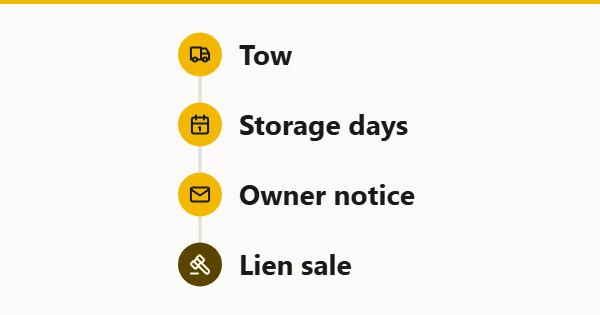
Notice to the owner
7 days
The Division's rule requires a certificated tower that removes an abandoned or unattended vehicle to notify the last known registered owner within seven days, and all known lienholders within 14 days. If it notifies the owner late, it may not charge the owner storage for the period between the deadline and the actual notice. The statute itself gives the tower 14 days to notify the owner and lienholders. The tower must also notify the police department of the city or town within two hours of the tow. The same notices apply to tows from private property. When police take an abandoned vehicle into custody themselves, they must notify the owner and lienholders within 15 days. A certificated tower need not send its notices for a vehicle that is at least 10 years old (or has an altered VIN), has not been registered within a year, has no established market value and would not pass a safety inspection: police may dispose of it five days after removing its VIN. An abandoned vehicle of no value (no current registration, worth $500 or less, no valid inspection sticker) taken by police is held at least 10 days and then demolished. Method: Registered mail, return receipt requested, to the address in the vehicle registry of the state where the vehicle is registered; by one newspaper publication if the owner or lienholders cannot be identified or have no address. The notice gives the tower's name, address and phone number, says charges are accruing and a lien is claimed, and explains how to reclaim the vehicle and how to contest the tow. Sources: Rhode Island Department of State, Rhode Island Code of Regulations (Division of Public Utilities and Carriers) [55] [50] [51] [52] [38]; State of Rhode Island General Assembly, Rhode Island General Laws [56] [37] [57] [58] [59] [60] [61] [62] [63] [64] · verified Oct 28, 2026
When the vehicle can be sold
30 days after the mailing of the tower's first notice; a second, foreclosure notice must then give 10 more days before the sale
A certificated tower has a possessory lien on the vehicle and its plates for the charges in its published tariff, but only if it has fully complied with the notice requirements. If the vehicle is not reclaimed and no complaint is filed within 30 days of the first notice, the tower sends a second notice by registered mail giving the date, time and place of a public auction; the vehicle may be sold if not redeemed within 10 days of that notice. If the owner or lienholders cannot be identified, no sale may take place until 60 days after the tower's notice. Notice of the sale must also be published in a newspaper at least 10 days before, posted at the tower's place of business and mailed to the police department or person who ordered the tow. The buyer takes title free of liens. Proceeds pay the auction expenses and then the tower's charges; any surplus is deposited with the state General Treasurer for the owner or lienholder. Charges above the sale price remain a debt of the owner. A separate, older law gives licensed wreckers a lien and lets them sell a vehicle, at a private or public sale, once charges have been unpaid for 60 days after the tow, with written notice by registered or certified mail 30 days before the sale and a newspaper advertisement on two consecutive days, 10 to 14 days before it. Abandoned vehicles taken into police custody can be reclaimed within three weeks of the police notice and are otherwise sold at public auction, with any surplus held for the owner for 90 days. A certificated tower need not send its notices for a vehicle that is at least 10 years old (or has an altered VIN), has not been registered within a year, has no established market value and would not pass a safety inspection: police may dispose of it five days after removing its VIN. An abandoned vehicle of no value (no current registration, worth $500 or less, no valid inspection sticker) taken by police is held at least 10 days and then demolished. Sources: State of Rhode Island General Assembly, Rhode Island General Laws [65] [67] [68] [69] [70] [71] [72] [73] [74] [75] [76] [77] [78] [79] [80] [81] [82] [83] [17] [84] [85] [86] [58] [59] [60] [61] [62] [63] [64]; Rhode Island Department of State, Rhode Island Code of Regulations (Division of Public Utilities and Carriers) [66] · verified Oct 28, 2026
How storage days are counted
Rhode Island law does not say how a storage day is counted; storage is charged under the tower's approved tariff. A tower that notifies the registered owner late (after seven days) may not charge the owner storage for the period of the delay. Sources: State of Rhode Island General Assembly, Rhode Island General Laws [39]; Rhode Island Department of State, Rhode Island Code of Regulations (Division of Public Utilities and Carriers) [50] [51] · verified Oct 28, 2026
How to dispute a tow or the fees
Where: Rhode Island Division of Public Utilities and Carriers (Motor Carriers Section); for private-property tows, the courts
If you believe the original tow was improper or not legally justified, the Towing Storage Act gives you a right to file an administrative complaint to contest it under the motor carrier law administered by the Division of Public Utilities and Carriers, which enforces the Act and can order a tower to comply after notice and a hearing. The notice form in the statute says the complaint must be filed within 10 days from the date of the notice, with security in an amount and form the regulator accepts. For a tow from private property, if you prove in court that the vehicle was not trespassing, the property owner who ordered the tow must bear the charges, but you must first pay the tower in full. A tower that breaks the Division's rules can be fined up to $1,000 per violation, or have its certificate suspended or revoked. Sources: State of Rhode Island General Assembly, Rhode Island General Laws [92] [93] [1] [2] [34] [35]; Rhode Island Department of State, Rhode Island Code of Regulations (Division of Public Utilities and Carriers) [94] · verified Oct 28, 2026
Official "find my towed car" lookups
Conflicts and open questions
Where official sources disagree
We show both rather than picking one.
- Deadline for the tower's notice to the owner. The Towing Storage Act gives a tower 14 days to notify the registered owner and lienholders by registered mail. The Division's rule requires notice to the registered owner within seven days (lienholders within 14), and bars the tower from charging the owner storage for any period of delay after the seventh day. Both are in force; the stricter rule is the one towers must follow. Sources: [56] [55] [50]
- Where and how soon to file a complaint about a tow. The body of the Towing Storage Act says the owner may file an administrative complaint under the motor carrier law, which the Division of Public Utilities and Carriers administers, and sets no deadline. The notice form printed in the same Act says to file with the Public Utilities Commission within 10 days of the notice and to post security. File with the Division within 10 days of the notice to be safe. Sources: [92] [93]
- Two lien laws with different sale timelines. An older law lets a licensed wrecker sell a vehicle after charges are unpaid for 60 days, with written notice 30 days before the sale. The Towing Storage Act, which covers certificated towers, allows foreclosure after 30 days and a second notice giving 10 days. The law does not say how the two fit together; watch for both notices and act on the earliest deadline. Sources: [78] [79] [67] [69]
Questions we have not answered from an official source yet
- We could not confirm the current dollar rates for towing and storage. Rhode Island's rates are set in towing companies' tariffs approved by the Division of Public Utilities and Carriers, and the Division publishes a rate sheet, but we could not read it. Ask the tower to show you its Division-approved tariff, or call the Division's Motor Carriers Section, before you pay.
- We found no Rhode Island law requiring warning signs in private parking lots before a car is towed. The property owner must hire the tower in writing, and the tower must keep that authorization. Ask the property owner or the tower for it if your car was towed from a private lot.
- Rhode Island law does not set after-hours release fees or rules for releases outside business hours (beyond requiring private-property impound lots to release cars during the same hours they receive them), and we found no rule on card payments. Call the tower before you go.
- We found no statewide online search for towed vehicles in Rhode Island. Call the police department of the city or town where the car was parked: the tower must tell that department about the tow within two hours.
- Apart from street racing, eluding police, a third DUI conviction and tows after a driver is detained, we found no Rhode Island law impounding a vehicle for driving without insurance; the penalty is suspension and surrender of the license or registration and plates. Ask the police department that ordered the tow whether it needs to give a release.
Guides
-
What is an impound lot? How it works and what it costs
An impound lot is a storage yard that holds towed cars until the owner pays. Here is who runs them, how storage is charged and each state's rules.
Updated
-

Find my towed car: where to look first, state by state
Find my towed car: call the police non-emergency line or the number on the lot's tow-away sign, then try your state's official lookup if it has one.
Updated
-
How much to get a car out of impound? Costs by state
How much to get a car out of impound: the tow, a daily storage charge and any release fees. See each state's limits and a worked example.
Updated
Sources (96)
- R.I. Gen. Laws § 39-12.1-15 Public utilities administrator enforces the Towing Storage Act
- R.I. Gen. Laws § 39-12-4(a)(5) Administrator's rules and orders under chapter 39-12.1
- R.I. Gen. Laws § 39-12.1-2(3) Certificated tower: holds a certificate from the public utilities administrator
- R.I. Gen. Laws § 39-12.1-3(a) Police or property owner may order removal of abandoned or unattended vehicles
- R.I. Gen. Laws § 39-12.1-2(10)(i) Unattended vehicle: left where or when prohibited, or causing congestion or hazard
- R.I. Gen. Laws § 39-12.1-2(10)(ii) Unattended vehicle: operator or owner removed by police
- R.I. Gen. Laws § 39-12.1-2(1)(i)-(ii) Abandoned vehicle: inoperable, over 8 years, 48 hours on public property; or illegally on public property over 3 days
- R.I. Gen. Laws § 39-12.1-2(1)(iii) Abandoned vehicle: on private property without consent for more than 3 days
- R.I. Gen. Laws § 39-12.1-3(c)(2) Tag says the vehicle will be removed after 48 hours
- R.I. Gen. Laws § 39-12.1-3(c)(2) Tagging 48 hours before removal; immediate removal without tag when illegal, hazardous or operator detained
- R.I. Gen. Laws § 39-12.1-3(d) Owner's choice of certificated tower
- R.I. Gen. Laws § 39-12.1-1 Police order the tow; the vehicle owner pays
- R.I. Gen. Laws § 39-12.1-3(b) Owner liable for reasonable recovery, towing and storage costs under the tower's tariff
- R.I. Gen. Laws § 31-22-14(a) Owner pays towing and storage after a tow for a violation, accident or breakdown
- R.I. Gen. Laws § 31-22-14(a) Tow after detention of an unlicensed or suspended driver: owner pays
- R.I. Gen. Laws § 31-42-2(b) Police post a 48-hour notice on an abandoned vehicle before towing
- R.I. Gen. Laws § 31-42-4(a) Unclaimed abandoned vehicle sold by the police at public auction
- R.I. Gen. Laws § 31-27-22(d) Street racing: impound at owner's expense for 1 to 30 days
- R.I. Gen. Laws § 31-27-22(d) Impound period
- R.I. Gen. Laws § 31-27-4.3(a) Eluding police in a high-speed pursuit: seizure and forfeiture
- R.I. Gen. Laws § 31-27-4.3(a) Innocent owner: no forfeiture without knowledge and consent
- R.I. Gen. Laws § 31-27-2(d)(3)(iii) Third DUI in 10 years: vehicle may be seized and sold
- R.I. Gen. Laws § 31-27-2(d)(3)(iii) Applies to a third or subsequent violation within ten years
- R.I. Gen. Laws § 31-21-11 DOT removal of disabled vehicles obstructing state highways at no expense to the owner
- R.I. Gen. Laws § 31-22-14(c) Towing costs unpaid 30 days after written notice
- R.I. Gen. Laws § 31-22-14(c) ... fine up to $200 on conviction
- R.I. Gen. Laws § 31-22-13 Abandoned vehicle: license and registration suspended until removal costs are paid
- R.I. Gen. Laws § 31-21-11 DOT removal of a disabled vehicle: no expense to the owner for its removal
- R.I. Gen. Laws § 39-12.1-12(a) Private trespass towing: written retention of a certificated tower
- R.I. Gen. Laws § 39-12.1-12(c) Written direction from the property owner required, kept in the tower's records
- R.I. Gen. Laws § 39-12.1-12(a) Impound lot within 10 miles, open to release the same hours it receives
- R.I. Gen. Laws § 39-12.1-12(a) Business hours posted outside the lot office
- R.I. Gen. Laws § 39-12.1-12(b) Towing charges per the published tariff, borne by the vehicle owner
- R.I. Gen. Laws § 39-12.1-12(b) Property owner bears the charges if a court finds the car was not trespassing
- R.I. Gen. Laws § 39-12.1-12(b) Vehicle owner must pay the tower in full before suing the property owner
- 815-RICR-50-05-1.13.1(B) Private trespass: charges per the tower's published tariff, borne by the vehicle owner
- R.I. Gen. Laws § 39-12.1-4(a) Tower notifies the local police within 2 hours
- 815-RICR-50-05-1.13.1(C) Private trespass tows: same owner and lienholder notices as section 1.13
- R.I. Gen. Laws § 39-12.1-6 Lien amount follows the tower's published tariff
- 815-RICR-50-05-1.6(F) Tariffs valid only when stamped and dated by the Division
- 815-RICR-50-05-1.6(E) Approved tariffs posted at each station or office
- 815-RICR-50-05-1.11(B) Tow bills of lading: who requested the tow and all charges
- Division of Public Utilities and Carriers, letter to House Corporations on H 8361 (April 7, 2026): towers follow statute, Division regulations and the approved tariff
- R.I. Gen. Laws § 39-12-12 Carrier may not charge more or less than its filed tariff
- R.I. Gen. Laws § 39-12-12 Rule applies to every common carrier of property by motor vehicle
- 815-RICR-50-00-1.2(B) Fuel surcharge of $0.50 per towing job when the Division authorizes it
- 815-RICR-50-00-1.2(H) Tow trucks must display a notice of the surcharge in months it is authorized
- 815-RICR-50-00-1.2(J) Surcharge is voluntary but must be applied without discrimination
- 815-RICR-50-00-1.2(I) Authorization expires at the end of the month
- 815-RICR-50-05-1.13(A) Late notice: no storage fees for the period of delay
- 815-RICR-50-05-1.13(A) Storage not chargeable between the notice deadline and the actual notice
- 815-RICR-50-05-1.13(B) Lienholders notified within 14 days
- R.I. Gen. Laws § 31-42-5(a) Garage keeper loses its storage claim if it does not report within 10 days
- R.I. Gen. Laws § 31-42-5(c) Garage keeper includes parking and storage facility operators
- 815-RICR-50-05-1.13(A) Tower notifies the registered owner within 7 days by registered mail
- R.I. Gen. Laws § 39-12.1-4(b) Tower notifies owner and lienholders within 14 days by registered mail
- R.I. Gen. Laws § 31-42-3(a) Police notify owner and lienholders within 15 days
- R.I. Gen. Laws § 39-12.1-5(a) No-notice vehicles: 10+ years old (or altered VIN), unregistered within a year, no market value
- R.I. Gen. Laws § 39-12.1-5(a) ... and would not pass inspection: tower need not give the 39-12.1-4 notices
- R.I. Gen. Laws § 39-12.1-5(c) Police may dispose of such a vehicle under 39-12.1-9
- R.I. Gen. Laws § 39-12.1-5(c) ... five days after removing the VIN
- R.I. Gen. Laws § 39-12.1-2(2)(A)-(C) Abandoned vehicle of no value: no registration, worth $500 or less, no valid inspection sticker
- R.I. Gen. Laws § 39-12.1-10 Abandoned vehicle of no value taken by police: held at least 10 days
- R.I. Gen. Laws § 39-12.1-10 ... then demolished
- R.I. Gen. Laws § 39-12.1-6 Possessory lien on vehicle and plates, only if the notice sections were followed in full
- 815-RICR-50-05-1.13.2(B) Tower's lien covers only the vehicle and its plates
- R.I. Gen. Laws § 39-12.1-7 Thirty-day waiting period before foreclosure
- R.I. Gen. Laws § 39-12.1-4(b)(8) Lien foreclosed and vehicle sold if not claimed within 30 days of the notice
- R.I. Gen. Laws § 39-12.1-8(a)(4) Foreclosure notice: sale if not claimed within 10 days of its mailing
- R.I. Gen. Laws § 39-12.1-8(b) Owner or lienholder cannot be identified: no foreclosure before 60 days after the tower's notice
- R.I. Gen. Laws § 39-12.1-9(b)(1) Sale notice published at least 10 days before the sale
- R.I. Gen. Laws § 39-12.1-9(b)(3) Sale notice mailed to the police department or person who ordered the tow
- R.I. Gen. Laws § 39-12.1-9(c) Auction purchaser takes title free of liens
- R.I. Gen. Laws § 39-12.1-9(d)(3) Surplus held by the general treasurer for the owner or lienholder
- R.I. Gen. Laws § 39-12.1-4(b)(10) Charges above the sale proceeds remain the owner's civil obligation
- R.I. Gen. Laws § 39-12.1-11 Vehicle held 60 days or longer: lien presumed, foreclosure after notice
- R.I. Gen. Laws § 31-22-15 Licensed wrecker's lien for towing and storage
- R.I. Gen. Laws § 31-22-16 Wrecker may sell after 60 days unpaid
- R.I. Gen. Laws § 31-22-17 Written notice of sale 30 days before
- R.I. Gen. Laws § 31-22-17 Notice by registered or certified mail
- R.I. Gen. Laws § 31-22-18 Newspaper advertisement 10 to 14 days before the sale
- R.I. Gen. Laws § 31-22-16(4) Surplus to the registered owner
- R.I. Gen. Laws § 31-42-3(a) Three weeks to reclaim on payment of charges
- R.I. Gen. Laws § 31-42-4(b) Surplus held for the owner or lienholder for 90 days
- R.I. Gen. Laws § 31-22-16 Wrecker may sell at private or public sale after 60 days unpaid from the tow
- R.I. Gen. Laws § 31-22-18 Newspaper advertisement on two consecutive days, 10 to 14 days before the sale
- R.I. Gen. Laws § 39-12.1-4(b)(6) Owner may retake possession during business hours by proving ownership and paying the tariff charges
- 815-RICR-50-05-1.13.2(B) Personal items released immediately on request, whether or not charges are paid
- 815-RICR-50-05-1.13.2(A) Animal in a towed car: tower notifies animal control or police
- 815-RICR-50-05-1.13.2(A)(2) Animals released immediately if the owner is present
- R.I. Gen. Laws § 39-12.1-13 Form of notice: retake during regular business hours with a police release, if required, and payment
- R.I. Gen. Laws § 39-12.1-4(b)(7) Right to file an administrative complaint to contest the original taking
- R.I. Gen. Laws § 39-12.1-13 Form of notice: complaint within 10 days, with security
- 815-RICR-50-05-1.18 Penalty: suspension, revocation or fine up to $1,000 per violation
- R.I. Gen. Laws § 31-12-12(a)(1) Local authorities may regulate standing and parking
- R.I. Gen. Laws § 31-12-12(b) Woonsocket boot/impound ordinance for five or more parking notices: hearing within 7 days
Spotted an outdated figure? Tell us. See how we verify.