
Nebraska towing laws and impound fees
We haven't covered a city in Nebraska yet.
Informational only, not legal advice. Fees change and many are set by cities or counties. Confirm the current amount with the tow lot or the agency that ordered the tow.
On this page
At a glance
We found no statewide limit on towing or storage fees in Nebraska's laws and official sources. Sources: [27] [28] [22] [23] [24] [25] [26] · verified Oct 26, 2026
We also found no statewide deadline to request a hearing. Sources: [27] [28] [72] [73] [59] [61] [39] · verified Oct 27, 2026
Statewide fees that do apply are in the fee table below.
- Regulator
- No single statewide towing regulator found.
- Key laws
- Neb. Rev. Stat. §§ 60-2401 to 60-2411 Towing from restricted parking lots (60-2401 for cities of the metropolitan or primary class, 60-2401.01 infraction elsewhere; signs, notice to police, written statement, fees, lien and notice to owner)
- Neb. Rev. Stat. § 60-6,165 Removal of vehicles from highways by peace officers; cost of towing and storage; lien
- Neb. Rev. Stat. § 60-4,110 Impound of a vehicle driven by a person whose license is suspended, revoked or impounded; release; tower's lien
- Neb. Rev. Stat. §§ 60-1901 to 60-1909 Abandoned vehicles (definition, removal from private property, notice, sale, costs)
- Neb. Rev. Stat. § 60-1903.02 Removal of abandoned or trespassing vehicles from private property; private towing services
- Neb. Rev. Stat. §§ 52-601.01 to 52-605 Liens for services on personal property: disposition after 90 days, notice of sale, proceeds, redemption
Estimate your bill in Nebraska
The most a lot can legally charge you under Nebraska's statewide rules, line by line. Where a fee is set locally, enter the rate the lot quoted.
Fees in Nebraska
| Fee | Applies to | Amount | Conditions and source |
|---|---|---|---|
| Police-ordered tow fee | Police / non-consent | No statewide figure foundNo statewide rule found | State law sets no dollar amount. The owner is charged 'the reasonable cost of towing and storage fees', and the fees are a lien on the vehicle ahead of all other claims. For an abandoned vehicle, anyone claiming it must pay the cost of removal and storage, and the last registered owner is liable for those costs to the county or city. After a suspended- or revoked-license impound, the tower has a lien for reasonable towing and storage charges; an owner who was not the driver may recover the impound expenses from the driver. No statewide limit applies, so ask the towing company or the city for its rates before you pay.Sources: Nebraska Legislature - Nebraska Revised Statutes [22] [23] [24] [25] [26] · verified Oct 27, 2026 |
| Private-property tow fee | Private property | No statewide figure foundNo statewide rule found | State law sets no dollar amount: the owner is charged 'the reasonable cost of towing and storage fees'. If the vehicle was not improperly parked on the restricted lot, the lot owner or tenant who had it towed must have it returned to you at no charge. No statewide limit applies, so ask the towing company for its rates before you pay.Sources: Nebraska Legislature - Nebraska Revised Statutes [27] [28] · verified Oct 26, 2026 |
| Daily storage fee | Police / non-consent, Private property | No statewide figure foundNo statewide rule found | No statewide dollar amount; storage must be a reasonable cost. The tower's notice to the owner must state the daily storage fee and the storage already owed. When police hold a vehicle as evidence, no storage fees may be charged to the registered owner unless the owner or the driver is charged with an offense related to it; if that person is charged but not convicted, the owner is entitled to a refund of the storage fees. A vehicle impounded because the driver's license was suspended or revoked for one of the listed offenses is held at least 10 days at the owner's expense, so storage runs for at least that long unless the court or the law allows an earlier release (for example to a lienholder, a leasing company, or an owner or spouse who shows the court the vehicle is essential to their livelihood).Sources: Nebraska Legislature - Nebraska Revised Statutes [27] [29] [30] [31] [32] [3] [4] [33] [34] [35] · verified Oct 27, 2026 |
Local rates. No statewide limit applies to towing or storage charges in Nebraska, so ask the city or the towing company for its rates before you pay. Cities, villages and counties regulate parking on their own streets and take custody of abandoned vehicles, and state law allows municipal ordinances on removing vehicles from private property. Sources: Nebraska Legislature - Nebraska Revised Statutes [74] [75] [9] [13] [76] · verified Oct 26, 2026
Major cities (largest cities in the state, Census Bureau Vintage 2025 estimates): Omaha, Lincoln, Bellevue, Grand Island, Kearney. Where a fee above is set locally, the city or the agency that ordered the tow sets the rate.
Cities we cover
We haven't covered a city in Nebraska yet.
Police tow vs. private-property tow
Police-ordered (non-consent) tow
A peace officer may remove, or have removed, a vehicle standing on a highway in violation of the Nebraska Rules of the Road. A vehicle driven by a person whose license is suspended, revoked or impounded may be seized when the driver is arrested and impounded at the owner's expense, whoever owns it; for the listed offenses (including drunk-driving revocations) the impound lasts at least 10 and at most 30 days. Vehicles left on public property are treated as abandoned after set periods: more than 6 hours without plates or a valid In Transit, more than 24 hours where parking is not allowed, or more than 48 hours after parking became illegal; a vehicle left more than 30 days in police custody after a letter to the owner is also abandoned. The county, city or village where the vehicle was abandoned takes custody. A law enforcement agency may also remove an abandoned or trespassing vehicle from private property at the property owner's request, itself or through a private towing service; a vehicle towed by a private towing service this way falls under the same fee, notice and sale rules as a private-property tow. Sources: Nebraska Legislature - Nebraska Revised Statutes [1] [2] [3] [4] [5] [6] [7] [8] [9] [10] [11] · verified Oct 27, 2026
Private-property tow
A vehicle parked without the owner's or tenant's consent in a properly posted restricted parking lot may be towed at the request of the lot owner or tenant. Outside cities of the metropolitan or primary class, parking there is also an infraction: a police officer who finds a violation serves or attaches a citation to the vehicle. In cities of the metropolitan or primary class, the towing rule applies unless the city has adopted its own ordinance on such parking. The signs must be readily visible and state the purpose of parking on the lot, the hours of restricted parking, and who to contact about a towed vehicle. The tower must take reasonable steps to confirm that the person asking for the tow is the owner or tenant of the lot, and the lot owner or tenant may not accept any payment from the tower. A private property owner may also remove, or call a private towing service to remove, an abandoned vehicle or a trespassing vehicle (one parked without permission on private property not usually open for public parking). Sources: Nebraska Legislature - Nebraska Revised Statutes [12] [13] [14] [15] [16] [17] [18] [19] [20] [21] · verified Oct 27, 2026
How to get your car back, step by step
- Find out who towed the car. After a tow from a private lot, the tower must give the local police the license number within 24 hours, and tell them again on the 30th day and every 30 days after that while it holds the car, so call the police non-emergency line. When an abandoned or trespassing vehicle is towed at the property owner's request, the tower must report within 24 hours the plate, VIN, make, model and color, its own name and where the car is stored. The lot's signs must also say who to contact about a towed vehicle. Sources: Nebraska Legislature - Nebraska Revised Statutes [63] [64] [65] [66] [67] [17] · verified Oct 27, 2026
- If you reach the car before it is fully hooked up to the tow truck, ask the driver to disengage: on a private-lot tow the tower must do so on request until the vehicle is fully and completely attached. Sources: Nebraska Legislature - Nebraska Revised Statutes [68] [69] · verified Oct 26, 2026
- Watch your mail. The tower must send a certified letter to the owner and any lienholder within 15 business days, giving its contact details, the daily storage fee and the amount owed so far. Sources: Nebraska Legislature - Nebraska Revised Statutes [36] [37] [29] · verified Oct 26, 2026
- Pay the towing and storage charges. Once they are paid, the vehicle must be returned to the owner, a lienholder or another person lawfully entitled to it. Act quickly: storage keeps adding up, and the vehicle can be sold 90 days after the tow. Sources: Nebraska Legislature - Nebraska Revised Statutes [56] [43] · verified Oct 26, 2026
- When you get the car back after a private-lot tow, the tower must give you a written statement with the name and address of whoever had it towed, the legal authority for the tow, and your rights under the towing law. Keep it, with your receipt. Sources: Nebraska Legislature - Nebraska Revised Statutes [70] [71] · verified Oct 26, 2026
- If your car was not improperly parked, the lot owner or tenant who had it towed must have it returned to you at no charge and is liable for reasonably foreseeable damages from the loss of transportation. Sources: Nebraska Legislature - Nebraska Revised Statutes [28] [72] · verified Oct 26, 2026
Documents to bring
- Payment of the towing and storage charges Sources: Nebraska Legislature - Nebraska Revised Statutes [56] [27] · verified Oct 26, 2026
- Proof that you are the owner, a lienholder or another person lawfully entitled to possession of the vehicle Source: Nebraska Legislature - Nebraska Revised Statutes [56] · verified Oct 26, 2026
Payment methods
We found no Nebraska law that says which payment methods a towing company must accept. The vehicle must be returned once the charges are paid; ask the company before you go which payment methods it takes. Source: Nebraska Legislature - Nebraska Revised Statutes [56] · verified Oct 26, 2026
Getting your personal items out
The tower's lien for towing and storage does not extend to the contents of the vehicle. For a tow from a posted restricted lot, whoever stores the vehicle is liable for reasonably foreseeable damage to the vehicle and its personal contents during storage. That rule is not applied to abandoned or trespassing vehicles removed under the abandoned-vehicle law, and for those the property owner and the state, county, city or village are not liable for loss or damage, including while the vehicle is held by a private towing service. Nebraska law does not set out how or when you can collect belongings from a towed car, or whether a fee may be charged; ask the towing company. Sources: Nebraska Legislature - Nebraska Revised Statutes [57] [58] [59] [60] [61] [62] · verified Oct 27, 2026
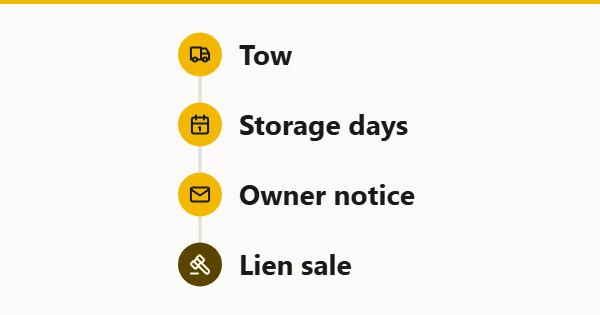
Deadlines: owner notice and lien sale
Notice to the owner
15 business days
The person who towed the vehicle must notify the owner and any lienholder on the title within 15 business days after the tow. The notice must state the daily storage fee and the storage owed so far, and that the vehicle may be sold or otherwise disposed of 90 days after the tow. If the tower does not send this notice, its lien ranks behind the lienholder's and any sale of the vehicle is void. When a county, city or village holds an abandoned vehicle, it must notify the last registered owner and any lienholder within 15 business days; when police no longer need a vehicle held as evidence, they must send a certified letter within 15 calendar days. Method: Certified mail, return receipt requested, to the last-known address of the owner and the lienholder. The notice gives the vehicle's make, model, color, year and VIN, the tower's name, address and phone number, and the date of the tow. Sources: Nebraska Legislature - Nebraska Revised Statutes [36] [37] [29] [38] [39] [40] [41] [42] · verified Oct 26, 2026
When the vehicle can be sold
90 days after the date of the tow; a notice of the intended sale must also be mailed at least 30 days before it
The tower may keep the vehicle until the charges are paid and, after 90 days, may sell or otherwise dispose of it to satisfy its lien under Chapter 52, article 6. The sale cannot take place until 30 days after a written notice of the intended sale has been sent by certified mail, return receipt requested, to the owner and any lienholder of record. Until the vehicle is sold, the owner can get it back by paying the amount of the lien and the reasonable costs of the notices and preparing the sale. From the sale money the tower takes its charges, then pays any lienholder; any balance goes to the county treasurer. For an abandoned vehicle held by a county, city or village, the vehicle can be sold or auctioned five days after the notice is mailed, or the local government can keep it after 30 days; if the owner cannot be found, title passes to the local government when it learns this; low-value vehicles without current plates (worth $500 or less) go to the local government at once. Sources: Nebraska Legislature - Nebraska Revised Statutes [43] [44] [45] [46] [47] [48] [49] [50] [51] [52] [53] [54] [55] · verified Oct 27, 2026
How storage days are counted
Nebraska law does not say how storage days are counted. It requires only a reasonable storage fee, and the tower's notice must state the daily rate and the amount owed on the date of the notice. Sources: Nebraska Legislature - Nebraska Revised Statutes [27] [29] · verified Oct 26, 2026
How to dispute a tow or the fees
Where: No state agency reviews towing charges. We found no statewide complaint or hearing process; ask the local police department or the city or county where the car was towed.
Nebraska has no statewide hearing procedure for towing. The law limits charges to a reasonable cost; makes the lot owner or tenant return a vehicle that was not improperly parked at no charge and pay reasonably foreseeable damages for the loss of transportation; and, for tows from a posted restricted lot, makes the tower liable for reasonably foreseeable damage during hookup, towing and disengagement and the storer liable during storage. For abandoned vehicles, the property owner and the state, county, city or village are not liable for loss or damage to the vehicle. If the tower does not send the required notice, its lien ranks behind the lienholder's and any sale is void. Sources: Nebraska Legislature - Nebraska Revised Statutes [27] [28] [72] [73] [59] [61] [39] · verified Oct 27, 2026
Official "find my towed car" lookups
Conflicts and open questions
Questions we have not answered from an official source yet
- Nebraska law sets no statewide maximum for towing or storage charges; it requires only a reasonable cost. Before paying, ask the towing company for an itemized bill and its daily storage rate in writing, and ask the city or police department whether a local limit applies.
- The law clearly requires the 15-business-day certified notice for tows from private lots and for abandoned or trespassing vehicles towed from private property. For other police-ordered tows from public roads, ask the police department which agency or company holds the vehicle and when it will send notice.
- We found no statewide online search for towed vehicles in Nebraska. Call the police non-emergency line in the city or county where the car was parked.
- The Department of Motor Vehicles has its own rules on abandoned vehicles, which we have not yet read on an official page. The figures here come from the statutes.
Guides
-
Illegal towing laws: your rights after a wrongful tow
Illegal towing laws explained: when a tow breaks the rules, how to dispute it, if you can sue, and what a tow company may owe you if it was wrong.
Updated
-
What is an impound lot? How it works and what it costs
An impound lot is a storage yard that holds towed cars until the owner pays. Here is who runs them, how storage is charged and each state's rules.
Updated
-

Find my towed car: where to look first, state by state
Find my towed car: call the police non-emergency line or the number on the lot's tow-away sign, then try your state's official lookup if it has one.
Updated
Sources (76)
- Neb. Rev. Stat. § 60-6,165 (1) peace officer may remove vehicle from highway (Persons authorized to remove vehicles; cost of removal; lien)
- Neb. Rev. Stat. § 60-4,110 (1) vehicle driven by a person with a suspended or revoked license (Operating motor vehicle during period of suspension, revocation, or impoundment; impounding of motor vehicle; release)
- Neb. Rev. Stat. § 60-4,110 (1) seizure and impound at the owner's expense (Operating motor vehicle during period of suspension, revocation, or impoundment; impounding of motor vehicle; release)
- Neb. Rev. Stat. § 60-4,110 (1) impound period 10 to 30 days (Operating motor vehicle during period of suspension, revocation, or impoundment; impounding of motor vehicle; release)
- Neb. Rev. Stat. § 60-1901 (1)(a) no plates, six hours on public property (Abandoned vehicle, defined)
- Neb. Rev. Stat. § 60-1901 (1)(b) abandoned on public property after 24 hours (Abandoned vehicle, defined)
- Neb. Rev. Stat. § 60-1901 (1)(c) 48 hours after parking became illegal (Abandoned vehicle, defined)
- Neb. Rev. Stat. § 60-1901 (1)(e) 30 days in police custody after letter (Abandoned vehicle, defined)
- Neb. Rev. Stat. § 60-1904 custody of abandoned vehicles (Custody; who entitled)
- Neb. Rev. Stat. § 60-1903.02 (1) police removal from private property on request (Law enforcement agency; authority to remove abandoned or trespassing vehicle; private towing service; notice)
- Neb. Rev. Stat. § 60-1903.02 (2) police-called private tower: chapter 52 and 60-2410 apply (Law enforcement agency; authority to remove abandoned or trespassing vehicle; private towing service; notice)
- Neb. Rev. Stat. § 60-2401 towing from a properly posted restricted lot (Restricted parking lots; cities of the metropolitan or primary class; vehicles towed away; when)
- Neb. Rev. Stat. § 60-2401 metropolitan and primary class city ordinances (Restricted parking lots; cities of the metropolitan or primary class; vehicles towed away; when)
- Neb. Rev. Stat. § 60-2401.01 infraction outside metropolitan and primary class cities (Restricted parking lots; unauthorized parking; towing; violation; penalty)
- Neb. Rev. Stat. § 60-2401.01 towing at the request of the lot owner or tenant (Restricted parking lots; unauthorized parking; towing; violation; penalty)
- Neb. Rev. Stat. § 60-2401.01 officer serves a citation (Restricted parking lots; unauthorized parking; towing; violation; penalty)
- Neb. Rev. Stat. § 60-2402 sign contents (Restricted parking lot; signs designating)
- Neb. Rev. Stat. § 60-2409 tower confirms the requester is owner or tenant (Person towing vehicle; ascertain owner or tenant of lot)
- Neb. Rev. Stat. § 60-2411 no compensation to lot owner from tower (Owner or tenant of lot; solicit or accept compensation from tower; prohibited)
- Neb. Rev. Stat. § 60-1903.02 (3) property owner may remove abandoned or trespassing vehicle (Law enforcement agency; authority to remove abandoned or trespassing vehicle; private towing service; notice)
- Neb. Rev. Stat. § 60-1903.02 (4) trespassing vehicle defined (Law enforcement agency; authority to remove abandoned or trespassing vehicle; private towing service; notice)
- Neb. Rev. Stat. § 60-6,165 (2) reasonable cost of towing and storage; lien (Persons authorized to remove vehicles; cost of removal; lien)
- Neb. Rev. Stat. § 60-1903 (2) claimant pays removal and storage (Local authorities or state agency; powers and duties)
- Neb. Rev. Stat. § 60-1909 owner liable for removal and storage of abandoned vehicle (Costs of removal and storage; last-registered owner; liable)
- Neb. Rev. Stat. § 60-4,110 (3) tower's lien (Operating motor vehicle during period of suspension, revocation, or impoundment; impounding of motor vehicle; release)
- Neb. Rev. Stat. § 60-4,110 (4) owner may recover expenses from the driver (Operating motor vehicle during period of suspension, revocation, or impoundment; impounding of motor vehicle; release)
- Neb. Rev. Stat. § 60-2410 (1) reasonable cost of towing and storage (Towing and storage fees; liability; lien; notice)
- Neb. Rev. Stat. § 60-2405 properly parked vehicle returned at no charge (Vehicle towed away; properly parked; liability)
- Neb. Rev. Stat. § 60-2410 (2)(d) notice states the daily storage fee (Towing and storage fees; liability; lien; notice)
- Neb. Rev. Stat. § 60-1903.01 no storage fees for investigatory holds (rule) (Law enforcement agency; powers and duties)
- Neb. Rev. Stat. § 60-1903.01 no storage fees for investigatory holds (exception) (Law enforcement agency; powers and duties)
- Neb. Rev. Stat. § 60-1903.01 storage refund if not convicted (Law enforcement agency; powers and duties)
- Neb. Rev. Stat. § 60-4,110 (2)(a) release to prior lienholder (Operating motor vehicle during period of suspension, revocation, or impoundment; impounding of motor vehicle; release)
- Neb. Rev. Stat. § 60-4,110 (2)(c) release to owner or spouse on good cause shown to the court (Operating motor vehicle during period of suspension, revocation, or impoundment; impounding of motor vehicle; release)
- Neb. Rev. Stat. § 60-4,110 (2)(c) vehicle essential to livelihood (Operating motor vehicle during period of suspension, revocation, or impoundment; impounding of motor vehicle; release)
- Neb. Rev. Stat. § 60-2410 (2) notice within 15 business days (Towing and storage fees; liability; lien; notice)
- Neb. Rev. Stat. § 60-2410 (2) certified mail (Towing and storage fees; liability; lien; notice)
- Neb. Rev. Stat. § 60-2410 (2)(e) notice states disposition after 90 days (Towing and storage fees; liability; lien; notice)
- Neb. Rev. Stat. § 60-2410 (3) effect of failure to give notice (Towing and storage fees; liability; lien; notice)
- Neb. Rev. Stat. § 60-2410 (2)(a)-(c) notice contents (Towing and storage fees; liability; lien; notice)
- Neb. Rev. Stat. § 60-1903 (2) notice within 15 business days (Local authorities or state agency; powers and duties)
- Neb. Rev. Stat. § 60-1903.01 certified letter within 15 calendar days (Law enforcement agency; powers and duties)
- Neb. Rev. Stat. § 60-2410 (1) possession until paid; disposal after 90 days (Towing and storage fees; liability; lien; notice)
- Neb. Rev. Stat. § 60-2404 unclaimed after 90 days; lien and disposition (Vehicle towed away; lien and disposition; when)
- Neb. Rev. Stat. § 52-601.01 disposal after holding 90 days (Services performed upon personal property; disposition of property; when; notice)
- Neb. Rev. Stat. § 52-601.01 30 days' notice of intended disposition (Services performed upon personal property; disposition of property; when; notice)
- Neb. Rev. Stat. § 52-601.01 notice also to lienholders of record (Services performed upon personal property; disposition of property; when; notice)
- Neb. Rev. Stat. § 52-603 sale for reasonable value (Lien; how satisfied; sale)
- Neb. Rev. Stat. § 52-605 redemption before sale (Redemption)
- Neb. Rev. Stat. § 52-604 application of sale proceeds (Sale; proceeds; distribution)
- Neb. Rev. Stat. § 52-604 proceeds then to lienholders of record (Sale; proceeds; distribution)
- Neb. Rev. Stat. § 52-604 balance to county treasurer (Sale; proceeds; distribution)
- Neb. Rev. Stat. § 60-1903 (2) sale after 5 days or title after 30 days (Local authorities or state agency; powers and duties)
- Neb. Rev. Stat. § 60-1903 (3)(c) title vests when owner cannot be found (Local authorities or state agency; powers and duties)
- Neb. Rev. Stat. § 60-1902 title vests immediately in low-value unplated vehicles (Abandoned vehicle; title; vest in local authority or state agency; when)
- Neb. Rev. Stat. § 60-2410 (1) return on payment (Towing and storage fees; liability; lien; notice)
- Neb. Rev. Stat. § 60-2410 (1) lien does not cover contents (Towing and storage fees; liability; lien; notice)
- Neb. Rev. Stat. § 60-6,165 (2) possession until paid; lien does not cover contents (Persons authorized to remove vehicles; cost of removal; lien)
- Neb. Rev. Stat. § 60-2406 storer liable for damage to vehicle and contents (Vehicle towed away; liability for reasonably foreseeable damages)
- Neb. Rev. Stat. § 60-1903.02 (3) property-owner tow: chapter 52 and 60-2410 apply (Law enforcement agency; authority to remove abandoned or trespassing vehicle; private towing service; notice)
- Neb. Rev. Stat. § 60-1906 premises owner and government not liable (Liability for removal)
- Neb. Rev. Stat. § 60-1906 including while held by a private towing service (Liability for removal)
- Neb. Rev. Stat. § 60-2403 tower notifies local law enforcement within 24 hours (Vehicle towed away; notification to local law enforcement agency; renotification)
- Neb. Rev. Stat. § 60-2403 renotification on the thirtieth day (Vehicle towed away; notification to local law enforcement agency; renotification)
- Neb. Rev. Stat. § 60-2403 renotification every thirty days (Vehicle towed away; notification to local law enforcement agency; renotification)
- Neb. Rev. Stat. § 60-1903.02 (3) tower notifies law enforcement within 24 hours (Law enforcement agency; authority to remove abandoned or trespassing vehicle; private towing service; notice)
- Neb. Rev. Stat. § 60-1903.02 (3) contents of the 24-hour report (Law enforcement agency; authority to remove abandoned or trespassing vehicle; private towing service; notice)
- Neb. Rev. Stat. § 60-2407 tower must disengage on request before full possession (Vehicle; full possession of towing vehicle; when; effect)
- Neb. Rev. Stat. § 60-2407 full possession defined (Vehicle; full possession of towing vehicle; when; effect)
- Neb. Rev. Stat. § 60-2408 written statement on release (Owner or driver; given written statement by tower; contents)
- Neb. Rev. Stat. § 60-2408 (3) statement of rights (Owner or driver; given written statement by tower; contents)
- Neb. Rev. Stat. § 60-2405 liability for loss of transportation (Vehicle towed away; properly parked; liability)
- Neb. Rev. Stat. § 60-2406 liability limited to tows under 60-2401 to 60-2411 (Vehicle towed away; liability for reasonably foreseeable damages)
- Neb. Rev. Stat. § 60-680 (1)(a) local authorities regulate parking (Regulation of highways by local authority; police powers)
- Neb. Rev. Stat. § 60-680 (1)(x) other local traffic regulations (Regulation of highways by local authority; police powers)
- Neb. Rev. Stat. § 60-1901 (1)(f) removal under a municipal ordinance (Abandoned vehicle, defined)
Spotted an outdated figure? Tell us. See how we verify.