Every figure below comes from our verified state data and links to its official source.
Quick answer
Call the police non-emergency line for the area where you parked. They can tell you whether the car was towed or reported stolen, and often which company has it. If you parked in a private lot, call the number on the tow-away sign. A few states and cities also have an official online lookup, listed below.
How do I find my towed car?
Work through the steps below in order. Most people are done after the first phone call. The rest is for when it isn't that simple.
Before you start, write down your license plate number, the make, model and color of the car, and where and when you parked it. Every person you call will ask for these.
First, check that your car was towed, not stolen
Look around before you call anyone. Check for tow-away signs at the lot entrance, temporary no-parking signs on the street, and fresh tickets on nearby cars. A street-cleaning or event sign put up after you parked is a common reason for a tow.
Then call the police non-emergency line for the area. This is how to find out if your car was towed: in many states, a tow company that removes a car without the owner's consent has to report it to the local police, so the police know about the tow even when they didn't order it. Here is how some states put it:
- New York: If you cannot find the car, call the local police: a company that tows from private property must notify the local police station immediately.[1]
- California: Private-property tow: call the local police. The property owner must notify them within one hour of authorizing the tow, and the tow company must notify them once the vehicle is in transit.[2]
If the police have no record of a tow, ask them whether you should report the car stolen, and do it right away. A stolen car reported quickly is easier to find, and the report helps if a lot ends up holding it later.
Don't call 911 for a missing car unless you see a crime happening. The non-emergency line is the right number, and you can usually find it on the city or county website.
Official towed-car lookups, state by state
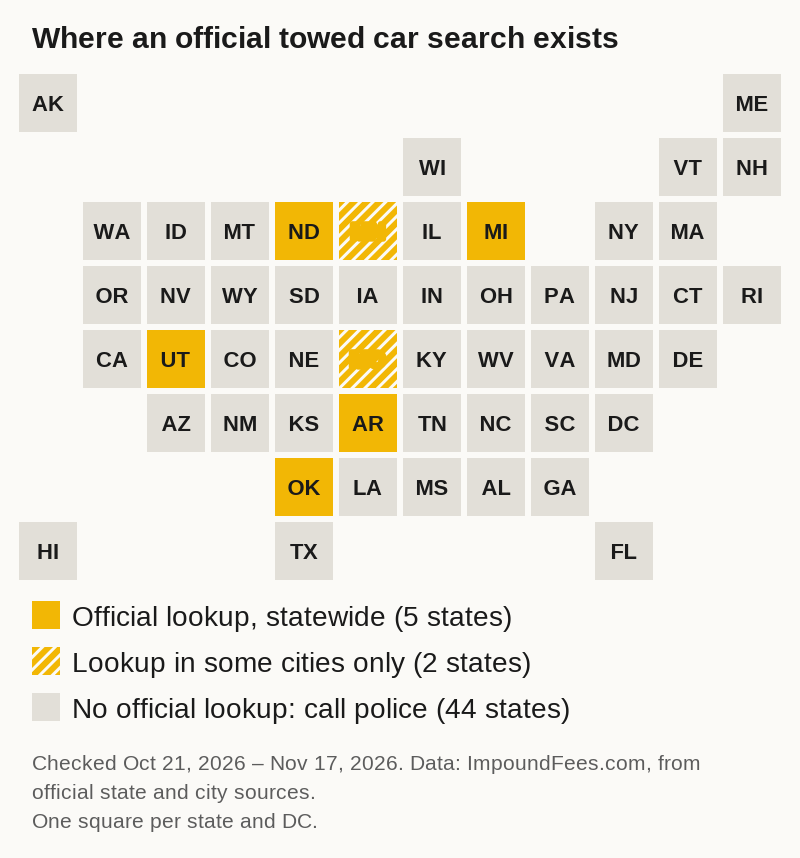
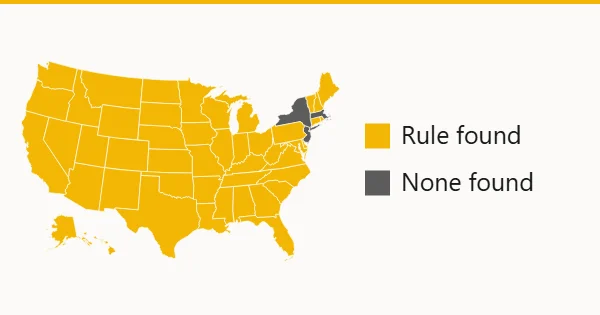
An online towed car search run by a government agency is the most reliable option, because tow companies or police actually report to it. They are rare. Of the 51 states we cover, 7 have one in our data, and some of those cover a single city rather than the whole state. Each link below is an official page from our state data:
- Alabama: No official online lookup found. Call the police non-emergency line for the area where the car was parked.
- Alaska: No official online lookup found. Call the police non-emergency line for the area where the car was parked.
- Arizona: No official online lookup found. Call the police non-emergency line for the area where the car was parked.
- Arkansas: Lost Auto search (run by an outside vendor for the Towing and Recovery Board)
- California: No official online lookup found. Call the police non-emergency line for the area where the car was parked.
- Colorado: No official online lookup found. Call the police non-emergency line for the area where the car was parked.
- Connecticut: No official online lookup found. Call the police non-emergency line for the area where the car was parked.
- Delaware: No official online lookup found. Call the police non-emergency line for the area where the car was parked.
- District of Columbia: No official online lookup found. Call the police non-emergency line for the area where the car was parked.
- Florida: No official online lookup found. Call the police non-emergency line for the area where the car was parked.
- Georgia: No official online lookup found. Call the police non-emergency line for the area where the car was parked.
- Hawaii: No official online lookup found. Call the police non-emergency line for the area where the car was parked.
- Idaho: No official online lookup found. Call the police non-emergency line for the area where the car was parked.
- Illinois: No official online lookup found. Call the police non-emergency line for the area where the car was parked.
- Indiana: No official online lookup found. Call the police non-emergency line for the area where the car was parked.
- Iowa: No official online lookup found. Call the police non-emergency line for the area where the car was parked.
- Kansas: No official online lookup found. Call the police non-emergency line for the area where the car was parked.
- Kentucky: No official online lookup found. Call the police non-emergency line for the area where the car was parked.
- Louisiana: No official online lookup found. Call the police non-emergency line for the area where the car was parked.
- Maine: No official online lookup found. Call the police non-emergency line for the area where the car was parked.
- Maryland: No official online lookup found. Call the police non-emergency line for the area where the car was parked.
- Massachusetts: No official online lookup found. Call the police non-emergency line for the area where the car was parked.
- Michigan: Michigan Secretary of State - Abandoned Vehicle Search (by VIN or plate)
- Minnesota: City of Minneapolis - search the Minneapolis Impound Lot for a vehicle
City of Saint Paul - Police Impound Lot (find my vehicle) - Mississippi: No official online lookup found. Call the police non-emergency line for the area where the car was parked.
- Missouri: City of St. Louis - check whether your vehicle was towed by the city
- Montana: No official online lookup found. Call the police non-emergency line for the area where the car was parked.
- Nebraska: No official online lookup found. Call the police non-emergency line for the area where the car was parked.
- Nevada: No official online lookup found. Call the police non-emergency line for the area where the car was parked.
- New Hampshire: No official online lookup found. Call the police non-emergency line for the area where the car was parked.
- New Jersey: No official online lookup found. Call the police non-emergency line for the area where the car was parked.
- New Mexico: No official online lookup found. Call the police non-emergency line for the area where the car was parked.
- New York: No official online lookup found. Call the police non-emergency line for the area where the car was parked.
- North Carolina: No official online lookup found. Call the police non-emergency line for the area where the car was parked.
- North Dakota: North Dakota Highway Patrol - Vehicle Impound Report (search impounded vehicles)
- Ohio: No official online lookup found. Call the police non-emergency line for the area where the car was parked.
- Oklahoma: Oklahoma Department of Public Safety - Stored Vehicle Search (find a vehicle towed by law enforcement, by VIN)
- Oregon: No official online lookup found. Call the police non-emergency line for the area where the car was parked.
- Pennsylvania: No official online lookup found. Call the police non-emergency line for the area where the car was parked.
- Rhode Island: No official online lookup found. Call the police non-emergency line for the area where the car was parked.
- South Carolina: No official online lookup found. Call the police non-emergency line for the area where the car was parked.
- South Dakota: No official online lookup found. Call the police non-emergency line for the area where the car was parked.
- Tennessee: No official online lookup found. Call the police non-emergency line for the area where the car was parked.
- Texas: No official online lookup found. Call the police non-emergency line for the area where the car was parked.
- Utah: Utah State Tax Commission - Impound Vehicle Search (find which impound yard has your vehicle)
- Vermont: No official online lookup found. Call the police non-emergency line for the area where the car was parked.
- Virginia: No official online lookup found. Call the police non-emergency line for the area where the car was parked.
- Washington: No official online lookup found. Call the police non-emergency line for the area where the car was parked.
- West Virginia: No official online lookup found. Call the police non-emergency line for the area where the car was parked.
- Wisconsin: No official online lookup found. Call the police non-emergency line for the area where the car was parked.
- Wyoming: No official online lookup found. Call the police non-emergency line for the area where the car was parked.
Where a state shows no lookup, that means we did not find an official one. It doesn't mean nobody has your car. Go to the next step.
A web search for an impound vehicle search will also turn up private sites. We list only official ones, because a lookup is only useful if the police or the tow companies in your area actually report to it.
In Texas, storage facilities post notices for unclaimed vehicles on CarLocate.com/Texas[3], a private website that TDLR has approved for these notices.
If there is no online lookup, call the police non-emergency line
The police dispatcher is your best single source. Give them your plate number and the place you parked, and ask: was the car towed, who towed it, and where is it stored.
If police ordered the tow themselves, for example after a crash or a parking violation on a public street, the department can tell you which company it used. Colorado's rule spells this out:
- Colorado: If police or another law enforcement agency ordered the tow, contact that agency to find out which towing company it used, and ask whether there is a law enforcement hold on the vehicle. A hold must be resolved before the vehicle can be released.[4]
If you parked on a highway or an interstate, the state police or highway patrol may have ordered the tow instead of the city police. Ask the city dispatcher which agency covers that road. Some big-city police departments also run their own police impound search on their websites; the dispatcher can point you to it.
Towed from private property? The sign tells you who towed it
If you parked at a store, an apartment complex or any other private lot, go back and read the tow-away signs at the entrances. In many states, those signs must name the towing company and give a phone number. Some states require more:
- Georgia: For a car towed from a parking lot, the tow-away sign at the lot's entrance must list the towing company's name, address and phone number, its towing and daily storage fees, its hours and accepted payment methods.[5]
- Maryland: Read the tow-away signs in the lot. They must state where the vehicle is taken, the name of the towing company, the maximum amount you can be charged, and a phone number to arrange to get the vehicle back. The vehicle may not be taken more than 15 miles away (unless a local law sets a different distance) or out of state.[6]
Call the number on the sign and ask where the car is stored, what you owe so far, what payment the lot takes and when it is open.
Take photos of every sign, and of the spot where you parked, before you leave. If the sign was missing or didn't say what your state requires, those photos matter if you dispute the tow. Our private property towing guide explains your rights after this kind of tow.
If you can't find a sign, call the police non-emergency line. As explained above, in many states the tow company has to report the tow to them.
What to bring when you find it
Once you know where the car is, call the storage lot before you go. Ask for the total so far, the hours, and the documents they need. Then bring:
- A government-issued photo ID.
- Proof that you own the car or may drive it, such as the registration or title. Insurance cards are accepted in some states.
- A way to pay. Payment rules differ by state: some require the lot to take credit cards, some don't.
- Your keys, if you have them.
- A release from the police, if they placed a hold on the car.
Each state page lists what its own rules require. In Texas, for example, the list looks like this:
- Photo ID: any state driver's license or ID card, any federal photo ID, or a foreign-government photo ID (e.g. Mexico driver's license, matricula consular)[7]
- Proof of ownership or right to use the car (any one): driver's license matching DMV registration, insurance card naming you, certificate of title, notarized power of attorney, tax collector's receipt and registration renewal card, lease/rental agreement, or TDLR form VSF-13 / VSF-12[8]
- Evidence of financial responsibility (proof of insurance) must be accepted as an additional form of identification establishing ownership or right of possession[9]
- Payment of all towing, storage and other allowed fees[10]
Go as soon as you can. Storage is usually charged for every day the car stays on the lot, so waiting costs money. Our guide on how much to get a car out of impound shows what the bill can include, and the towing and impound calculator adds it up for your state.
Common mistakes
Assuming the car was stolen, or assuming it was towed. Check with the police either way. A wrong guess costs time.
Waiting a few days. The bill grows every day, and after a while the lot can start the process to sell the car. Our guide to impound lots shows that timeline.
Driving to the lot without paperwork. Without photo ID, proof of ownership and payment, you may be sent home and charged another day.
Leaving without photos. Photograph the signs, the bill and the car, including any new damage, before you drive away.
Arguing at the counter. The person at the counter usually can't change the bill, and every extra day adds storage. Ask for an itemized invoice and for how to dispute the charges. Your state page explains the dispute process.
Questions people ask
How to find out who towed my car
Call the police non-emergency line, or read the tow-away sign if you parked on private property. If police ordered the tow, they know which company they called. If a property owner ordered it, the tow company is usually required to report it to the police, and the sign at the lot names the company.
Can I find my towed car online?
Only in a few places. Check the official lookups listed above. If your state or city has none, the phone is faster than searching websites.
Can you find a towed car by VIN number?
Some official lookups let you search by VIN or plate number. Michigan's is one:
- Michigan: Find the vehicle: use the Secretary of State's Abandoned Vehicle Search (by VIN or plate) or the abandoned-vehicle notice mailed to you.[11]
Your VIN is printed on your registration and your insurance card, and on the dashboard by the windshield on the driver's side.
Is there a way to find my towed car free of charge?
Yes. Calling the police non-emergency line costs nothing, and so does reading the sign at the lot. You pay the tow and storage only when you collect the car.
What if nobody has a record of my car?
Call back a little later. Tow companies don't always report a tow the moment it happens, and the record can take time to show up. If there is still nothing, report the car stolen.
How long do I have before the car is sold?
Not long, and it depends on the state. The earliest a lot can sell an unclaimed car ranges from 10 days[12] (Mississippi) to 90 days[13] (Nebraska), counted from a notice or another start date set by each state. Your state page has the exact rule. See also: how to get car out of impound.
Related state pages
- California towing & impound fees · City pages: Bakersfield, Clovis, Corona, Escondido, Fresno, Hayward, Huntington Beach, Los Angeles, Murrieta, Oakland, Rancho Cucamonga, Riverside, Roseville, Sacramento, San Bernardino, San Diego, San Francisco, Temecula
- Florida towing & impound fees · City pages: Jacksonville
- Michigan towing & impound fees · City pages: Detroit, Grand Rapids
- Minnesota towing & impound fees · City pages: Minneapolis, St. Paul
- New York towing & impound fees · City pages: New York City
- Texas towing & impound fees · City pages: Austin, Corpus Christi, Dallas, Irving, Pasadena
Related guides
-
What is an impound lot? How it works and what it costs
An impound lot is a storage yard that holds towed cars until the owner pays. Here is who runs them, how storage is charged and each state's rules.
Updated
-
How much to get a car out of impound? Costs by state
How much to get a car out of impound: the tow, a daily storage charge and any release fees. See each state's limits and a worked example.
Updated
-
Private property towing: your rights and the limits
Private property towing is legal when state rules are followed: signs, notice to police and fee limits. See what it can cost and how to dispute a tow.
Updated
-
Can a tow company keep my personal belongings? State rules
Can a tow company keep my personal belongings? What each state's law says about getting them back, which items are free and the deadlines.
Updated
-
How to get a car out of impound: steps and documents
How to get a car out of impound: find the lot, check for a police hold, bring the papers your state lists and pay the fees. Steps and state rules.
Updated
Sources (13)
- N.Y. Veh. & Traf. Law §1210(c) private-property tows reported to police
- Cal. Veh. Code §22658(f) - property owner notifies police within one hour
- Third-Party Website Notices (TDLR-approved posting website)
- 4 CCR 723-6, Rule 6512(e)(III) hold orders
- DPS Non-Consensual Towing Permit FAQ, Q13 (sign contents)
- Md. Code, Transp. §21-10A-02(b)(5)-(6) Signs: maximum charge and phone number
- Consumer Information about Towing (acceptable photo ID)
- Consumer Information about Towing (proof of ownership)
- Tex. Occ. Code §2303.160(b) Proof of insurance as identification
- Consumer Information about Towing (recovering your car)
- MCL 257.252a (5)(c)(ii) public locator website
- SB 2848 (2026), Sec. 1, Miss. Code Ann. 85-7-251, (1)(c)
- Neb. Rev. Stat. § 60-2410 (1) possession until paid; disposal after 90 days (Towing and storage fees; liability; lien; notice)
General information, not legal advice. See how we verify figures.