Every figure below comes from our verified state data and links to its official source.
Quick answer
If nobody picks up a towed car, storage keeps adding up, the owner and any lender get a written notice, and after a waiting period the company can sell the car to cover its bill. That is the tow company lien process. The earliest sale ranges from 10 days[1] (Mississippi) to 90 days[2] (Nebraska), counted from a notice or another start date each state sets. If the sale doesn't cover the bill, some states let the company come after you for the rest.
What happens if you don't pick up your towed car?
Three things start at once, and none of them stops on its own.
First, the bill grows. Storage is charged for every day the car stays on the lot, so a car left for a few weeks can cost more than the tow itself. Our towing and impound calculator shows how fast it adds up in your state.
Second, the paperwork starts. The company, or the agency that ordered the tow, looks up the registered owner and any lender and sends them a notice. That notice starts a clock.
Third, the company gains the right to sell. Once the waiting period ends and the car is still there, the law lets the company turn the car into money to pay what it is owed.
Leaving the car on the lot is not a way out of the bill. It usually makes the bill bigger and ends with the car gone.
Can a tow company put a lien on your vehicle?
Yes. A lien is a legal claim on property for a debt. A towing or storage company that holds your car has one for its charges, and the law then tells it what steps to follow before it can sell. Here is how two states describe it:
- Kentucky: A towing or storage business that has sent the notices required by KRS 281.928 has a lien on the vehicle and its contents for the reasonable charges under its rate sheet, as long as it keeps the vehicle.[3]
- New Jersey: A garage keeper that tows or stores a vehicle at the request of a law enforcement officer, or with the owner's consent, has a lien for the towing and storage charges and may keep the vehicle until they are paid.[4]
Not every state uses the same tool. Some send the car through a state agency instead of a lien auction, and some need a court order first:
- Arizona: Arizona does not use a lien auction for most tows.[5]
- Georgia: A court order is needed before the car can be sold at a public sale.[6]
The car's lender is part of this too. A tow company lien sits alongside any loan on the car: if you still owe money on it, the lender usually gets the same notices you do and may step in to pay and take the car.
The tow company lien process, step by step
The order is much the same everywhere. The deadlines are not.
Notice to the owner. The company or the agency writes to the registered owner and any lienholder, usually by certified mail. Where a state sets a deadline for that notice, it ranges from 1 business days[7] (Idaho) to 45 days[8] (South Dakota). Each state's rule is listed in the next section.
A waiting period. The owner gets a set time to pay and collect the car. In many states this is also the time to ask for a hearing if you think the tow or the charges were wrong:
- North Carolina: You then have 10 days from receiving it to ask for a court hearing; if you do not ask, you waive the hearing before the sale.[9]
- Michigan: If you do not redeem the vehicle or request a hearing within 20 days of the notice, it may be sold and you lose all rights to it.[10]
Notice of the sale. Many states require the sale to be announced, in a newspaper, online or by a second letter:
- Washington: The auction must be advertised in a local newspaper 3 to 10 days before the sale.[11]
The sale or a transfer of title. The car is sold at a public auction, sold to a dealer or a scrap yard, or the company applies for the title itself:
- Missouri: Thirty days after the notice has been mailed to the owner and lienholder, if the vehicle is unredeemed, no arrangement for continued storage has been made and no hearing has been requested, the towing company may apply to the Department of Revenue for title to the vehicle.[12]
- Ohio: Private tow-away zone tows: if the vehicle is worth less than $3,500 and stays unclaimed for 60 days after the earliest notice was received (or the company was told delivery was not possible), the tow company or lot can apply for the title.[13]
Until the sale, you can usually still pay and take the car back:
- North Carolina: Paying the amount owed before the sale ends the lien.[9]
Notice to the owner, state by state
Here is what each state's law says about who must send the notice, how and by when. Each entry links to its official source.
Alabama — 1 item
State page: Alabama
5 days. The person in possession of an unclaimed vehicle must report it to the Department of Revenue within five calendar days from the date it was first considered unclaimed (a towed vehicle may be reported immediately after towing). Within five calendar days after that report, the person must submit a records request to the state where the vehicle is titled or registered. The Department of Revenue's rule says the person in possession must send a notice of possession to the owner and lienholder of record by certified mail, return receipt. The statute's sentence requiring certified-mail notice 'within five calendar days from receipt of the title record' sits in the paragraph about vehicles for which no national title record exists; see the open questions below. The notice must give the vehicle's location, the facility's normal business hours, any accrued charges or fees, the daily storage rate and the holder's mailing address and phone number, and must warn that if the vehicle is not redeemed within 30 calendar days from the date of the notice it will be considered abandoned and may be sold. Separately, an officer who has a vehicle removed under § 32-13-2 must give written notice of the removal to the Secretary of the Alabama Law Enforcement Agency within five calendar days.[14]
Alaska — 1 item
State page: Alaska
7 business days. Unless the vehicle has already been reclaimed, the towing company holding it must notify the registered owner and the primary lienholder of the tow or storage within seven working days after the initial towing, transporting or storage. If it does not, and you did not get actual notice of the lien, storage charges stop being part of the lien after 60 days. For an abandoned vehicle stored at the direction of a peace officer or a state or municipal employee, the storer must also give notice to the owner and lienholders of record within 30 days, stating the grounds for removal and where the vehicle is impounded.[15]
Arizona — 1 item
State page: Arizona
3 business days. For a 20-day impoundment (A.R.S. 28-3511), the impounding agency must mail or personally deliver a notice of storage to the owner within three business days, excluding weekends and holidays. For other police removals, ADOT mails a notice to everyone listed as having an ownership interest once it receives the tow information; the law sets no deadline for that notice. After a private-property tow, the tow company must phone the local police within one hour. If a vehicle stays unclaimed and an abandoned vehicle report is filed, ADOT mails a notice of intent to transfer ownership within five days (30 days for vehicles without an Arizona record).[16]
Arkansas — 1 item
State page: Arkansas
8 business days. The towing company must send the owner notice not sooner than two business days, but within eight business days, after the date it receives the vehicle. Under the Board's rules, the 45-day period before a sale runs from the date the lien is perfected by keeping the vehicle and sending this certified-mail notice. If the vehicle was towed without notice, the Board says you may be able to get money back through a complaint.[17]
California — 1 item
State page: California
Police/public-agency storage: notice must be mailed or personally delivered to the registered and legal owners within 48 hours, excluding weekends and holidays (VC §22852(b)); it must state how to request a poststorage hearing. Private-property tows: the tow operator must 'immediately' give written notice to the registered and legal owner of the removal, the grounds and where the vehicle is (VC §22658(b)) if it can find out who the owner is. If the owner cannot be identified and the vehicle is not returned within 120 hours, a written report goes to the Department of Justice (VC §22853(c)).[18]
Colorado — 1 item
State page: Colorado
10 days. For a vehicle towed from private property, state law says the tow operator must notify the owner and any lienholder not more than ten days after the vehicle has been towed. The operator should wait 24 hours after the tow and then send the notice as soon as reasonably practical. The PUC describes the notice window as between 2 and 10 days after the tow, and says there is no longer a 2-day delay for tows from private property. The Colorado DMV's checklist for tow operators (form DR 2773) says the notice to the owner and any lienholder shall be sent within 5 calendar days after receipt of the completed record search from the Department.[19]
Connecticut — 1 item
State page: Connecticut
2 days. After a police or parking-authority tow, the agency must send a notice of tow and a copy of the DMV Consumer Bill of Rights within 48 hours after taking the vehicle into custody. After a private-property tow, the tow company must notify the local police within 2 hours; if the vehicle is still unclaimed 48 hours after that, the company must immediately send the DMV notice-of-tow form to the owner and all lienholders. Since October 1, 2026, every notice of tow a tow company mails must include the Consumer Bill of Rights and an itemized bill showing the towing charges and the daily storage rate, with a statement that storage keeps adding up until the vehicle is picked up.[20]
Delaware — 1 item
State page: Delaware
It depends on the kind of tow. Private-property tow without consent: to claim a lien for unpaid towing or storage, the company must notify the owner, lessor and any lienholder by certified mail within 30 days of the tow, with an itemized list of fees, and say that it may claim a lien if the car is not retrieved and paid for within 60 days of delivery of the notice; without this notice it has no lien. Police-ordered tow: the tower must send the owner and secured party a certified-mail notice of the towing charges and daily storage rate, giving a payment date at least 15 days after service (if the owner cannot be identified, the notice is published once in a local newspaper); the Division of Motor Vehicles' rule says this notice is mailed within 5 days of removal. Abandoned vehicle removed by police: the police or Department must mail a notice to the registered owner and lienholders within 5 days of removal, unless the owner's address cannot be found. Vehicle 8 years old or older: the wrecker owner asks the Division of Motor Vehicles for the owner within 5 calendar days of towing and notifies the owner and secured parties by registered or certified mail within 10 days of getting that information. A business storing a vehicle towed at someone else's request gets lien priority over a lender only by certified-mail notice to the title holder and lienholders within 7 business days and notice to the police.[21]
District of Columbia — 1 item
State page: District of Columbia
5 days. For an impounded vehicle, DPW must mail the impoundment notice no later than 5 days after the vehicle arrives at the impoundment or storage facility. If the owner's or lienholder's address cannot be found, DPW publishes a notice in a newspaper of general circulation within 10 days; it also publishes one if the mailed notice comes back undeliverable within 14 days after mailing. If the vehicle was taken from private property (other than District property), the notice is also mailed to the owner of that property. For an abandoned, accident or recovered stolen vehicle stored by a private towing company, DPW sends a towing and storage notice within 5 days after the tow.[22]
Florida — 1 item
State page: Florida
5 business days. A tow or storage company that claims a lien must send a notice of lien within 5 business days after the date of storage, not counting Saturdays, Sundays or federal legal holidays. It goes to the registered owner, the insurance company and every lienholder. The notice must itemize the charges and say when the vehicle may be sold.[23]
Georgia — 1 item
State page: Georgia
15 days. Within 3 business days of the tow, the towing company must ask the Department of Revenue (or another state, for out-of-state plates) for the names and addresses of all owners and lienholders. Within 15 calendar days of removing or first storing the car, it must send every owner the standard notification letter. The letter must give the car's location, the towing fee, the daily storage fee, a statement that fees keep accruing, and a statement that after 10 calendar days the company may ask a court to foreclose a lien. If the owner cannot be identified, the company must instead advertise in a local newspaper within 60 days of the tow. For a private-property tow the company also notifies local police, which is what the $26 notification fee covers.[24]
Hawaii — 1 item
State page: Hawaii
15 days. After a private-property tow, the towing company must look up the legal owner and the last registered owner and notify them within a reasonable period of no more than 15 days after the tow. After a police-ordered or disabled-vehicle tow, the towing company must notify the lienholder and registered owner within 20 days of the tow. The notice gives the vehicle's location and description, the maximum charges allowed by law, a phone number to call (the state consumer information service for private-property tows, the county finance department for police tows), and says the vehicle will be treated as abandoned and sold or junked if not recovered within 30 days of the mailing. If the notice is not sent in time, you can recover the vehicle without paying any tow or storage charges. After a private-property tow (and for county abandoned-vehicle notices), a mailed notice is presumed received five days after mailing. For abandoned vehicles a county takes into custody, the county must immediately mail a notice giving 10 days after the mailing to reclaim the vehicle (20 business days when the registered owner's address is out of state).[25]
Idaho — 1 item
State page: Idaho
1 business days. The tow company must report every police-directed and private-property tow in the ITD Abandoned Vehicle Portal within one business day of the tow (weekends and holidays excluded). ITD then notifies the owners and lienholders of record within one business day of that report. If you have not signed up for electronic notices, ITD mails the first notice and, if the vehicle is still not claimed 10 business days after the report, a second notice. If you have signed up, ITD sends an electronic notice, then mailed notices if the vehicle is not claimed within 5 and 15 business days. The notice states the vehicle, the tow company and its contact details, the date, time and reason for the tow, where the vehicle is stored, the amount owed for towing, the daily storage rate, and your rights to a tow procedure hearing, to claim personal property and to file a declaration of opposition. For a police tow, the officer also gives the owner a copy of the tow notice at the scene when the owner is present. When police store a recovered stolen vehicle, the agency sends a certified letter if it cannot reach the owner within 48 hours (excluding weekends and holidays), or reaches the owner but no action is taken within 7 days.[7]
Illinois — 1 item
State page: Illinois
10 business days. Police impounds: the law enforcement agency must send certified-mail notice to the registered owner and lienholder no later than 10 business days after impounding (or within 2 days after identifying the owner). Private towers that charge storage must notify the lienholder of record within 2 business days. If a towed vehicle was reported stolen, the tower must notify the registered owner within 2 business days. Relocation towers must notify local police within one hour of the tow and confirm that notice in writing within 24 hours.[26]
Indiana — 1 item
State page: Indiana
3 business days. Within 3 business days after the tow, the towing company, storage facility or public agency must search the National Motor Vehicle Title Information System (or an equivalent database) for the owner and lienholder. Not later than 3 business days after obtaining the name and address, it must notify the owner and any lienholder that storage charges are accruing, that the vehicle may be sold if not claimed, and of the earliest possible date and place of the sale.[27]
Iowa — 1 item
State page: Iowa
10 days. The police agency or towing company that takes custody of an abandoned vehicle must send notice no more than 10 days after taking custody (20 days before July 1, 2026). The notice goes to the last registered owner, all lienholders of record and any other known claimant, and counts as given on the day it is mailed. It must describe the vehicle, say where it is held, and tell you that you can reclaim the vehicle and its contents within 20 days after the notice, that the vehicle is released when you pay the towing, preservation, storage and notice costs, and that if you do not reclaim it, the vehicle can be auctioned or sent to a demolisher. After an impound for driving without proof of insurance or an OWI impound, any lienholder must be notified within 72 hours.[28]
Kansas — 1 item
State page: Kansas
15 days. If the towing company knows the owner's name, it must notify the owner within 15 days that the vehicle is being held to satisfy its lien; the state's lien form counts the 15 days from the tow. Before a sale it must ask the Division of Vehicles for the last registered owner and any lienholders no more than 30 days after taking the vehicle, and mail a notice of sale within 15 calendar days after the answer. If a required notice is not given, storage fees stop until it is. When a public agency impounds an abandoned registered vehicle, it mails a certified notice within 15 calendar days after the Division of Vehicles confirms the owner (10 days for a vehicle not registered in Kansas).[29]
Kentucky — 1 item
State page: Kentucky
10 days. Within one business day of the removal, the towing company must contact the Transportation Cabinet to find the owner and any lienholder of a Kentucky-registered vehicle; the cabinet must supply the names and addresses within two business days. Within ten days of the removal, the towing company must send notice by certified mail to the owner and any lienholder. This applies to private-property tows and to vehicles towed by order of police or another public authority. If the vehicle is placed in a garage or storage facility, the facility owner must send the notice within ten days of taking possession, with an estimated itemized invoice of towing, recovery, storage and other charges. A lienholder with a recorded lien on a Kentucky title must be notified by certified mail within the first ten days of impoundment.[30]
Louisiana — 1 item
State page: Louisiana
10 business days. Within three business days of the tow, the storage facility must report the vehicle to the Department of Public Safety and Corrections (or its agent), which sends back the owner and lienholder information; no report is needed if the vehicle is released within three business days. Within ten business days from the date the department sends that information (five business days if it is sent electronically), the facility must send notice to the owner and any lienholder. The notice must list all outstanding charges and the right to an administrative hearing, including the deadline and the date by which a hearing request must be mailed. After forty-five days from the original date of storage, the facility must send a final notice. For a private-property tow, the storage facility must also notify the sheriff or city police within twenty-four hours of the tow.[31]
Maine — 1 item
State page: Maine
Maine law does not require the towing company to notify you directly. Whoever holds a towed or left vehicle must notify the Secretary of State in writing, on the Secretary of State's form, that it has the vehicle; the notice gives the vehicle's description and plates, the date it came into the holder's possession and how. If that notice is made more than 14 days after the holder received the vehicle, or not at all, the holder may collect no more than 14 days of storage fees (the Bureau of Motor Vehicles counts the 14 days by the postmark). Repair shops and storage facilities must notify the Secretary of State, and any lienholder shown on the title, within 14 days after the owner or lienholder first becomes responsible for unpaid repair or storage charges. The Secretary of State then writes to the owner and any lienholder, stating the charges they must pay to get the vehicle back and the date ownership will pass to the holder.[32]
Maryland — 1 item
State page: Maryland
7 days. Private parking-lot tows: the tow company must notify the owner, the insurer of record and any secured party 'within 7 days, exclusive of days that the towing business is closed, after towing or removing the vehicle'. It must also notify the local police within 1 hour after the tow. Police custody of an abandoned vehicle: the police department must send notice 'as soon as reasonably possible and within 7 days at most' after taking the vehicle into custody.[33]
Massachusetts — 1 item
State page: Massachusetts
For a vehicle that police remove from an accident scene and place in a garage or storage lot, the officer gives the garage the registered owner's name and address. On receiving it, the garage must notify the registered owner that it has the vehicle, state its storage rates, and ask whether to keep holding the vehicle at those rates. The law sets no number of days for this notice. If the owner does not answer within twenty-one days after receiving it, the vehicle stays in storage at the prevailing rates.[34]
Michigan — 1 item
State page: Michigan
7 days. Within 24 hours after the vehicle is taken into custody as abandoned, the police agency enters it into the law enforcement network and notifies the Secretary of State. Within 7 days after being notified, the Secretary of State mails a notice to the last titled owner and any secured party (lender). The notice says where the vehicle is, how to redeem it, and how to request a hearing within 20 days. A police-impounded vehicle enters this process only once it is treated as abandoned (not redeemed within 7 days of the impound). Notices go only to owners of vehicles titled or registered in Michigan.[35]
Minnesota — 1 item
State page: Minnesota
5 business days. When an impounded vehicle is taken into custody, the unit of government or impound lot operator taking it must give written notice of the taking within five days, excluding Saturdays, Sundays, and legal holidays, to the registered owner and any lienholders. The notice must give the date and place of the taking, describe the vehicle (if that information can be reasonably obtained), say where it is held, and explain the right to reclaim the vehicle and its contents. It must also state that failing to reclaim the vehicle (or its contents) in time is a waiver of all rights to it and a consent to its sale or disposal, and that an owner who gives the lot documentation of being homeless, receiving relief based on need, or being eligible for legal aid has the unencumbered right to retrieve all contents without charge. If an unauthorized vehicle is still unclaimed 30 days after the notice was sent, a second notice must be sent by certified mail, return receipt requested (this second notice is not required for unauthorized vehicles impounded by Minneapolis or St. Paul).[36]
Mississippi — 1 item
State page: Mississippi
7 days. Within 24 hours the towing company must report the tow to the local police (unless the owner asked for it). If the owner has not contacted the company within two business days of the tow, the company must look up the owner and any lienholder, and then notify them by certified mail, sent through a third-party vendor approved by the Department of Revenue, of the amount due, postmarked no later than the seventh day after the tow. If the company does not make a good-faith effort to follow these rules, it may not impose any towing or storage charges. These rules apply to vehicles towed on or after July 1, 2026.[37]
Missouri — 1 item
State page: Missouri
5 business days. Notice of the removal 'shall be made in writing within five working days' to the registered owner and any lienholder, by the public agency that authorized the removal or, when the property owner authorized it, by the towing company. Later, after the Department of Revenue tells the towing company who the owner and lienholder are, the towing company must notify them 'within ten business days of the date of mailing indicated on the notice sent by the department of revenue'. That notice must state that the accrued towing, storage and administrative costs are the owner's responsibility, that the owner has a right to request a hearing, and that title will pass to the person or firm holding the vehicle if it remains unclaimed for thirty days from the date of mailing.[38]
Montana — 1 item
State page: Montana
15 days. When a rotation tow company removes a wrecked or disabled vehicle from a public road at an officer's request, it must send a certified letter to the owner or lienholder within 15 days after the removal, saying the vehicle has been towed and is being stored. For abandoned vehicles, the Highway Patrol tells the sheriff or city police within 72 hours where the vehicle is stored; the sheriff or city police must make reasonable efforts to find the owner, lienholder or person entitled to the vehicle and tell them where it is. Notice counts as given when a certified letter is mailed at least 30 days before the sale (at least 60 days when the vehicle was taken after the driver's arrest).[39]
Nebraska — 1 item
State page: Nebraska
15 business days. The person who towed the vehicle must notify the owner and any lienholder on the title within 15 business days after the tow. The notice must state the daily storage fee and the storage owed so far, and that the vehicle may be sold or otherwise disposed of 90 days after the tow. If the tower does not send this notice, its lien ranks behind the lienholder's and any sale of the vehicle is void. When a county, city or village holds an abandoned vehicle, it must notify the last registered owner and any lienholder within 15 business days; when police no longer need a vehicle held as evidence, they must send a certified letter within 15 calendar days.[40]
Nevada — 1 item
State page: Nevada
15 days. When a vehicle is towed at the request of anyone other than its owner, the tow company must notify the registered and legal owner by certified mail within 15 days after placing it in storage, or within 21 days if police requested the tow after a crash. If the owner is not known, it must make every reasonable attempt to identify the owner within the same period, and must send the notice as soon as possible and no later than 15 days after the owner is identified. Without that notice, its towing and storage fee may not be charged beyond 15 days (21 days after a crash). Exception: for an abandoned vehicle that looks like junk, is not registered in Nevada or readily traceable to another state, and whose owner cannot be found, the tow company or agency may instead post a notice on the vehicle saying it will be junked or disposed of if not removed within 7 days; if the vehicle is then appraised as junk (scrap value of $500 or less), the tow company does not have to identify or notify the owner.[41]
New Hampshire — 1 item
State page: New Hampshire
Whoever directs the removal (the police officer or the private property owner) must try to tell the registered owner, by the most practicable means, that the vehicle was removed and where it was taken, if the owner's name and address are known or can be found in the registration records. The law sets no deadline for this. If the police officer who had the vehicle removed cannot identify or notify the owner, the officer must file the notice with the director of the Division of Motor Vehicles within 30 days of the removal; the division keeps it on file and mails the owner and lienholder information to the company holding the vehicle. A private property owner who has a car towed must notify a peace officer as soon as reasonably possible. A garage or storage business must report a vehicle unclaimed for 30 days to the director within 5 days after that. Before a storage company sells or disposes of a towed vehicle, it must send a sale notice to the owner (see lien sale).[42]
New Jersey — 1 item
State page: New Jersey
30 days. For a tow authorized by law enforcement, the towing company must notify the operator, owner, lessor and lienholder within 30 days of the vehicle being towed and arriving at the towing company's lot. If it does not, the law says it may charge a maximum storage fee of $750. For an abandoned vehicle taken by a public agency, the person storing it must send its own notice after the public agency notifies it.[43]
New Mexico — 1 item
State page: New Mexico
2 business days. The towing company must ask for the registered owner's and lienholder's names and addresses within three business days after it takes the vehicle (from the Motor Vehicle Division, or from the other state if the vehicle has out-of-state plates), and must mail notice to the registered owner and any lienholder within two business days after it receives that information. If it misses either deadline, it may not collect any storage charges or liens on an unclaimed vehicle. The owner notice is not needed if you contact the company first and make arrangements to pay, but the lienholder must still be notified.[44]
New York — 1 item
State page: New York
5 business days. For a tow made at the request of a law enforcement officer, the tower must mail the owner a notice within five working days from the initial towing. It must give the tower's name, the amount claimed for towing and storage, and the address and times when the vehicle can be recovered, and say the vehicle will be released on full payment of the charges. Lienholders on the title must be notified within twenty days of the first day of storage. These notice rules do not apply when police request the tow under a local law on stolen or abandoned vehicles that requires the vehicle to be turned over to the locality after a set time. For a private-property tow, the tow company must immediately notify the local police of the vehicle and the time of removal.[45]
North Carolina — 1 item
State page: North Carolina
For a police-ordered tow, the person who authorized the tow must notify the registered owner within 24 hours if the vehicle has North Carolina registration, or within 72 hours if it is registered in another state. The notice gives the vehicle description, where it is stored, any violation charged, how to get it back and how to request a probable cause hearing. For private-property tows, state law requires no direct notice to the owner. Outside the posted lots covered by G.S. 20-219.2, the tower must phone the local law-enforcement agency before moving the vehicle. The agency must tell a caller who can describe the vehicle and where it was where it is stored and whom to contact.[46]
North Dakota — 1 item
State page: North Dakota
10 days. The government agency or towing company that takes an abandoned vehicle into custody must give notice within 10 days of the taking, or within 10 days after communications from the owner, lienholder or other secured party have stopped. The notice gives the date and place of the taking, the year, make, model and serial number of the vehicle and where it is held, tells you of your right to reclaim it, and states that if you do not reclaim it within 30 days you give up all rights to it and consent to its disposal, with the end date of that 30-day period. A towing company must also notify the local law enforcement agency within 12 hours of completing the tow. No notice is required for a vehicle worth $1,000 or less whose owner and lienholders cannot be identified from Department of Transportation records; it may go straight to a scrap processor.[47]
Ohio — 1 item
State page: Ohio
5 business days. Private tow-away zone tows: within two hours of the tow, the tow company must report it to the local sheriff or police. Within 3 business days, the tow company or lot must search the motor vehicle records for the owner and any lienholder. If the vehicle is still unclaimed, it must mail them a notice within 5 business days after the records provider gives it their identity. If the company can apply for the vehicle's title (vehicles worth less than $3,500), it must send a second notice when the vehicle is still unclaimed 30 days after the first; otherwise only the first notice is required. Police tows from public roads, crashes or arrests: the police agency searches the records within 5 business days of the removal and sends the notice. The notice warns that the vehicle will be declared a nuisance and disposed of if it is not claimed within 10 days after the notice is sent.[48]
Oklahoma — 1 item
State page: Oklahoma
After a private-property tow, the wrecker service must ask the Oklahoma Tax Commission (or another motor license agent) for the owner's and lienholder's names within three business days, and must send the notice within seven days of receiving them; if it does not follow these steps, the owner does not have to pay any storage. To keep a lien on a vehicle towed at police direction or from private property, the wrecker service must ask Service Oklahoma for the owner and lienholder within five business days of the tow and send the notice within seven business days of receiving the information.[49]
Oregon — 1 item
State page: Oregon
3 business days. Private-property tow: the tower must notify the local police of the vehicle's location within one hour after it is placed in storage. If the tower has not given notice by mail or actual notice to the owner and each person with an interest on the title within three business days after the vehicle is placed in storage (Oregon-registered vehicle), it may not charge for storage after that point. If the owner was not present at the tow, the tower must also request the owner's name and address from the motor vehicle agency within five business days of the tow (unless the owner contacts it first) and mail its price disclosure by the end of the next business day after receiving it. Police-ordered tow: the tow company must mail a notice of hearing rights no later than the third business day after storage (not required for an abandoned vehicle appraised at $1,000 or less), and for a hazard tow under ORS 819.120 the agency must send notice by certified mail within 48 hours of the towing, not counting Saturdays, Sundays or holidays.[50]
Pennsylvania — 1 item
State page: Pennsylvania
There is no general statewide deadline for telling an owner about a tow. For abandoned vehicles, the salvor must report the vehicle to PennDOT within 48 hours of taking it, and PennDOT then notifies the registered owner and lienholders by certified mail, return receipt requested (the law sets no number of days for PennDOT's notice). If the owner or lienholder cannot be identified, the notice is published once in a local newspaper. Before police remove an abandoned vehicle from a highway, if its plate, inspection certificate or VIN plate identifies the owner, they must send the last registered owner a notice by certified mail giving seven days to move it. After an accident tow, the tow operator must give an owner who is at the scene a written point of contact for where the vehicle will be stored. When police tow a vehicle for driving without a license or registration, notice goes to the owner and lienholders by the most expeditious means and by first class mail (in Philadelphia, by first class mail with proof of mailing).[51]
Rhode Island — 1 item
State page: Rhode Island
7 days. The Division's rule requires a certificated tower that removes an abandoned or unattended vehicle to notify the last known registered owner within seven days, and all known lienholders within 14 days. If it notifies the owner late, it may not charge the owner storage for the period between the deadline and the actual notice. The statute itself gives the tower 14 days to notify the owner and lienholders. The tower must also notify the police department of the city or town within two hours of the tow. The same notices apply to tows from private property. When police take an abandoned vehicle into custody themselves, they must notify the owner and lienholders within 15 days. A certificated tower need not send its notices for a vehicle that is at least 10 years old (or has an altered VIN), has not been registered within a year, has no established market value and would not pass a safety inspection: police may dispose of it five days after removing its VIN. An abandoned vehicle of no value (no current registration, worth $500 or less, no valid inspection sticker) taken by police is held at least 10 days and then demolished.[52]
South Carolina — 1 item
State page: South Carolina
5 business days. The towing company, storage facility, garage or repair shop must send the notice within five business days after receiving the owner's and lienholder's identities from the title search the law requires. The notice must describe the vehicle and state the daily storage amount that will accrue after the notice is sent. For a police-ordered tow, the company must give the sheriff or police chief a list of the vehicles it still holds within ten days after the towing request, and the sheriff or police chief must supply the owner and lienholder information within ten days of receiving the list. For a recovered stolen vehicle, the police agency must notify the owner within two business days after the tow.[53]
South Dakota — 1 item
State page: South Dakota
45 days. Within 45 days after removing an abandoned, wrecked or impounded vehicle, the towing company (or agency) must send written notice to the registered owner and all readily identifiable lienholders. If the notice is not sent within 10 days of the removal, no storage may be charged after day 10 until the notice is mailed. The notice gives the date and place of the taking, the year, make, model and serial number of the vehicle and where it is held, and tells you of your right to reclaim it. Separately, a company that removes an unattended vehicle from a public street or highway without a written request from the owner, the owner's agent or a police officer must report the removal to the owner within 24 hours, or, if it cannot reach the owner, to the county sheriff (outside a city) or the chief of police (inside a city); if it does not, it may not bill or collect any towing or storage fee.[8]
Tennessee — 1 item
State page: Tennessee
3 business days. A storage facility holding an abandoned or immobile vehicle must verify ownership within 3 business days after taking possession, then send notice to the last known registered owner and all lienholders of record within 3 business days after receiving the ownership verification. When law enforcement takes the vehicle into custody, the agency or the tow company sends the notice that the vehicle has been taken into custody within 3 business days after ownership is verified. The notice must tell the owner of the right to reclaim the vehicle within 20 days after receiving the notice, by paying the towing, preservation and storage charges. The storage facility's verification and notice duty under § 55-31-302(b) does not apply if the owner or the owner's agent is present when the facility starts towing the vehicle.[54]
Texas — 1 item
State page: Texas
5 days. For a vehicle registered in Texas, the VSF must send written notice to the registered owner and the primary lienholder no earlier than 24 hours and no later than the 5th day after receiving the vehicle. For an out-of-state vehicle, the deadline is the 14th day. Notice by publication (newspaper or a TDLR-approved website) is allowed in limited cases, such as an unknown owner or address.[55]
Utah — 1 item
State page: Utah
2 business days. After a private-property tow (any tow done without the owner's knowledge that police did not order), the tow company must send a certified letter within two business days to the registered owner and every lien holder. If it does not give timely and proper notice, it loses the right to collect towing, storage and impound fees, and the owner or lien holder can demand the vehicle back free of charge if the company cannot show the letter was sent. In the first two business days after the tow, you owe the fees if the company has entered the tow in the state's impound database; after that, only if it has sent the certified letter. If you say you were not properly notified, the law presumes you were not, and the company must show credible, time-stamped evidence of the database entry or the certified letter. After a police impound, the officer's agency and the tow company must report the impound to the Motor Vehicle Division before noon on the next business day, and the Division then sends the notice to the registered owner and lien holders.[56]
Vermont — 1 item
State page: Vermont
Vermont law does not require the towing company to notify you directly. For an abandoned vehicle, the landowner where the vehicle was found or moved to must apply to the DMV for an abandoned-vehicle certification within 90 days after the date it was discovered or relocated (the DMV's page says the towing service files within 90 days of removal). If the vehicle can be identified by its plate or identification number, the DMV sends notice to the last registered owner and lienholder within three business days after receiving the form. If the return receipt does not come back within seven business days, the DMV sends a second notice. When police tow a vehicle from a highway, the officer reports the removal, the towing service and the place of storage to the DMV. A landowner who has an abandoned vehicle removed must immediately notify the local police. A business that stores vehicles for the public must report a vehicle that has been unclaimed for 30 days to the DMV within five days after that period; if it does not, it loses its claims and liens for the storage charges.[57]
Virginia — 1 item
State page: Virginia
After a private-property tow, the tow truck operator must notify the State Police or the local police of the jurisdiction the vehicle was towed from right away. After a police removal, the officer must report it to the DMV and to the owner as promptly as possible. If the towing or storage company starts the lien process, it must check with the DMV for title liens within seven business days of taking possession; the DMV then mails a notice to the owner and any lienholder by first-class mail.[58]
Washington — 1 item
State page: Washington
At the time of impoundment, the tow company must notify a local law enforcement agency, which keeps a log of impounds. It must then mail a notice to the last known registered and legal owners, and to any lessor or lessee, within twenty-four hours after the impoundment. The notice includes the written notice of the right of redemption and of the opportunity for a hearing to contest the impound. If the vehicle becomes abandoned, the company must mail a separate notice of custody and sale within twenty-four hours after it receives the owner information from the Department of Licensing.[59]
West Virginia — 1 item
State page: West Virginia
15 days. After a third-party tow (any tow without the owner's or operator's consent), the towing company must mail a copy of its itemized invoice to the registered owner within 15 days of the tow for a vehicle registered in West Virginia, or 30 days for an out-of-state vehicle, and in either case within 24 hours of learning who the registered owner is. The invoice must itemize the towing and daily storage charges, list the company's approved rates or say the tariff is available, and state that tow rates are regulated by the Public Service Commission, with its address for complaints. These invoice rules come from the Commission's towing rules; these Public Service Commission rules carry a sunset date and we found no renewal on the Secretary of State's rules site. When police take an abandoned or junked vehicle into custody, the agency must notify the last registered owner and all lienholders within 15 days; a towing company hired by police must also notify them within 30 days, and if it does not, the owner is liable for no more than the first five days of towing, preservation and storage charges.[60]
Wisconsin — 1 item
State page: Wisconsin
30 days. Within 30 days after taking possession of a vehicle, a towing company that holds a towing and storage lien (a motor carrier with a permit for vehicle towing, or a licensed motor vehicle salvage dealer or motor vehicle dealer) must send written notice to the owner and to the holder of the senior lien, telling them they must take steps to obtain the release of the vehicle. This lien applies when the towing or storage is done at the direction of a traffic officer or the vehicle's owner. For a police-ordered tow, the traffic or police officer or parking enforcer who requested the removal must give the towing service the names and last-known addresses of the registered owner and all lienholders within 24 hours of requesting the removal, if the vehicle is taken anywhere other than a public highway within one mile and the agency's towing agreement does not make the municipality or county responsible for notifying them. For a vehicle that a municipality or county treats as abandoned, the notice to the owner and lienholders goes by certified mail.[61]
Wyoming — 1 item
State page: Wyoming
30 days after the date payment is due. For a vehicle held under the towing company's lien, the company must send a notice of intent to file, enforce and foreclose the lien within 30 days from the date payment is due; if it has not sent that notice and started an action to foreclose, it can collect no more than 180 days of storage. If a towed vehicle stays in the recovery lot more than 5 business days, the company must request a title search within the next 5 business days and tell lienholders where the vehicle is within 1 business day of receiving the owner information. If the towing company towed an abandoned vehicle on its own (one not under the control of a city, town or county), it must report the tow to the sheriff within 30 minutes, request a title search within 3 business days and send certified notice to the owner and lienholders within 3 business days of identifying their address. For an abandoned vehicle removed by the police, the Department of Transportation sends the notice to the owner and lienholders, but no notice is required if the sheriff values the vehicle at less than $2,000. When a trooper removes a hazardous vehicle and could not reach the owner, the trooper sends a notification form to the registered owner. A garage or lot that keeps a vehicle more than 30 days without reporting it to the sheriff forfeits all claims for storage.[62]
The notice goes to the address on the registration. If you have moved and not updated it, you may never see the letter, and the clock runs anyway.
How long before a towed car is sold?
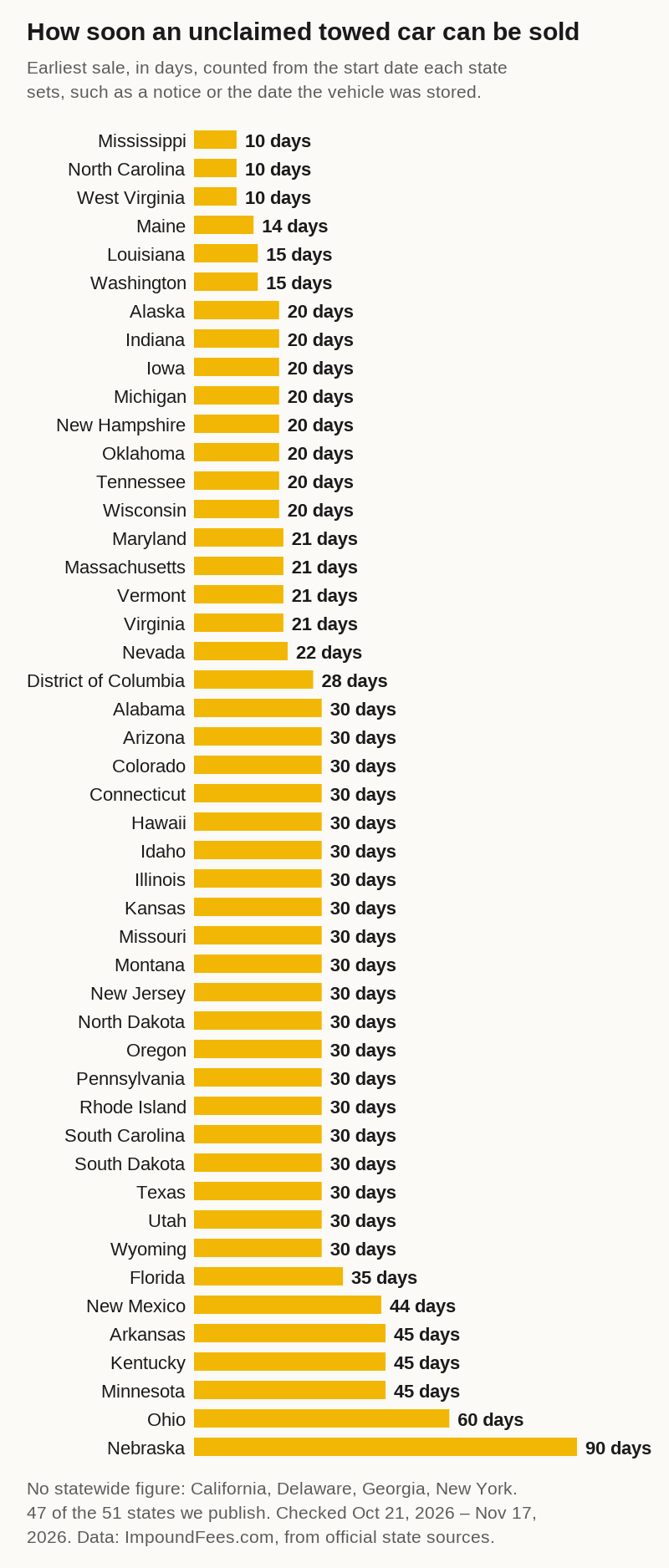
The earliest sale ranges from 10 days[1] (Mississippi) to 90 days[2] (Nebraska) in the states that set one. These numbers can't be compared directly, because each state starts the clock at a different point: the first notice, a second notice, the date the car was stored, or the date the charges were due. Add the time before the notice goes out, and the real wait is longer. Texas spells this out:
- Texas: Because the first notice cannot go out until 24 hours after the vehicle arrives, the earliest possible sale is about 45 days or more after the tow.[63]
The value of the car can change the route, too. A car worth little may go to a scrap yard sooner:
- New York: A vehicle worth less than $500 may instead be sold to a dismantler or scrap processor, but not earlier than 30 days after the notice was mailed or 60 days after the tow, whichever is later.[64]
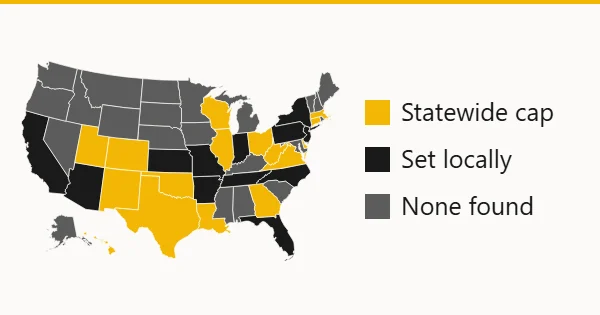
The table gives each state's figure with its source. "No statewide figure" means we did not find one in the official sources we checked; the state page explains the process there.
| State | Earliest sale |
|---|---|
| Alabama | 30 days after the date the notice was sent to the owner and lienholder of record (after that the vehicle counts as abandoned; the auction also needs notice to the Department of Revenue at least 35 calendar days before the sale)[65] |
| Alaska | 20 days after the notice of sale, which may be given once the vehicle has been unclaimed for 30 days in the towing company's possession[66] |
| Arizona | 30 days after the date on ADOT's notice of intent to transfer ownership[5] |
| Arkansas | 45 days after the date the towing lien is perfected (the company keeps the vehicle and has sent the certified-mail notice)[67] |
| California | Not found statewide[68] |
| Colorado | 30 days after the postmarked date of the notice to the owner (or the date the tow operator learns that no record exists for the vehicle)[69] |
| Connecticut | 30 days after the start of storage (start of the sale process)[70] |
| Delaware | Not found statewide[71] |
| District of Columbia | 28 days after the impoundment notice[72] |
| Florida | 35 days after the date the vehicle was stored (57 days for a vehicle 3 model years old or newer)[73] |
| Georgia | Not found statewide[6] |
| Hawaii | 30 days after the mailing of the towing company's notice[74] |
| Idaho | 30 days after the first notice sent by the Idaho Transportation Department[75] |
| Illinois | 30 days after notice is given (conditions apply)[76] |
| Indiana | 20 days after the mailing of the owner notice[77] |
| Iowa | 20 days after the date the notice is mailed; an auction must also be advertised at least seven days ahead[78] |
| Kansas | 30 days after the tow; the notice of sale then gives 15 days to pay, and the auction must be advertised at least 7 days ahead[79] |
| Kentucky | 45 days after charges going unpaid (the statute does not say from which date)[3] |
| Louisiana | 15 days after the final notice is mailed (the final notice is sent after forty-five days in storage) (start of the sale process)[80] |
| Maine | 14 days after the date the Secretary of State sends its notices to the owner and lienholder (or the date the newspaper notice is published)[81] |
| Maryland | 21 days after the date of the police notice (abandoned vehicles in police custody)[82] |
| Massachusetts | 21 days after the garage's sale notice, which it may send once the vehicle has been unclaimed for sixty days[83] |
| Michigan | 20 days after the date of the Secretary of State's abandoned-vehicle notice (or the court's decision, if you requested a hearing)[10] |
| Minnesota | 45 days after the notice to the owner (unauthorized vehicles impounded other than by Minneapolis or St. Paul)[84] |
| Mississippi | 10 days after the mailing of the second certified letter, which may be sent only if the bill is still unpaid 30 days after the tow[1] |
| Missouri | 30 days after the date the towing company mails its certified-mail notice[12] |
| Montana | 30 days after the certified-mail notice (or the newspaper notice); 60 days when the vehicle was taken into custody after the driver's arrest[85] |
| Nebraska | 90 days after the date of the tow; a notice of the intended sale must also be mailed at least 30 days before it[2] |
| Nevada | 22 days after the first newspaper advertisement of the sale, which may run only after the payment deadline in the lien notice (at least 10 days after the notice)[86] |
| New Hampshire | 20 days (conditions apply)[87] |
| New Jersey | 30 days after the date of detention[4] |
| New Mexico | 44 days after the mailing date shown on the certified-mail receipt for the lien notice, not the date it was received (vehicles registered in New Mexico; 70 days for vehicles registered in another state)[88] |
| New York | Not found statewide[64] |
| North Carolina | 10 days after the date the towing and storage charges were due (start of the sale process)[9] |
| North Dakota | 30 days after receipt of the notice when a towing company holds the vehicle, or the date of the notice when a government agency holds it[89] |
| Ohio | 60 days after the date the owner notice is received (signed receipt) or the company learns it could not be delivered[13] |
| Oklahoma | 20 days after the lien arises (start of the sale process)[90] |
| Oregon | 30 days after the notice of foreclosure sale mailed to the owner (15 days for a vehicle appraised at $1,000 or less)[91] |
| Pennsylvania | 30 days after the date PennDOT mails the abandoned-vehicle notice (or publishes it)[92] |
| Rhode Island | 30 days after the mailing of the tower's first notice; a second, foreclosure notice must then give 10 more days before the sale[93] |
| South Carolina | 30 days after the written notice to the owner and lienholders[94] |
| South Dakota | 30 days after the date the towing company sent the notice; title then passes to the towing company (no auction)[95] |
| Tennessee | 20 days after the date the owner receives the notice[96] |
| Texas | 30 days after the second notice[63] |
| Utah | 30 days after the original notice of the impound (60 days for a vehicle seven model years old or newer)[97] |
| Vermont | 21 days after the DMV's second notice to the owner (for a vehicle with no identifiable plate or identification number, the DMV's receipt of the certification form)[98] |
| Virginia | 21 days after the company's notice of intent to sell to the DMV[99] |
| Washington | 15 days after the mailing of the notice of custody and sale[11] |
| West Virginia | 10 days after the date the owner or lienholder receives the abandoned-vehicle notice (or the date a newspaper notice is published)[100] |
| Wisconsin | 20 days after the certified-mail notice of the sale or junking[101] |
| Wyoming | 30 days after the notice to the owner, for a police-impounded abandoned vehicle worth $2,000 or more (sheriff's auction)[102] |
Tow company lien sale: where the money goes
A sale rarely brings in exactly what is owed.
If it brings in more, the extra doesn't belong to the towing company. Depending on the state, it goes to the owner, the lender or a state office that holds it for them:
- Texas: Sale proceeds pay the storage charges, and any excess goes to the person entitled to it.[63]
- Washington: Money left after the company's lien is paid goes to the Department of Licensing, and the registered owner can claim it within one year of the auction.[11]
- Georgia: Money left after the lien is paid goes to the Department of Revenue as unclaimed property.[6]
If it brings in less, you may still owe the rest. Some states say so directly:
- Kentucky: If the sale does not cover the charges, the owner remains responsible for the rest.[3]
- Michigan: If the sale does not cover the charges, the towing company may collect the rest from the last titled owner, subject to the storage-fee limit.[10]
- Missouri: Charges above the vehicle's value at the time of transfer remain the owner's debt.[12]
- Louisiana: The final notice must tell the owner that the facility may apply to the Department of Public Safety and Corrections for a permit to sell or permit to dismantle fifteen days after the final notice is mailed, and that unpaid charges may be turned over to collections.[80]
What happens if I can't pay impound fees?
Call the lot before the deadline, not after. Ask for the total so far, the daily rate, and the date the sale process starts. Then decide quickly, because every day adds storage.
- Get your belongings out. In most states you can collect personal items without paying the bill. Our guide can a tow company keep my personal belongings has each state's rule.
- Call your insurer and your lender. Insurance may cover the tow after a crash or theft, and a lender may prefer to pay and take the car rather than lose it.
- Check the bill. Compare each charge with the limits on your state page. If a charge is over the limit, dispute it in writing.
- Ask for a hearing if the tow was wrong. Many states set a short deadline; your state page has it.
- Pay before the sale if you can. Paying the full amount before the sale usually ends the lien.
Here is how Washington puts it: You can redeem the vehicle at any time before the auction starts by paying the towing and storage fees.[11]
If the car is worth less than the bill, paying may not make sense. Ask the company in writing whether it will release you from the rest of the debt if you sign the car over, and keep its answer.
What happens if your car is impounded by police?
Police tows follow the same broad steps, but the agency is in charge. It sends the notice, it may place a hold on the car, and in some states it sells the car itself:
- Texas: If police take the vehicle into custody as abandoned (Transportation Code ch. 683), the police agency sends notice by certified mail within 10 days; you have until the 20th day after that notice to claim the vehicle by paying the charges, after which the agency may sell it at public auction.[63]
- Maryland: If the vehicle is not reclaimed, the police department sells it at public auction (or may keep it for public use).[82]
If the police hold the car, you need their release before the lot can give it back. Ask the agency what it needs and how long the hold lasts, and keep paying attention to the lot's notices: storage usually runs during a hold.
Common mistakes
Ignoring the notice. It tells you what you owe, where the car is and how long you have. Unopened, it still counts.
Thinking the debt ends with the car. In some states you owe what the sale didn't cover.
Missing the hearing deadline. If the tow was wrong, the time to say so is before the sale, and the window can be short.
Not telling your lender or insurer. They may help, and they will get the notices anyway.
Leaving your belongings in the car. If the car is sold, what's inside may be lost with it.
An old address on the registration. The notice goes there, whether or not you still live there.
Questions people ask
Can a tow company put a lien on your license?
A towing lien is a claim on the vehicle, and in some states on what's inside it. None of the lien rules in our state data attach it to a driver's license. Unpaid charges can still follow you as a debt where the sale didn't cover them. If a letter mentions your license or registration, ask the sender which law it relies on, and check with your state's motor vehicle agency.
Does a tow company lien hurt your credit?
The lien itself is a claim on the car, not a loan. But if unpaid charges are sent to a collection agency, as some states allow, that debt can be reported like any other collection account. Dealing with the bill before it reaches that point is the safest course.
Can I get my car back after it has been sold?
Usually not. Once the waiting period ends and the sale happens, the owner's rights in the car are gone:
Will my lender find out?
Yes. Lienholders get notices too, and some states give them their own chance to pay and take the car:
- Florida: The notice of lien must be sent to the owner, the insurer and the lienholder at least 30 days before the sale (at least 52 days for a vehicle 3 model years old or newer).[73]
What happens to my things if the car is sold?
They can go with it. Some states let the seller decide what to do with them:
- Alabama: When an abandoned vehicle is sold at auction, personal property and items in it will be disposed of in a manner determined by the person or entity conducting the sale.[103]
Take your belongings out early. Our impound lot guide explains how a lot works, and our guide on how much it costs to get a car out of impound shows a full bill.
Related state pages
- Georgia towing & impound fees
- Kentucky towing & impound fees
- Michigan towing & impound fees · City pages: Detroit, Grand Rapids
- North Carolina towing & impound fees
- Texas towing & impound fees · City pages: Austin, Corpus Christi, Dallas, Irving, Pasadena
- Washington towing & impound fees · City pages: Seattle
Related guides
-
Can a tow company keep my personal belongings? State rules
Can a tow company keep my personal belongings? What each state's law says about getting them back, which items are free and the deadlines.
Updated
-
What is an impound lot? How it works and what it costs
An impound lot is a storage yard that holds towed cars until the owner pays. Here is who runs them, how storage is charged and each state's rules.
Updated
-
How much to get a car out of impound? Costs by state
How much to get a car out of impound: the tow, a daily storage charge and any release fees. See each state's limits and a worked example.
Updated
-
Private property towing: your rights and the limits
Private property towing is legal when state rules are followed: signs, notice to police and fee limits. See what it can cost and how to dispute a tow.
Updated
Sources (103)
- SB 2848 (2026), Sec. 1, Miss. Code Ann. 85-7-251, (1)(c)
- Neb. Rev. Stat. § 60-2410 (1) possession until paid; disposal after 90 days (Towing and storage fees; liability; lien; notice)
- KRS 376.275(1)(a) Lien for towing and storage (Lien on motor vehicles and contents for reasonable and applicable charges under KRS 281.920 to 281.936)
- N.J.S.A. 2A:44-21 Garage keeper liens; detention of vehicles; notice; priority - lien for towing and storage [source note: L.1951 (1st SS), c.344; amended 1961, c.121, s.4; 1998, c.122, s.1; 2023, c.132, s.2 (approved and effective Aug. 7, 2023)]
- A.R.S. 28-4838(A) Abandoned vehicle report after ten days
- O.C.G.A. 40-11-19.1(a) (HB 307, 2019) - when the foreclosure petition may be filed
- Idaho Code 49-1807(1) procedures apply to tows under 49-1803 to 49-1806
- SDCL 32-36-8 notice within 45 days of removal
- N.C.G.S. 44A-2(d) Towing and storage lien
- MCL 257.252a (18) public sale timing
- RCW 46.55.010 (1) Definition: abandoned vehicle
- RSMo 304.155.9 Lien of the person who removes abandoned property at police direction
- R.C. 4505.101(B)(2)-(3) Title for private tow-away zone vehicles
- Ala. Code § 32-8-84 (b)(1) report to Department of Revenue
- AS 28.10.502(b) certified letter to owner and primary lienholder
- A.R.S. 28-3514(D) Notice to owner within three business days
- Act 1053 of 2007, § 11, Ark. Code § 27-50-1208(c)(2) (when the owner notice is sent)
- Cal. Veh. Code §22852(b) - notice of storage within 48 hours
- HB22-1314, Ch. 416 (2022), C.R.S. § 42-4-2103(3)(c)(I)(A) - notice deadline
- PA 26-24, S. 42 (C.G.S. 14-150(e)) police notice within 48 hours of custody
- 21 Del. C. § 6907A(d) No lien unless the notice requirements are met
- D.C. Code § 50-2455(c) Impoundment notice by first class mail
- Fla. Stat. §713.78(4)(c) Notice of lien deadline
- O.C.G.A. 40-11-19(a)(1) (HB 307, 2019) - notice letter within 15 calendar days
- HRS 290-11 Vehicles left unattended on private and public property
- 625 ILCS 5/4-205 Record searches
- IC 9-22-1-19(a) Title database search
- Iowa Code 321.89(3)(a) notice by certified mail
- K.S.A. 8-1103(a)(2) Towed motor vehicles, lien created thereon; procedure; personal property; notice of fee; city ordinance or county resolution
- KRS 281.928(1) Contact the cabinet within one business day (Required notice to owner and lienholder -- Contents -- Holding and retrieval period)
- La. R.S. 32:1719(A) Report of stored vehicle to the department
- 29-A M.R.S. §1854(1) holder must notify the Secretary of State
- Md. Code, Transp. §21-10A-04(a)(2) Police notice within 1 hour
- M.G.L. c. 255, § 39A (vehicles removed from an accident scene by police)
- MCL 257.252a (5)(b) police entry within 24 hours
- Minn. Stat. 168B.06, subd. 1(a) Written notice of impound
- SB 2848 (2026), Sec. 1, Miss. Code Ann. 85-7-251, (2)
- RSMo 304.158.1 Written notice of removal within five working days
- MCA 61-8-913(1) certified letter within 15 days after a rotation tow
- Neb. Rev. Stat. § 60-2410 (2) notice within 15 business days (Towing and storage fees; liability; lien; notice)
- NRS 706.4479 (1)(a) certified-mail notice: 21 days after a police crash tow
- RSA 262:34 Notice of removal by the person who directs it (police or property owner)
- N.J.S.A. 56:13-16 Unlawful practices, towing company - (i) duty to notify [source note: L.2007, c.193, s.10; amended 2009, c.39, s.6; 2017, c.321, s.2; 2018, c.165, s.3; 2023, c.132, s.1 (approved and effective Aug. 7, 2023, retroactive to Oct. 18, 2008)]
- 18.3.12.26(A)(2)(a) NMAC (Towing Services)
- N.Y. Lien Law §184(2) owner notice within five working days
- N.C.G.S. 20-219.11(a) Notice to owner - deadline
- NDCC 23.1-15-05(1) notice of the taking within ten days
- R.C. 4513.601(E)(1) Tow company notifies police within two hours
- 47 O.S. § 954A (G) ownership request within three business days (Abandoned motor vehicle - removal (private property))
- ORS 98.812(2) Lien conditioned on notifying police within one hour
- 75 Pa.C.S. § 7304 Salvor report to PennDOT within 48 hours
- 815-RICR-50-05-1.13(A) Tower notifies the registered owner within 7 days by registered mail
- S.C. Code § 29-15-10(B) Notice deadline and content
- Pub. Ch. 457 (2025), Tenn. Code Ann. § 55-31-302(b)(1) Garagekeeper must verify ownership and notify owner
- Tex. Occ. Code §2303.151(a) Notice to owner/lienholder (deadline)
- Utah Code § 72-9-603(1)(b) certified letter within two business days
- 23 V.S.A. § 2153(a) Certification application within 90 days
- Va. Code § 46.2-1231(B) Tow must be reported to police
- RCW 46.55.100 (1) Immediate notice to law enforcement
- 150 CSR 9 r. 6.2.3: invoice mailed to the registered owner within 15 days (West Virginia vehicles)
- Wis. Stat. § 779.415(1m)(a) written notice to owner within 30 days
- W.S. 29-7-102(e)(i) notice of intent to foreclose the lien within 30 days
- Tex. Occ. Code §2303.154(a) Vehicle considered abandoned
- N.Y. Lien Law §201 notice of sale: payment deadline at least ten days
- Ala. Code § 32-13-1 (1) abandoned motor vehicle defined
- AS 28.10.502(c) sale after 30 days unclaimed, 20 days notice
- Act 1053 of 2007, § 12, Ark. Code § 27-50-1209(a)(1) (45 days to reclaim)
- Cal. Civ. Code §3068.1(b) - low-value vehicles: lien sale within 15 days or storage stops accruing
- HB22-1314, Ch. 416 (2022), C.R.S. § 42-4-2105(1)(b)(II) - when the lien attaches
- PA 26-24, S. 37 (C.G.S. 14-150c(a)) lien for towing and storage
- 25 Del. C. § 3901(a) Lien for storing, safekeeping or towing vehicles
- D.C. Code § 50-2456(a) 28-day reclamation period
- Fla. Stat. §713.78(6) Sale timing
- HRS 290-11 Vehicles left unattended on private and public property
- Idaho Code 49-1807(1)(c)(iii) title or junk certificate to the tow company after 30 days
- 625 ILCS 5/4-208(b) Disposal of unclaimed vehicles
- IC 9-22-1-21.5(a) Towing lien
- HF 2617 (2026) sec. 2, Iowa Code 321.89(3)(e): hearing request or reclaim within the reclaiming period
- K.S.A. 8-1103(a)(2) Towed motor vehicles, lien created thereon; procedure; personal property; notice of fee; city ordinance or county resolution
- La. R.S. 32:1728(A)(3) Permit to sell 15 days after final notice
- 29-A M.R.S. §1852 Abandonment defined: 14 days after the Secretary of State's notices
- Md. Code, Transp. §25-201(b)(3) Abandoned vehicle - private property
- M.G.L. c. 159B, § 6B (storage facility lien; enforced under c. 255, § 39A)
- Minn. Stat. 168B.051, subd. 1 Sale after 15 days (junk or abandoned vehicles)
- MCA 61-8-913(3) title request after 30 days unpaid
- NRS 108.270 (1) lien for towing and storage ordered by police
- RSA 262:33 I Reasonable removal and storage charges are a lien paid by the owner
- 18.3.12.26(B)(1) NMAC (Towing Services)
- NDCC 23.1-15-06(2) reclaim from a towing service within thirty days after receipt of the notice
- 42 O.S. § 91 (A)(1)(b) police-directed and private-property tows follow § 91A (Lien on personal property for service thereon - foreclosure - notice)
- ORS 98.812(2) Tower's lien for just and reasonable charges
- 75 Pa.C.S. § 3353(c) Lien for removal and storage
- R.I. Gen. Laws § 39-12.1-6 Possessory lien on vehicle and plates, only if the notice sections were followed in full
- S.C. Code § 29-15-10(A)(3) Thirty days after notice before sale
- SDCL 32-36-9 title vests in the removal agency 30 days after notice
- Pub. Ch. 457 (2025), Tenn. Code Ann. § 55-31-301(d)(4) 20 days to reclaim
- Utah Code § 41-6a-1406(10)(b) possessory lien
- 23 V.S.A. § 2154(a)(2) 21 days after the second notice to reclaim
- Va. Code § 46.2-644.01(B) Lien for towing and storage
- W. Va. Code 17-24A-4(a)(3): 10 days to reclaim on payment of towing, preservation and storage
- Wis. Stat. § 779.415(1g)(a) towing and storage lien; vehicle may be held until paid
- W.S. 31-13-104(e) title vests in the county 30 days after notice
- Ala. Code § 41-27-61 (a)(5) freight and contents
General information, not legal advice. See how we verify figures.