
Vermont towing laws and impound fees
We haven't covered a city in Vermont yet.
Informational only, not legal advice. Fees change and many are set by cities or counties. Confirm the current amount with the tow lot or the agency that ordered the tow.
On this page
At a glance
- Earliest lien sale
-
21 days after the DMV's second notice to the owner (for a vehicle with no identifiable plate or identification number, the DMV's receipt of the certification form)
Sources: Vermont General Assembly, Vermont Statutes Online [54] [55] [56] [57] [58] [59] [60] [61] [62] [33] [63]; Office of the Vermont Attorney General [64] [65] [66] · verified Oct 28, 2026
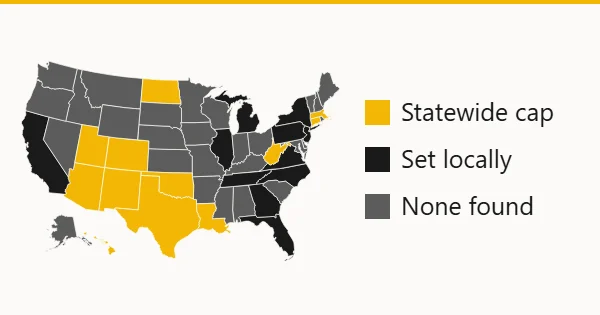
We found no statewide limit on towing or storage fees in Vermont's laws and official sources. Sources: [31] [33] [6] [4] [5] [13] [34] · verified Oct 28, 2026
We also found no statewide deadline to request a hearing. Sources: [68] [71] [74] [72] [75] [76] [77] [78] · verified Oct 28, 2026
Statewide fees that do apply are in the fee table below.
- Regulator
- No single statewide towing regulator found.
- Key laws
- 23 V.S.A. §§ 2151 to 2158 Abandoned motor vehicles: definition (48 hours without consent), removal from public and private property, DMV certification within 90 days, owner notice, 21 days to reclaim, title to the certificate holder, private-property tow fee and storage rules, $250 limit for public-property tows
- 23 V.S.A. § 2158 Fee of up to $250 for towing an abandoned vehicle from public property, paid by the State when the certificate of abandoned motor vehicle issues (amended by Act 153 of 2026, effective July 1, 2026)
- 23 V.S.A. § 2084(c) Businesses that store vehicles for the public must report a vehicle unclaimed for 30 days to the DMV within five days, or lose their claims and liens for storage
- 23 V.S.A. § 1102 Police removal of stopped, obstructing, stolen and arrest-related vehicles from highways; owner's choice of towing operator; owner and motor carrier pay reasonable costs
- 23 V.S.A. §§ 1751 to 1753 Town towing of vehicles parked against parking ordinances (where adopted by town voters) and municipal ordinances on removal from public and private land, with reasonable towing and storage charges set by the municipality
- 23 V.S.A. §§ 1213a to 1213c Court-ordered immobilization (second DUI conviction) and forfeiture (third DUI conviction) of vehicles; hearing and innocent-owner protection
- 23 V.S.A. § 674 Driving while suspended or revoked: plate removal; immobilization or forfeiture after repeat convictions for driving while suspended for DUI
- 9 V.S.A. §§ 1951 to 1954 Artisan's lien for repairs made at the owner's request; sale at public auction after three months; notice; disputing the charges
Estimate your bill in Vermont
The most a lot can legally charge you under Vermont's statewide rules, line by line. Where a fee is set locally, enter the rate the lot quoted.
Fees in Vermont
| Fee | Applies to | Amount | Conditions and source |
|---|---|---|---|
| Police-ordered tow fee | Police / non-consent | No statewide figure foundNo statewide rule found | Vermont law sets no dollar amount for a police-ordered tow from a highway. The vehicle owner and the motor carrier, if any, are responsible for the reasonable costs of the removal and disposition. You may choose the towing operator, in consultation with the officer, unless that operator cannot arrive in time and the vehicle is a hazard, blocks traffic or cannot legally stay where it is. Towns may set the amount for tows under town parking ordinances. Ask the towing company for its rates in writing.Sources: Vermont General Assembly, Vermont Statutes Online [6] [4] [5] [13]; Office of the Vermont Attorney General [34] · verified Oct 28, 2026 |
| Towing an abandoned vehicle from public property (State payment) | Police / non-consent | Up to $250Statewide maximum, effective Jul 1, 2026 | A towing service may charge up to $250 for towing an abandoned vehicle from public property under the abandoned-vehicle law. The fee is paid by the State to the towing service when the DMV issues a certificate of abandoned motor vehicle (or to the Agency of Transportation when it paid for a tow from a State right-of-way). An owner who reclaims the vehicle pays the towing and storage charges the abandoned-vehicle law permits. The limit was $125 before July 1, 2026.Sources: Vermont General Assembly, Vermont Statutes Online [35] [36] [37] [39]; Vermont General Assembly, Acts and Resolves [38]; Office of the Vermont Attorney General [34] · verified Oct 28, 2026 |
| Private-property tow fee | Private property | No statewide figure foundNo statewide rule found | No dollar limit. For towing an abandoned vehicle from private property, a towing service may charge a reasonable fee, paid by the vehicle owner or the landowner. Where a town, village or city has an ordinance on removing vehicles parked without authorization, the municipality sets reasonable towing and storage charges.Sources: Vermont General Assembly, Vermont Statutes Online [31] [33] · verified Oct 28, 2026 |
| Towing and storage under a town or city ordinance | Police / non-consent, Private property | Set locally — ask the lot or your citySet locally | Towns, villages and cities may adopt ordinances allowing the removal of vehicles parked without authorization on public or private land, including public, municipal and private parking lots, drives and ways. The owner may be required to pay reasonable towing and storage charges set by the municipality's legislative body, which can be secured by a lien on the vehicle and its owner. In towns whose voters have adopted it, town police may tow vehicles parked against a town parking ordinance that interferes with policing, construction, maintenance or snow removal, at the owner's expense in an amount the town sets, if tow-away signs are posted.Sources: Vermont General Assembly, Vermont Statutes Online [32] [33] [13] [14] [15] · verified Oct 28, 2026 |
| Daily storage fee | Police / non-consent, Private property | No statewide figure foundNo statewide rule found | Vermont sets no statewide daily storage rate. For an abandoned vehicle, an owner or lienholder who reclaims it must pay the storage costs, but no storage may be charged for any time before the abandoned-vehicle certification form is sent to the DMV. The Attorney General's 2024 report to the Legislature says towing companies set their own storage fees. A business that stores vehicles for the public must report a vehicle that has been unclaimed for 30 days to the DMV within five days after that period; if it does not, it loses its claims and liens for the storage charges. A vehicle left by an owner whose name and address the business knows does not count as unclaimed.Sources: Vermont General Assembly, Vermont Statutes Online [40] [41] [43] [44] [45]; Office of the Vermont Attorney General [42] · verified Oct 28, 2026 |
Local rates. Vermont delegates much of its towing law to towns and cities. A town, village or city may adopt ordinances allowing the removal of vehicles parked without authorization on public or private land and set reasonable towing and storage charges, secured by a lien. In towns whose voters have adopted it, town police may tow vehicles parked against town parking ordinances at the owner's expense in an amount the town sets, with tow-away signs. The state abandoned-vehicle law does not override municipal abandoned-vehicle ordinances. Ask the town or city police department where the car was towed for the local rules and rates. Sources: Vermont General Assembly, Vermont Statutes Online [32] [33] [13] [14] [15] [79] · verified Oct 28, 2026
Major cities (largest cities in the state, Census Bureau Vintage 2025 estimates): Burlington, South Burlington, Rutland, Essex Junction, Winooski. Where a fee above is set locally, the city or the agency that ordered the tow sets the rate.
Cities we cover
We haven't covered a city in Vermont yet.
Police tow vs. private-property tow
Police-ordered (non-consent) tow
A Vermont enforcement officer may have a vehicle removed from a highway to a garage or other place of safety when it is stopped or parked unlawfully, when an unattended vehicle or its cargo obstructs traffic or highway maintenance, when the officer is reliably told it was stolen, when the person in charge cannot arrange its removal, or when that person has been arrested. The owner or operator may summon the towing operator of their choice, in consultation with the officer, unless that operator cannot arrive in time and the vehicle is a hazard, blocks traffic or may not legally stay where it is. The vehicle owner and the motor carrier, if any, must pay the reasonable costs of the removal and disposition. The officer reports the removal and the place of storage to the Department of Motor Vehicles (DMV), and a vehicle towed this way may be handled as an abandoned vehicle. An officer may also remove an abandoned vehicle from public property on the officer's own observation: a vehicle counts as abandoned after more than 48 hours without the property owner's consent, or at once if it has no valid plate or its identification number has been removed or altered, or if an officer has asked for its removal by a towing business. Towns that have adopted it by vote may have their police tow vehicles parked against a town parking ordinance, at the owner's expense in an amount the town sets, if tow-away signs are posted; a town may also boot a vehicle whose owner has four or more unpaid parking tickets in a calendar year, if the town's legislative body has authorized it, after 15 days' notice by first-class mail. After a second conviction for driving under the influence (DUI), or for driving while suspended for DUI, a court may order the vehicle immobilized; the immobilization ends after 18 months at most, and towing and impoundment costs must be paid before release. After a third such conviction, the court may order the vehicle forfeited and sold, after notice and a hearing. Sources: Vermont General Assembly, Vermont Statutes Online [1] [2] [3] [4] [5] [6] [7] [8] [9] [10] [11] [12] [13] [14] [15] [16] [17] [18] [19] [20] [21] [22] [23] [24] [25] [26] · verified Oct 28, 2026
Private-property tow
Vermont's state law on towing from private property covers abandoned vehicles: a vehicle left on private property for more than 48 hours without the consent of the owner or person in control of the property, or for any time if it has no valid plate or its identification number has been removed or altered. The landowner may move such a vehicle elsewhere on its property or have it towed, without civil liability to the vehicle's owner, and must immediately notify the police agency for the area with the plate number, the identification number if available, and the make, model and color. A police officer may also remove it at the landowner's request. A towing service may charge a reasonable fee, paid by the vehicle owner or the landowner. Towns, villages and cities may adopt ordinances allowing the removal of vehicles parked without authorization on public or private land, including private parking lots, and may set reasonable towing and storage charges, which can be secured by a lien on the vehicle. We found no statewide rule on warning signs in private lots, and no statewide limit on private-property towing fees. Sources: Vermont General Assembly, Vermont Statutes Online [10] [12] [27] [28] [29] [30] [31] [32] [33]; Office of the Vermont Attorney General [34] · verified Oct 28, 2026
How to get your car back, step by step
- Find out who has the car. If police had it towed from a highway, call the police agency: the officer reports the towing service and the place of storage to the DMV. If it was towed from private property, the landowner must have notified the local police. Sources: Vermont General Assembly, Vermont Statutes Online [7] [28] · verified Oct 28, 2026
- If the car was treated as abandoned, check the DMV's list of current abandoned-vehicle title applications, and watch for the DMV's certified letter, which tells you where the vehicle is and gives a phone number. Sources: Vermont General Assembly, Vermont Statutes Online [69] [51]; Vermont Department of Motor Vehicles (Agency of Transportation) [70] · verified Oct 28, 2026
- Ask the towing company for its towing and storage charges in writing. For an abandoned vehicle, no storage may be charged for the time before the certification form was sent to the DMV. Sources: Office of the Vermont Attorney General [67]; Vermont General Assembly, Vermont Statutes Online [41] · verified Oct 28, 2026
- Reclaim an abandoned vehicle quickly: within 21 days after the DMV's second notice, show the DMV satisfactory evidence of ownership and pay, or arrange to pay, the permitted towing and storage charges. After that, title can pass to the holder of the certificate of abandoned motor vehicle. Sources: Vermont General Assembly, Vermont Statutes Online [54] [39] [55] [57] · verified Oct 28, 2026
- If a court ordered the car immobilized after a DUI conviction, it is released when the order expires and the towing and impoundment costs are paid in full. Sources: Vermont General Assembly, Vermont Statutes Online [20] [19] · verified Oct 28, 2026
- If you think the charges are unfair, contact the Attorney General's Consumer Assistance Program (800-649-2424), which offers a complaint mediation service, or sue in small claims court for up to $10,000. Sources: Office of the Vermont Attorney General [68] [71]; Vermont General Assembly, Vermont Statutes Online [72] · verified Oct 28, 2026
Documents to bring
Payment methods
We found no Vermont rule requiring towing companies or storage lots to accept credit cards. The Attorney General's 2024 report to the Legislature found no explicit statutory requirements for rate disclosures or billing. Ask which payments the company takes, and ask for its rates in writing, before you go. Source: Office of the Vermont Attorney General [67] · verified Oct 28, 2026
Getting your personal items out
We found no Vermont law giving you a right to collect belongings from a towed car, free or otherwise. The Attorney General's 2024 report to the Legislature says towing companies decide whether to allow access to personal or commercial possessions once a car is impounded. Ask the company before you go, and if it refuses, contact the Attorney General's Consumer Assistance Program. Sources: Office of the Vermont Attorney General [42] [68] · verified Oct 28, 2026
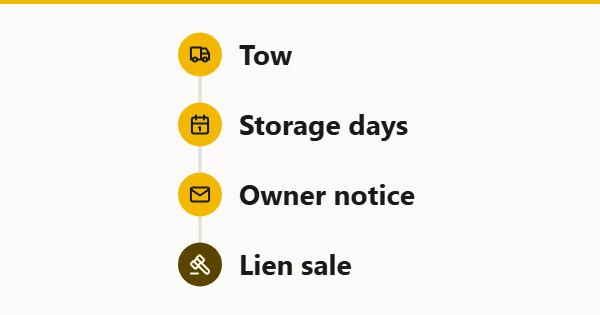
Deadlines: owner notice and lien sale
Notice to the owner
Vermont law does not require the towing company to notify you directly. For an abandoned vehicle, the landowner where the vehicle was found or moved to must apply to the DMV for an abandoned-vehicle certification within 90 days after the date it was discovered or relocated (the DMV's page says the towing service files within 90 days of removal). If the vehicle can be identified by its plate or identification number, the DMV sends notice to the last registered owner and lienholder within three business days after receiving the form. If the return receipt does not come back within seven business days, the DMV sends a second notice. When police tow a vehicle from a highway, the officer reports the removal, the towing service and the place of storage to the DMV. A landowner who has an abandoned vehicle removed must immediately notify the local police. A business that stores vehicles for the public must report a vehicle that has been unclaimed for 30 days to the DMV within five days after that period; if it does not, it loses its claims and liens for the storage charges. Method: Landowner to DMV: abandoned-vehicle certification form VN-012. DMV to owner and lienholder: certified mail, return receipt requested, telling you where the vehicle is and a phone number for more information; second notice by first-class mail. Sources: Vermont General Assembly, Vermont Statutes Online [47] [48] [50] [51] [52] [7] [28] [43] [45]; Vermont Department of Motor Vehicles (Agency of Transportation) [49] [53] · verified Oct 28, 2026
When the vehicle can be sold
21 days after the DMV's second notice to the owner (for a vehicle with no identifiable plate or identification number, the DMV's receipt of the certification form)
Within 21 days after the DMV sends its second notice, the owner or lienholder may reclaim the vehicle by showing the DMV satisfactory evidence of ownership and paying, or arranging to pay, the permitted towing and storage charges. If they do not, the DMV issues a certificate of abandoned motor vehicle with a title or salvage title, and title passes to the holder of the certificate, free of the owner's claims. For a vehicle that cannot be identified, the certificate issues if no owner is found within 21 days after the DMV receives the form. Vermont's abandoned-vehicle law sets no auction: ownership passes to the certificate holder. The Attorney General's office, in its 2024 report to the Legislature, says there is no statutory or common-law basis for a priority lien for a tow without the owner's consent, citing a 2011 trial-court ruling. Separately, a person who repairs a vehicle at the owner's request has a lien for reasonable charges and may sell the vehicle at public auction in the town once the debt has been unpaid for three months, after posting notice in two public places and giving the owner written notice at least 10 days before; any surplus goes to the owner. A town ordinance may impose a lien for its set towing and storage charges. After a DUI immobilization, if the towing and impoundment costs are not paid within 30 days after the order expires, the State may sell the vehicle at public auction. Sources: Vermont General Assembly, Vermont Statutes Online [54] [55] [56] [57] [58] [59] [60] [61] [62] [33] [63]; Office of the Vermont Attorney General [64] [65] [66] · verified Oct 28, 2026
How storage days are counted
Vermont law does not say how a storage day is counted. For an abandoned vehicle, no storage may be charged for any period before the abandoned-vehicle certification form is sent to the DMV. Sources: Vermont General Assembly, Vermont Statutes Online [41]; Vermont Department of Motor Vehicles (Agency of Transportation) [46] · verified Oct 28, 2026
How to dispute a tow or the fees
Where: Office of the Vermont Attorney General, Consumer Assistance Program (complaint mediation); small claims court
Vermont has no towing regulator and no hearing process for towing or storage charges. The Attorney General's Consumer Assistance Program offers a complaint mediation service (800-649-2424, AGO.CAP@vermont.gov), and Vermont's Consumer Protection Act makes unfair or deceptive acts in commerce unlawful. Claims of up to $10,000 can be brought in small claims court. If a repair shop holds your car under its lien and you dispute the charges, you may tender the amount you think is owed within the three months; the shop must then sue within 30 days or its lien ends 30 days after the tender. Court-ordered DUI immobilization or forfeiture is decided at a court hearing where an owner who did not know of or consent to the use can protect the vehicle, and the decision can be appealed to the Supreme Court. We found no deadline for filing a complaint. Sources: Office of the Vermont Attorney General [68] [71]; Vermont General Assembly, Vermont Statutes Online [74] [72] [75] [76] [77] [78] · verified Oct 28, 2026
Official "find my towed car" lookups
- Vermont DMV - Abandoned vehicles (rules, and a search of current abandoned-vehicle title applications)
- Vermont DMV - Abandoned Vehicle Certification form (VN-012)
- Vermont Attorney General - Consumer Assistance Program (complaints and mediation)
- Vermont Attorney General - Towing practices in Vermont (2024 report to the Legislature)
Conflicts and open questions
Where official sources disagree
We show both rather than picking one.
- Who files the abandoned-vehicle form, and when the 90 days start. The statute says the landowner on whose property the abandoned vehicle was discovered, or to whose property it was moved, must apply to the DMV within 90 days after the vehicle was discovered or relocated. The DMV's page says the towing service that removed the vehicle must apply within 90 days of removing it. Either way, no storage may be charged for the time before the form is sent. Sources: [47] [48] [49]
- Who pays the fee for towing an abandoned vehicle from private property. The statute says the reasonable fee for towing an abandoned vehicle from private property is paid by the vehicle owner or the landowner. The DMV's page says the property owner (or person in control of the property) must pay it. The statute's wording controls. Sources: [31] [80]
- Limit for towing an abandoned vehicle from public property. The Attorney General's 2024 report to the Legislature gives a $125 limit for towing from public spaces. Act 153 of 2026 raised the limit to $250 from July 1, 2026; the report predates that change. Sources: [35] [38] [34]
Questions we have not answered from an official source yet
- Vermont sets no statewide dollar limit on police-ordered or private-property towing fees, or on daily storage (apart from the $250 limit for towing abandoned vehicles from public property, which the State pays). Ask the towing company for its rates in writing before you pay, and keep the receipt. Source: [35]
- Vermont law does not say whether an owner who reclaims an abandoned vehicle towed from public property must pay the towing company directly; the law sets the State's payment at up to $250 when the vehicle is not reclaimed. Ask the DMV's abandoned-vehicle office what you must pay. Source: [35]
- Outside town parking ordinances, we found no Vermont law requiring warning signs in private parking lots before a car is towed, or limiting tows of cars parked there for less than 48 hours. Your town or city may have its own ordinance; ask the local police.
- Vermont law has no rule on release hours, after-hours or gate fees, or on what papers you need to collect a car from a towing company (outside the abandoned-vehicle process, where you show the DMV evidence of ownership). Call the company before you go and ask about its hours, fees and what to bring.
- We found no statewide online search for towed vehicles in Vermont. The DMV lists vehicles for which an abandoned-vehicle title application has been filed; for a recent tow, call the police department for the town where the car was parked, or the State Police.
- Apart from court-ordered immobilization or forfeiture after repeat DUI convictions or repeat driving while suspended for DUI, we found no Vermont law that impounds a vehicle for driving without insurance, driving while suspended for other reasons, or a commercial out-of-service order. An officer may remove the plates from a vehicle driven by someone whose license is suspended or revoked. Ask the police agency that took the car what it needs to release it.
- If you sign for the DMV's certified letter about an abandoned vehicle, the law does not say when the 21 days to reclaim it start: it counts them only from the second notice, which is sent when the receipt is not returned. Call the DMV at once.
Guides
-
What is an impound lot? How it works and what it costs
An impound lot is a storage yard that holds towed cars until the owner pays. Here is who runs them, how storage is charged and each state's rules.
Updated
-

Find my towed car: where to look first, state by state
Find my towed car: call the police non-emergency line or the number on the lot's tow-away sign, then try your state's official lookup if it has one.
Updated
-
How much to get a car out of impound? Costs by state
How much to get a car out of impound: the tow, a daily storage charge and any release fees. See each state's limits and a worked example.
Updated
Sources (80)
- 23 V.S.A. § 1102(a)(2) Removal of unattended vehicles obstructing traffic
- 23 V.S.A. § 1102(a)(3)(C) Removal when the person in charge is arrested
- 23 V.S.A. § 1102(a)(3)(A) Removal of stolen vehicles
- 23 V.S.A. § 1102(c)(1) Owner or operator chooses the towing operator
- 23 V.S.A. § 1102(c)(3) Officer may override the owner's choice
- 23 V.S.A. § 1102(d)(1) Owner and motor carrier pay reasonable removal costs
- 23 V.S.A. § 1102(f) Officer notifies DMV of the removal and storage place
- 23 V.S.A. § 1102(f) Vehicle towed by police may become an abandoned vehicle
- 23 V.S.A. § 2152(a) Officer removal of abandoned vehicles from public property
- 23 V.S.A. § 2151(1)(A)(i) Abandoned motor vehicle: more than 48 hours without consent (with valid plate or VIN)
- 23 V.S.A. § 2151(1)(A)(ii)(II) Abandoned at once when a law enforcement officer has asked for removal
- 23 V.S.A. § 2151(1)(A)(ii)(I) Abandoned at once when there is no valid plate or the VIN is removed or altered
- 23 V.S.A. § 1752(a) Town police may tow vehicles parked against a town ordinance; amount set by the municipality
- 23 V.S.A. § 1752(a) Tow-away signs required
- 23 V.S.A. § 1751 Sections 1741-1750 and 1752 apply only after adoption by town voters
- 23 V.S.A. § 1752(b) Immobilization for four or more unpaid parking violations, 15 days' notice
- 23 V.S.A. § 1213a(a) Immobilization after a second DUI conviction
- 23 V.S.A. § 1213a(a) Vehicle seized and immobilized
- 23 V.S.A. § 1213a(d) Immobilization order expires in 18 months
- 23 V.S.A. § 1213a(f) Costs paid before release
- 23 V.S.A. § 1213b Forfeiture after a third DUI conviction
- 23 V.S.A. § 1213b Forfeiture and sale after notice and hearing
- 23 V.S.A. § 674(h) Immobilization after a second conviction for driving while suspended for DUI
- 23 V.S.A. § 674(h) Forfeiture after a third conviction
- 23 V.S.A. § 674(b) Driving while suspended or revoked for DUI
- 23 V.S.A. § 1752(b) Boot only if authorized by the local legislative body
- 23 V.S.A. § 2152(b)(2) Landowner may remove an abandoned vehicle or have it towed
- 23 V.S.A. § 2152(b)(2) Landowner must immediately notify the police
- 23 V.S.A. § 2152(b)(2) No civil liability to the owner for the removal
- 23 V.S.A. § 2152(b)(1) Officer removal from private property at the landowner's request
- 23 V.S.A. § 2155(a) Reasonable fee for towing an abandoned vehicle from private property
- 23 V.S.A. § 1753 Municipal ordinances authorizing removal from public and private land
- 23 V.S.A. § 1753 Reasonable towing and storage charges set by the municipality; lien
- Attorney General towing report (2024): tow operators set their own rates; $125 public-property limit (before Act 153)
- 23 V.S.A. § 2158(a)(1) Up to $250 for towing an abandoned vehicle from public property
- 23 V.S.A. § 2158(a)(2)(A) Fee paid to the towing service when the certificate of abandoned motor vehicle issues
- 23 V.S.A. § 2158(a)(3) State payment for vehicles removed from public property
- Act 153 of 2026 (S.326) Sec. 31 Effective date (amends 23 V.S.A. §§ 2158 and 2154)
- 23 V.S.A. § 2154(b) Reclaiming: evidence of ownership and payment of permitted towing and storage
- 23 V.S.A. § 2155(b) Owner or lienholder reclaiming pays storage costs
- 23 V.S.A. § 2155(b) No storage fee before the certification form is sent
- Attorney General, Report to the Legislature on Towing Practices in Vermont (Jan. 30, 2024): storage fees and access to belongings
- 23 V.S.A. § 2084(c) Storage business must report a vehicle unclaimed for 30 days to the DMV within five days
- 23 V.S.A. § 2084(c) A vehicle left by an owner whose name and address are known is not unclaimed
- 23 V.S.A. § 2084(c) Failure to report forfeits claims and liens for storage
- DMV Abandoned Vehicles page: no storage fee before the form is sent
- 23 V.S.A. § 2153(a) Certification application within 90 days
- 23 V.S.A. § 2153(a) The landowner where the vehicle was found or relocated applies
- DMV Abandoned Vehicles page: towing service applies within 90 days of removal
- 23 V.S.A. § 2154(a)(2) DMV notice to owner and lienholder within three business days
- 23 V.S.A. § 2154(a)(2) Notice by certified mail, return receipt requested
- 23 V.S.A. § 2154(a)(2) Second notice by first-class mail
- DMV form VN-012 Abandoned Vehicle Certification (form page)
- 23 V.S.A. § 2154(a)(2) 21 days after the second notice to reclaim
- 23 V.S.A. § 2154(a)(2) Certificate of abandoned motor vehicle if not reclaimed
- 23 V.S.A. § 2154(a)(1) Unidentifiable vehicles: certificate if no owner found within 21 days
- 23 V.S.A. § 2156(a) Title passes to the certificate holder
- 9 V.S.A. § 1951 Artisan's lien (repairs at the owner's request)
- 9 V.S.A. § 1952 Sale at public auction after three months unpaid
- 9 V.S.A. § 1952 Sale notice posted 10 days before
- 9 V.S.A. § 1953 Written notice of sale to the owner 10 days before
- 9 V.S.A. § 1952 Surplus to the owner
- 23 V.S.A. § 1213a(f) Public auction if costs unpaid 30 days after the order expires
- Attorney General towing report (2024): no statutory or common-law basis for a priority lien
- Attorney General towing report (2024), quoting a 2011 Superior Court decision on liens for tows without consent
- Attorney General towing report (2024): citation of the 2011 decision (Champlain Valley RV Rentals v. Collision Unlimited)
- Attorney General towing report (2024): no statutory rate-disclosure, billing or release rules
- Attorney General Consumer Assistance Program: complaint mediation
- 23 V.S.A. § 2154(a)(3) DMV website list of abandoned-vehicle applications
- DMV Abandoned Vehicles page: search of current abandoned-vehicle title applications
- Attorney General Consumer Assistance Program: contact
- 12 V.S.A. § 5531(a) Small claims up to $10,000
- DMV Abandoned Vehicles page: reclaiming with evidence of ownership
- 9 V.S.A. § 2453(a) Unfair or deceptive acts in commerce are unlawful
- 9 V.S.A. § 1954 Owner may tender and dispute the charges
- 23 V.S.A. § 1213c(d) Court hearing on immobilization or forfeiture
- 23 V.S.A. § 1213c(g) Innocent owner or operator protection
- 23 V.S.A. § 1213c(k) Appeal to the Supreme Court
- 23 V.S.A. § 2157 Municipal abandoned-vehicle ordinances not preempted
- DMV Abandoned Vehicles page: who pays the private-property tow fee
Spotted an outdated figure? Tell us. See how we verify.