
Connecticut towing laws and impound fees
We haven't covered a city in Connecticut yet.
Informational only, not legal advice. Fees change and many are set by cities or counties. Confirm the current amount with the tow lot or the agency that ordered the tow.
On this page
Upcoming change
From Jan 1, 2027: From January 1, 2027, the maximum private-property tow charge for a light-duty vehicle rises from $130.63 to $136.51 (and to $142.65 on January 1, 2028). Source: Connecticut Department of Motor Vehicles (Administrative Hearings Section) [45] · verified Oct 27, 2026
From Jan 1, 2027: From January 1, 2027, the DMV must run a free public website where anyone can search whether a vehicle has been towed or taken by police and where it is stored. Tow companies must report each tow there within 48 hours. Sources: Connecticut General Assembly - Public Act 26-24 (2026) [130] [165] [166] · verified Oct 27, 2026
At a glance
- Private-property tow (light-duty)
-
Up to $130.63
DMV statewide maximum for 2026. Includes the trip to the scene, the first two loaded miles, preparing the vehicle, up to 15 minutes of waiting, clean-up and the release of the vehicle. No fuel surcharge is allowed, and no extra charge for night, weekend or holiday tows or for an extra person on a private-property tow. The maximum rises to $136.51 on January 1, 2027 and $142.65 on January 1, 2028. No tow company may charge more than the DMV schedule or charge for services not in it.Sources: Connecticut Department of Motor Vehicles (Administrative Hearings Section) [45]; Connecticut General Assembly - General Statutes of Connecticut (2026 Supplement) [46]; Connecticut Department of Motor Vehicles [47] [48] [52]; Connecticut Secretary of the State - eRegulations (Regulations of Connecticut State Agencies, Department of Motor Vehicles) [49] [50]; Connecticut General Assembly - Public Act 26-24 (2026) [51] · verified Oct 27, 2026 - Police / non-consent tow (light-duty)
-
Up to $200 / hour
DMV statewide maximum base hourly rate for police-ordered tows, posted as effective June 2, 2026. One-hour minimum, then 15-minute steps. Billed from the time the tow truck sets off for the scene until it reaches the nearest storage lot, and includes securing the vehicle, transport, scene restoration and up to 15 minutes of waiting. A light-duty tow without winching is presumed to take less than one hour and one worker; anything longer must be explained in writing. No tow company may charge more than the schedule or for services not in it. The rates may be raised each January for inflation in the second and third years of the three-year schedule.Sources: Connecticut Department of Motor Vehicles [69] [70] [71] [72] [73] [74]; Connecticut General Assembly - Public Act 26-24 (2026) [20] [51] [75] · verified Oct 27, 2026 - Daily storage (private-property tow)
-
Up to $30 / day
DMV statewide maximum for days 1 to 5; $37 per day after 5 days. Applies to all nonconsensual tows. Storage rates depend on the vehicle's length and the type of storage, not on its weight.Sources: Connecticut Department of Motor Vehicles (Administrative Hearings Section) [84] [85]; Connecticut General Assembly - General Statutes of Connecticut (2026 Supplement) [86] · verified Oct 27, 2026 - Daily storage (police tow)
-
Up to $30 / day
DMV statewide maximum for days 1 to 5; $37 per day after 5 days. Applies to all nonconsensual tows. Storage rates depend on the vehicle's length and the type of storage, not on its weight.Sources: Connecticut Department of Motor Vehicles (Administrative Hearings Section) [84] [85]; Connecticut General Assembly - General Statutes of Connecticut (2026 Supplement) [86] · verified Oct 27, 2026 - Sale process can start
-
30 days after the start of storage
Sources: Connecticut General Assembly - Public Act 26-24 (2026) [108] [110] [111] [112] [113] [114] [115] [116] [117] [118] [119] [120] [121] [122] [123] [127] [128] [129] [130]; Connecticut General Assembly - General Statutes of Connecticut (2026 Supplement) [109] [124] [125] [126] · verified Oct 27, 2026 - Deadline to request a hearing
-
10 days
Sources: Connecticut General Assembly - Public Act 26-24 (2026) [103] [122] [3] [149]; Connecticut Department of Motor Vehicles [150] [148] [161]; Connecticut General Assembly - General Statutes of Connecticut (2026 Supplement) [151] [152] [153] [155] [158] [159] [160]; Connecticut Secretary of the State - eRegulations (Regulations of Connecticut State Agencies, Department of Motor Vehicles) [154] [156] [157] · verified Oct 27, 2026
- Regulator
- Connecticut Department of Motor Vehicles (DMV) - licenses tow companies (wrecker services), sets the statewide maximum rates for tows made without the owner's consent and investigates complaints Sources: Connecticut Department of Motor Vehicles [1]; Connecticut General Assembly - General Statutes of Connecticut (2026 Supplement) [2]; Connecticut General Assembly - Public Act 26-24 (2026) [3] · verified Oct 27, 2026
- Key laws
- C.G.S. 14-66 to 14-66g Wreckers: registration, nonconsensual towing defined, storage lots, release and payment, records, DMV rate schedules for private-property and police-ordered tows, Police-Ordered Towing Council, consumer bill of rights
- C.G.S. 14-145 to 14-145e Towing from private property: written authorization, photographs, drop fee, police notice, signs at parking facilities, property owner liability
- C.G.S. 14-150 and 14-150c Abandoned, unregistered and hazardous vehicles: removal, notice, hearing; lien and sale of towed vehicles
- Public Act 26-24, sections 29 to 43 2026 towing changes, signed May 27, 2026 and not yet in a compiled supplement: rate-schedule changes in effect since then; sale, notice and complaint changes since October 1, 2026; towed-vehicle search portal from January 1, 2027
- C.G.S. 7-282g Driver's choice of tow company after a crash or breakdown (as amended by Public Act 26-24, section 36, effective October 1, 2026)
- C.G.S. 14-307 Town traffic authority removal of illegally parked vehicles
- C.G.S. 14-12h and 14-36i Police impounds: suspended registration, young drivers
- C.G.S. 14-222 Reckless driving; 48-hour impound after a repeat arrest for driving over 100 mph
- C.G.S. 14-227h 48-hour impound after an arrest for impaired driving while the license is suspended or revoked
- RCSA 14-63-34 to 14-63-37b DMV rules for wrecker services: storage charges, permitted charges, release, emergency access
- RCSA 14-150-1 to 14-150-4 and 14-307-1 to 14-307-8 Hearings on police and traffic-authority tows; notice to owners and lienholders
Estimate your bill in Connecticut
The most a lot can legally charge you under Connecticut's statewide rules, line by line. Where a fee is set locally, enter the rate the lot quoted.
Fees in Connecticut
| Fee | Applies to | Amount | Conditions and source |
|---|---|---|---|
| Private-property tow, light-duty vehicle (under 10,000 lb) | Private property | Up to $130.63Statewide maximum, effective Jan 1, 2026 | DMV statewide maximum for 2026. Includes the trip to the scene, the first two loaded miles, preparing the vehicle, up to 15 minutes of waiting, clean-up and the release of the vehicle. No fuel surcharge is allowed, and no extra charge for night, weekend or holiday tows or for an extra person on a private-property tow. The maximum rises to $136.51 on January 1, 2027 and $142.65 on January 1, 2028. No tow company may charge more than the DMV schedule or charge for services not in it.Sources: Connecticut Department of Motor Vehicles (Administrative Hearings Section) [45]; Connecticut General Assembly - General Statutes of Connecticut (2026 Supplement) [46]; Connecticut Department of Motor Vehicles [47] [48] [52]; Connecticut Secretary of the State - eRegulations (Regulations of Connecticut State Agencies, Department of Motor Vehicles) [49] [50]; Connecticut General Assembly - Public Act 26-24 (2026) [51] · verified Oct 27, 2026 |
| Private-property tow, medium-duty vehicle (10,000 to 26,000 lb) | Private property | Up to $200Statewide maximum, effective Jan 1, 2026 | DMV statewide maximum, January 1, 2026 to December 31, 2028. Includes the trip to the scene and the first two loaded miles. No fuel surcharge.Sources: Connecticut Department of Motor Vehicles (Administrative Hearings Section) [53]; Connecticut Department of Motor Vehicles [47] [48] [52] · verified Oct 27, 2026 |
| Private-property tow, heavy-duty vehicle (over 26,000 lb) | Private property | Up to $350Statewide maximum, effective Jan 1, 2026 | DMV statewide maximum, January 1, 2026 to December 31, 2028. Includes the trip to the scene and the first two loaded miles. No fuel surcharge.Sources: Connecticut Department of Motor Vehicles (Administrative Hearings Section) [54]; Connecticut Department of Motor Vehicles [47] [48] [52] · verified Oct 27, 2026 |
| Mileage after the first two miles, private-property tow, light-duty | Private property | Up to $6.65 / mileStatewide maximum, effective Jan 1, 2026 | Per loaded mile after the first two. At most 13 extra miles may be charged, so mileage can total no more than $86.45.Sources: Connecticut Department of Motor Vehicles (Administrative Hearings Section) [55]; Connecticut General Assembly - General Statutes of Connecticut (2026 Supplement) [56] · verified Oct 27, 2026 |
| Mileage after the first two miles, private-property tow, medium-duty | Private property | Up to $8.65 / mileStatewide maximum, effective Jan 1, 2026 | Per loaded mile after the first two, for at most 13 extra miles ($112.45 at most).Sources: Connecticut Department of Motor Vehicles (Administrative Hearings Section) [57]; Connecticut General Assembly - General Statutes of Connecticut (2026 Supplement) [56] · verified Oct 27, 2026 |
| Mileage after the first two miles, private-property tow, heavy-duty | Private property | Up to $10.65 / mileStatewide maximum, effective Jan 1, 2026 | Per loaded mile after the first two, for at most 13 extra miles ($138.45 at most).Sources: Connecticut Department of Motor Vehicles (Administrative Hearings Section) [58]; Connecticut General Assembly - General Statutes of Connecticut (2026 Supplement) [56] · verified Oct 27, 2026 |
| Additional labor, private-property tow, light-duty (winching or exceptional services only) | Private property | Up to $50 / hourStatewide maximum, effective Jan 1, 2026 | Only if winching or exceptional services (special equipment such as cutting torches or air compressors) were needed. Billed in 15-minute steps of $12.50. The charges must be documented and itemized.Sources: Connecticut Department of Motor Vehicles (Administrative Hearings Section) [59]; Connecticut Department of Motor Vehicles [60]; Connecticut Secretary of the State - eRegulations (Regulations of Connecticut State Agencies, Department of Motor Vehicles) [61] · verified Oct 27, 2026 |
| Additional labor, private-property tow, medium-duty and heavy-duty (exceptional services only) | Private property | $150–$175 / hourStatewide maximum, effective Jan 1, 2026 | $150 per hour for medium-duty vehicles (15-minute steps of $37.50) and $175 per hour for heavy-duty vehicles (15-minute steps of $43.75), only for exceptional services. The charges must be documented.Sources: Connecticut Department of Motor Vehicles (Administrative Hearings Section) [62] [63]; Connecticut Department of Motor Vehicles [60] · verified Oct 27, 2026 |
| Drop fee (vehicle hooked up but not yet removed from the property) | Private property | Up to $50Statewide maximum, effective Jan 1, 2026 | If you return before your vehicle is hooked up, the tow must stop and nothing may be charged once you move the vehicle or fix the reason for the tow. If it is hooked up but still on the property, the company must release it on payment of the drop fee, by cash or credit or debit card, and give you a receipt. $50 for light-duty vehicles, $125 for medium-duty and $175 for heavy-duty (2026 to 2028).Sources: Connecticut Department of Motor Vehicles (Administrative Hearings Section) [64] [65]; Connecticut General Assembly - General Statutes of Connecticut (2026 Supplement) [66] [67] [68] · verified Oct 27, 2026 |
| Police-ordered tow, light-duty vehicle (under 10,000 lb), per hour | Police / non-consent | Up to $200 / hourStatewide maximum, effective Jun 2, 2026 | DMV statewide maximum base hourly rate for police-ordered tows, posted as effective June 2, 2026. One-hour minimum, then 15-minute steps. Billed from the time the tow truck sets off for the scene until it reaches the nearest storage lot, and includes securing the vehicle, transport, scene restoration and up to 15 minutes of waiting. A light-duty tow without winching is presumed to take less than one hour and one worker; anything longer must be explained in writing. No tow company may charge more than the schedule or for services not in it. The rates may be raised each January for inflation in the second and third years of the three-year schedule.Sources: Connecticut Department of Motor Vehicles [69] [70] [71] [72] [73] [74]; Connecticut General Assembly - Public Act 26-24 (2026) [20] [51] [75] · verified Oct 27, 2026 |
| Police-ordered tow, medium-duty vehicle (10,000 to 26,000 lb), per hour | Police / non-consent | Up to $617.50 / hourStatewide maximum, effective Jun 2, 2026 | DMV statewide maximum base hourly rate, one-hour minimum, then 15-minute steps of $154.38.Sources: Connecticut Department of Motor Vehicles [69] [70] [74] · verified Oct 27, 2026 |
| Police-ordered tow, heavy-duty vehicle (over 26,000 lb), per hour | Police / non-consent | Up to $1,275 / hourStatewide maximum, effective Jun 2, 2026 | DMV statewide maximum base hourly rate, one-hour minimum, then 15-minute steps of $318.75. Oversize or overweight vehicles: $1,950 per hour (15-minute steps of $487.50).Sources: Connecticut Department of Motor Vehicles [69] [70] [74] · verified Oct 27, 2026 |
| Winching, police-ordered tow, light-duty (vehicle off the paved road), per hour | Police / non-consent | Up to $200 / hourStatewide maximum, effective Jun 2, 2026 | Only for a vehicle off the paved portion of the road. No minimum; billed in $50 steps of 15 minutes. Medium-duty $500, heavy-duty $760 and oversize $1,150 per hour. Must be documented.Sources: Connecticut Department of Motor Vehicles [76] [72]; Connecticut General Assembly - Public Act 26-24 (2026) [20] · verified Oct 27, 2026 |
| Additional labor, police-ordered tow, light-duty, per hour | Police / non-consent | Up to $85.50 / hourStatewide maximum, effective Jun 2, 2026 | Labor not included in the base hourly rate; must be documented and justified in writing. One-hour minimum, then 15-minute steps of $21.37. Medium-duty $142.50, heavy-duty $166.25 and oversize $250 per hour.Sources: Connecticut Department of Motor Vehicles [77] [78] [73] · verified Oct 27, 2026 |
| Dolly or wheel lift, police-ordered tow, light-duty | Police / non-consent | Up to $50Statewide maximum, effective Jun 2, 2026 | Only when the vehicle cannot be towed from the front or rear. The DMV schedule also lists $100 for an electric-vehicle dolly and hourly rates for specialized equipment used on larger incidents.Sources: Connecticut Department of Motor Vehicles [79] [80] · verified Oct 27, 2026 |
| Administrative services fee, police-ordered tow | Police / non-consent | Up to 5%Statewide maximum | 5% of the total invoice, capped at $675, as posted on the DMV's police-ordered rate schedule (form K-11a). Covers paperwork, photos and video, mailing records, access to the vehicle during normal business hours for owners and insurers, and the release procedure. The notice of tow must warn that this charge is added at the time of release.Sources: Connecticut Department of Motor Vehicles [81] [82]; Connecticut General Assembly - Public Act 26-24 (2026) [83] · verified Oct 27, 2026 |
| Daily storage, vehicle under 20 feet, inside a building | Police / non-consent, Private property | Up to $30 / dayStatewide maximum, effective Jan 1, 2026 | DMV statewide maximum for days 1 to 5; $37 per day after 5 days. Applies to all nonconsensual tows. Storage rates depend on the vehicle's length and the type of storage, not on its weight.Sources: Connecticut Department of Motor Vehicles (Administrative Hearings Section) [84] [85]; Connecticut General Assembly - General Statutes of Connecticut (2026 Supplement) [86] · verified Oct 27, 2026 |
| Daily storage, vehicle under 20 feet, outside in a fenced, lighted and protected lot | Police / non-consent, Private property | Up to $26 / dayStatewide maximum, effective Jan 1, 2026 | DMV statewide maximum for days 1 to 5; $31 per day after 5 days. Applies to all nonconsensual tows.Sources: Connecticut Department of Motor Vehicles (Administrative Hearings Section) [84] [85]; Connecticut General Assembly - General Statutes of Connecticut (2026 Supplement) [86] · verified Oct 27, 2026 |
| Daily storage, vehicle under 20 feet, outside (open lot) | Police / non-consent, Private property | Up to $23 / dayStatewide maximum, effective Jan 1, 2026 | DMV statewide maximum for days 1 to 5; $25 per day after 5 days. Applies to all nonconsensual tows.Sources: Connecticut Department of Motor Vehicles (Administrative Hearings Section) [84] [85]; Connecticut General Assembly - General Statutes of Connecticut (2026 Supplement) [86] · verified Oct 27, 2026 |
| Daily storage, vehicle 20 to 32 feet | Police / non-consent, Private property | $30–$50 / dayStatewide maximum, effective Jan 1, 2026 | Days 1 to 5: inside $42, fenced and lighted $36, open lot $30. After 5 days: inside $50, fenced and lighted $39, open lot $32.Sources: Connecticut Department of Motor Vehicles (Administrative Hearings Section) [87] [85] [84] · verified Oct 27, 2026 |
| Daily storage, vehicle over 32 feet | Police / non-consent, Private property | $36–$65 / dayStatewide maximum, effective Jan 1, 2026 | Days 1 to 5: inside $51.60, fenced and lighted $42, open lot $36. After 5 days: inside $65, fenced and lighted $48, open lot $40.Sources: Connecticut Department of Motor Vehicles (Administrative Hearings Section) [88] [85] [84] · verified Oct 27, 2026 |
| After-hours redemption fee | Police / non-consent, Private property | Up to $50Statewide maximum, effective Jan 1, 2026 | Only if the vehicle is released outside the hours of operation the company files with the DMV, which must include at least 8 a.m. to 5 p.m., Monday to Friday. No after-hours fee may be charged if the company is open after those hours and has a regularly scheduled employee on site who can release the vehicle. $125 for medium-duty and $175 for heavy-duty vehicles. A release during business hours carries no fee.Sources: Connecticut Department of Motor Vehicles (Administrative Hearings Section) [89] [65]; Connecticut General Assembly - General Statutes of Connecticut (2026 Supplement) [90] [91]; Connecticut Secretary of the State - eRegulations (Regulations of Connecticut State Agencies, Department of Motor Vehicles) [92] [93] [94] [95] · verified Oct 27, 2026 |
Local rates. Connecticut has one statewide schedule of maximum rates for tows made without the owner's consent, set by the DMV; towns do not set their own tow or storage rates. Towns appoint the hearing officers for contested police tows, may run rotation lists of tow companies for police calls, and may remove vehicles parked against local parking rules. The DMV does not regulate the price of a tow you request yourself. Sources: Connecticut Department of Motor Vehicles (Administrative Hearings Section) [162]; Connecticut Department of Motor Vehicles [1] [163]; Connecticut General Assembly - General Statutes of Connecticut (2026 Supplement) [151]; Connecticut General Assembly - Public Act 26-24 (2026) [19]; Connecticut General Assembly - General Statutes of Connecticut (revised to January 1, 2025) [8] · verified Oct 27, 2026
Major cities (largest cities in the state, Census Bureau Vintage 2025 estimates): Bridgeport, Stamford, New Haven, Hartford, Waterbury. Where a fee above is set locally, the city or the agency that ordered the tow sets the rate.
Cities we cover
We haven't covered a city in Connecticut yet.
Police tow vs. private-property tow
Police-ordered (nonconsensual) tow
A tow ordered by a police officer, a DMV inspector, a parking authority or a town traffic authority. Officers must remove a vehicle they find to be a menace to traffic or to public health or safety. A vehicle that appears abandoned or has no proper registration first gets a sticker, and is towed and stored at the owner's expense if it is not moved within 24 hours. Towns may also remove vehicles parked against local parking rules. Police also impound vehicles in these cases: for 48 hours after an arrest for impaired driving while the driver's license is suspended or revoked; for 48 hours after a repeat arrest for driving over 100 mph; when the vehicle shows registration plates listed as suspended (for example for lack of insurance), released only on a valid registration and a current insurance card and forfeited to the state if not reclaimed within 45 days; and when a 16- or 17-year-old driver is arrested for certain offenses. After a crash, a municipal police officer must ask a driver who is present whether they want to choose the tow company, which must be on the town's rotation list if the town keeps one. Police-ordered tows are billed by the hour at no more than the DMV's statewide police-ordered rates. Sources: Connecticut General Assembly - General Statutes of Connecticut (2026 Supplement) [4] [5] [6] [7] [12] [13] [21]; Connecticut General Assembly - General Statutes of Connecticut (revised to January 1, 2025) [8] [9] [10] [11] [14] [15] [16] [17]; Connecticut General Assembly - Public Act 26-24 (2026) [18] [19] [20] · verified Oct 27, 2026
Private-property tow
The property owner, tenant or their agent must sign a DMV written authorization form for each tow. A tow company may sign as the owner's agent only under a written contract, and then only for vehicles parked in a disabled space without a placard, in an emergency-vehicle area, within 10 feet of a hydrant, blocking a building, an entrance, an exit, a parking space or a traffic aisle, leaking a hazardous fluid, or breaking parking rules listed in the contract. At a parking facility, including apartment complexes of five or more units, condominiums and common interest communities, signs must be up at all entrances for at least 48 hours before any tow; they must show the towing symbol, be at least 12 by 18 inches, state the fees and give the tow company's name, address and phone number, and the facility's parking rules must also be posted. No sign is needed for vehicles in a disabled space without a placard, in an emergency area, near a hydrant, blocking access, entrances, spaces or traffic aisles, leaking fluid, or in an area not meant for parking. A non-residential lot without signs may tow after leaving a windshield notice at least 48 hours ahead. Towing only for an expired registration needs a 14-day windshield notice, and towing from a residential lot only for an expired parking permit needs a 72-hour notice. The sign rules do not apply at buildings of four or fewer units. Before hooking up, the tow company must take at least two photos showing the reason for the tow and the vehicle's condition. Property owners may not issue private parking tickets or use wheel boots (private colleges and secondary schools excepted), and tow companies may not pay them for towing rights. The tow company must notify the local police within 2 hours of the tow. Sources: Connecticut General Assembly - General Statutes of Connecticut (2026 Supplement) [22] [23] [24] [25] [26] [27] [28] [29] [30] [31] [32] [33] [34] [35] [36] [37] [38] [39] [40] [41] [42]; Connecticut General Assembly - Public Act 26-24 (2026) [43]; Connecticut Department of Motor Vehicles [44] · verified Oct 27, 2026
How to get your car back, step by step
- Find the vehicle. After a private-property tow, the sign at the lot entrance gives the tow company's name and phone number, and the company must tell the local police within 2 hours where the vehicle is stored. After a police tow, call the police department that ordered it. Sources: Connecticut General Assembly - General Statutes of Connecticut (2026 Supplement) [30]; Connecticut General Assembly - Public Act 26-24 (2026) [43] [101] · verified Oct 27, 2026
- If you get back before the car is hooked up, move it and the tow must stop with no fee. If it is hooked up but still on the property, you can pay the drop fee ($50 for a car) and drive away. Sources: Connecticut General Assembly - General Statutes of Connecticut (2026 Supplement) [66] [67] [68]; Connecticut Department of Motor Vehicles (Administrative Hearings Section) [64] · verified Oct 27, 2026
- Go during the company's posted hours (at least 8 a.m. to 5 p.m., Monday to Friday) to avoid the after-hours fee. Outside those hours, call the company's 24-hour number; it must release the car within 4 hours of your request. Sources: Connecticut General Assembly - General Statutes of Connecticut (2026 Supplement) [91] [134] [135] [90]; Connecticut Secretary of the State - eRegulations (Regulations of Connecticut State Agencies, Department of Motor Vehicles) [94] · verified Oct 27, 2026
- Bring proof of ownership (registration, title, bill of sale or lease) and payment. The company must release the car even if the address on your documents is out of date. If police impounded it for suspended registration plates, you also need a valid registration and a current insurance card. Sources: Connecticut General Assembly - General Statutes of Connecticut (2026 Supplement) [141] [142]; Connecticut General Assembly - General Statutes of Connecticut (revised to January 1, 2025) [15] · verified Oct 27, 2026
- Inspect the car before you pay and take it. You cannot be made to sign a general release of the company's liability. After a private-property tow, ask for free copies of the signed tow authorization and the photos taken before the tow. Sources: Connecticut General Assembly - General Statutes of Connecticut (2026 Supplement) [143] [144] [145] · verified Oct 27, 2026
- Check the bill against the DMV's maximum rates. Pay by cash, credit or debit card and keep the itemized receipt. Sources: Connecticut Department of Motor Vehicles [146]; Connecticut General Assembly - General Statutes of Connecticut (2026 Supplement) [131] [133] · verified Oct 27, 2026
- If you think the tow or the charges were wrong, file a consumer complaint (Form K-35) with the DMV's Consumer Complaint Center; complaints about a police-ordered tow must be filed within two years. After a police or town tow, you can also ask for a hearing within 10 days of the notice of tow. Sources: Connecticut Department of Motor Vehicles [147] [148]; Connecticut General Assembly - Public Act 26-24 (2026) [149] [103] · verified Oct 27, 2026
Documents to bring
- Proof of ownership: the registration, the certificate of title, the bill of sale, the lease or other reasonable proof (the address does not have to be current) Sources: Connecticut General Assembly - General Statutes of Connecticut (2026 Supplement) [141] [142] · verified Oct 27, 2026
- Payment of the towing and storage costs Source: Connecticut General Assembly - General Statutes of Connecticut (2026 Supplement) [141] · verified Oct 27, 2026
- If the cardholder pays by credit or debit card: the cardholder in person, to sign the receipt Source: Connecticut General Assembly - General Statutes of Connecticut (2026 Supplement) [132] · verified Oct 27, 2026
- If police impounded the vehicle for suspended registration plates: a valid registration and a current automobile insurance identification card Source: Connecticut General Assembly - General Statutes of Connecticut (revised to January 1, 2025) [15] · verified Oct 27, 2026
Payment methods
The lot must accept credit cards.
A tow company storing a nonconsensually towed vehicle must accept cash, credit cards and debit cards, and keep enough cash to make change. If you pay by card, the cardholder must come to the office and sign the receipt. You must get an itemized receipt. A drop fee at the scene may also be paid by cash or card. Sources: Connecticut General Assembly - General Statutes of Connecticut (2026 Supplement) [131] [132] [133] [68] · verified Oct 27, 2026
Getting your personal items out
The tow company has no lien on the personal property in your vehicle and may not hold it for any reason. It must let you or someone you authorize take your belongings during its business hours, or within 4 hours of a request made outside those hours through its 24-hour phone line. Property essential to someone's health or welfare must be made available within 4 hours, at no charge, unless police have ordered the vehicle secured for a search warrant or other investigation. Statute does not say whether a fee may be charged for other after-hours access. Sources: Connecticut General Assembly - General Statutes of Connecticut (2026 Supplement) [109] [134] [135]; Connecticut Department of Motor Vehicles [136]; Connecticut Secretary of the State - eRegulations (Regulations of Connecticut State Agencies, Department of Motor Vehicles) [137] [138] [139] [140] · verified Oct 27, 2026
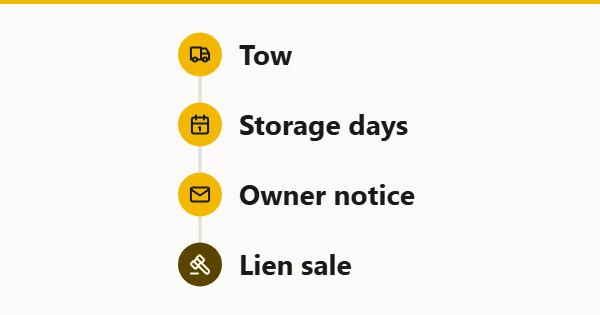
Deadlines: owner notice and lien sale
Notice to the owner
2 days
After a police or parking-authority tow, the agency must send a notice of tow and a copy of the DMV Consumer Bill of Rights within 48 hours after taking the vehicle into custody. After a private-property tow, the tow company must notify the local police within 2 hours; if the vehicle is still unclaimed 48 hours after that, the company must immediately send the DMV notice-of-tow form to the owner and all lienholders. Since October 1, 2026, every notice of tow a tow company mails must include the Consumer Bill of Rights and an itemized bill showing the towing charges and the daily storage rate, with a statement that storage keeps adding up until the vehicle is picked up. Method: Regular mail and certified mail, return receipt requested, to the owner and all lienholders of record. A police notice says the vehicle was taken and where it is stored, that it may be sold, and that the owner may ask for a hearing within 10 days. Sources: Connecticut General Assembly - Public Act 26-24 (2026) [101] [102] [103] [43] [105] [106] [107] [83]; Connecticut Secretary of the State - eRegulations (Regulations of Connecticut State Agencies, Department of Motor Vehicles) [104] · verified Oct 27, 2026
When the vehicle can be sold
30 days after the start of storage
This is when the sale process can start, not the sale: the tow company may send its notice of intent to sell; the sale itself needs DMV approval and a later notice of the sale date, at least 5 business days before it.
The tow company has a lien on the vehicle for its towing and storage charges, but not on the personal property inside it. Since October 1, 2026, once a vehicle has been stored for 30 days the company sends a notice of intent to sell, with the Consumer Bill of Rights, to the DMV, the owner and any lienholder by regular mail; the notice says the vehicle may be redeemed up to the point of sale. The DMV does not approve the sale while a customer complaint against the company is open. After DMV approval, the company mails a notice of proposed sale with the date, time and place, and may sell at least 5 business days later. If your notice of tow came back undeliverable, or you told the company in writing that you no longer own the vehicle or do not want further notices, the company does not have to send you either sale notice, so keep your address current with the DMV. From January 2027 the company must also post each auction notice on the DMV's public towing website. A vehicle less than 15 model years old must be sold at public auction for cash, advertised in a newspaper or on the company's website; the company may set a minimum bid equal to its charges and, if no one bids, may sell or dispose of the vehicle. A vehicle 15 or more model years old may be sold without an auction. Storage charges stop growing: the company may charge only 10 more days after DMV approval on top of the first 30 days. No sale notice may be sent while your hearing application on a police tow is pending, once you have told the company about it. Money left after the charges is held in escrow and paid to you if you claim it within one year, then goes to the state. An abandoned vehicle worth $500 or less that is unusable and has no valid plates becomes town property as soon as police take it, and the town sells it to a recycler; you can claim the net proceeds for one year. Sources: Connecticut General Assembly - Public Act 26-24 (2026) [108] [110] [111] [112] [113] [114] [115] [116] [117] [118] [119] [120] [121] [122] [123] [127] [128] [129] [130]; Connecticut General Assembly - General Statutes of Connecticut (2026 Supplement) [109] [124] [125] [126] · verified Oct 27, 2026
How storage days are counted
Storage starts when the vehicle is put in the storage area, not while it is being towed. If a towing charge was made for bringing the vehicle in, no storage may be charged for the first 8 hours; after 8 hours, storage may be charged from the start. Rates are per 24 hours, and a stay of 12 hours or less may cost no more than half the daily rate. No storage may be charged for a day on which the company does not make the vehicle available for release, or, after a private-property tow, for the time before the company notified the police. If a towing charge was made, no storage charge if picked up within 8 hours; after that, storage can be charged from the start. Sources: Connecticut Secretary of the State - eRegulations (Regulations of Connecticut State Agencies, Department of Motor Vehicles) [96] [97] [98]; Connecticut General Assembly - General Statutes of Connecticut (2026 Supplement) [99]; Connecticut General Assembly - Public Act 26-24 (2026) [100] · verified Oct 29, 2026
How to dispute a tow or the fees
10 days to request a hearing
Where: Hearing officer appointed by the town where the vehicle was towed (police, parking-authority and traffic-authority tows); DMV Consumer Complaint Center (charges and conduct of any tow company); civil court (improper private-property tows and towing damage).
After a tow ordered by police, a parking authority or a town traffic authority, you may contest the tow by filing DMV form A-25 (Request for Hearing Contested Tow) with the hearing officer named in the notice of tow within 10 days from the date of the notice. The hearing officer is appointed by the town and may not be a police officer; tell the tow company you have applied, and it may not start the sale process while the hearing is pending. If the hearing officer finds the vehicle was not a menace to traffic, abandoned or unregistered, you owe nothing and the department that ordered the tow pays the costs or refunds you. The decision is in writing, and either side may appeal to the Superior Court within 15 days. For any nonconsensual tow, you can file a complaint with the DMV's Consumer Complaint Center about excessive or unauthorized charges; complaints about a police-ordered tow must be brought within two years. After an improper private-property tow, the property owner or tenant who ordered it is liable for the towing and storage costs plus reasonable attorney's fees and court costs; if the tow company cannot produce the signed authorization form, the law presumes it had no authorization. The DMV does not handle damage claims; those go to small claims court. Sources: Connecticut General Assembly - Public Act 26-24 (2026) [103] [122] [3] [149]; Connecticut Department of Motor Vehicles [150] [148] [161]; Connecticut General Assembly - General Statutes of Connecticut (2026 Supplement) [151] [152] [153] [155] [158] [159] [160]; Connecticut Secretary of the State - eRegulations (Regulations of Connecticut State Agencies, Department of Motor Vehicles) [154] [156] [157] · verified Oct 27, 2026
Official "find my towed car" lookups
- Connecticut DMV - Towing (maximum rates, procedures, Consumer Bill of Rights)
- Connecticut DMV - Maximum private-property towing charges (form K-11, 2026)
- Connecticut DMV - Maximum police-ordered towing charges (form K-11a)
- Connecticut DMV - Request for Hearing Contested Tow (form A-25)
- Connecticut DMV - File a complaint against a dealer or repairer (including tow companies)
Conflicts and open questions
Where official sources disagree
We show both rather than picking one.
- Police-ordered tow rates and sale timeline in the DMV Consumer Bill of Rights. The DMV's Consumer Bill of Rights (September 2025) still shows the police-ordered tow charges in effect from July 1, 2025 (for example $125 plus mileage for a car) and says a towed vehicle can be sold after 15 or 45 days depending on its value. The DMV's towing page also still describes the older sale procedure (a vehicle worth $1,500 or less after 15 days, a more valuable one held 45 days, with sale notices by certified mail), and says police mail the notice of tow only if the vehicle is still unclaimed after 48 hours, while the law requires the notice within 48 hours of the tow. The DMV has since posted a new police-ordered schedule effective June 2, 2026, which replaced the 2025 rates, and since October 1, 2026 the law starts the sale process after 30 days based on the vehicle's age, with notices by regular mail. We show the newer rates and the current law. Sources: [167] [168] [74] [169] [110] [170] [171] [172] [101]
- Storage rates on the DMV storage posting (form K-88). The storage rate posting linked from the DMV towing page is dated July 1, 2018. Its rates for vehicles under 20 feet match the current schedule, but its rates for vehicles 20 feet and longer are lower than the rates the DMV set from January 1, 2026. We show the 2026 rates. Sources: [173] [87] [88]
- Private-property towing procedure on the DMV towing page. The DMV's towing page says a tow company must keep its record of the police notification for two years and send the notice of tow by certified mail. The law now requires tow records to be kept for three years, and since October 1, 2026 the notice of tow goes by both regular and certified mail. We follow the law. Sources: [174] [175] [106]
Questions we have not answered from an official source yet
- The police-ordered rates shown here are the DMV's posted schedule (form K-11a), which has no printed effective date; the DMV's towing page labels it effective June 2, 2026, and we show no start date for the administrative services fee. Ask the tow company for its posted DMV rate sheet.
- We found no statewide online search for a towed or impounded vehicle in Connecticut before January 2027. Call the police department for the town where the car was parked, or the tow company named on the lot's sign.
- We found no statewide right to a hearing after a private-property tow. You can complain to the DMV about the charges, or sue the property owner for an improper tow.
- The DMV schedule for police-ordered tows may rise each January for inflation in its second and third years. Check the DMV towing page for the current figures.
Guides
-
Impound release form: what it is and where to get it
An impound release form can be a police release, a DMV letter or a signed authorization. See which papers your state lists and how to get them.
Updated
-
Can your car get towed for expired tags? What states say
Can your car get towed for expired tags? See which state rules let police tow for expired registration, the limits on private lots, and what to do next.
Updated
-
What is an impound lot? How it works and what it costs
An impound lot is a storage yard that holds towed cars until the owner pays. Here is who runs them, how storage is charged and each state's rules.
Updated
Sources (175)
- DMV towing page: DMV sets maximum rates for nonconsensual towing and storage
- C.G.S. 14-66(b) only licensed dealers or repairers may operate a wrecker business
- PA 26-24, S. 33 (C.G.S. 14-63(b)(2)) DMV investigates customer complaints about towing
- C.G.S. 14-150(b) officers remove vehicles that are a menace to traffic or safety
- C.G.S. 14-150(a) abandonment: more than 24 hours
- C.G.S. 14-150(c) 24-hour sticker before removing an abandoned or unregistered vehicle
- C.G.S. 14-150(c) sticker on a vehicle that is apparently abandoned or without proper registration
- C.G.S. 14-307(a) town traffic authority may remove illegally parked vehicles
- C.G.S. 14-227h impound for DUI while license suspended or revoked
- C.G.S. 14-227h 48-hour impound
- C.G.S. 14-227h owner reclaims after 48 hours on paying towing and storage
- C.G.S. 14-222(b)(3) 48-hour impound on a repeat arrest for driving over 100 mph
- C.G.S. 14-222(b)(1) driving over 100 mph
- C.G.S. 14-12h(b)(2) police may impound a vehicle with suspended registration plates
- C.G.S. 14-12h(c) release needs valid registration and insurance card
- C.G.S. 14-12h(c) forfeiture if not reclaimed within 45 days
- C.G.S. 14-36i(b) vehicle removed when a 16- or 17-year-old driver is arrested for certain offenses
- PA 26-24, S. 36 (C.G.S. 7-282g(a)) officer asks the driver whether they want to choose a wrecker
- PA 26-24, S. 36 (C.G.S. 7-282g(a)) chosen wrecker must be on the town's rotation list
- PA 26-24, S. 30 (C.G.S. 14-66e(b)(1)) DMV sets a base hourly rate for police-ordered tows by vehicle class
- C.G.S. 14-66(a)(1) definition of nonconsensual towing
- C.G.S. 14-145(b)(1) signed written authorization for each tow
- C.G.S. 14-145(c)(1) wrecker may sign as agent only under a written contract
- C.G.S. 14-145(c)(1) violations a contracted wrecker may tow for on its own signature
- C.G.S. 14-145(c)(1) towing for parking rules listed in the contract
- C.G.S. 14-145e(a)(2) residential parking facility defined
- C.G.S. 14-145e(b)(1) signs up at least 48 hours before towing
- C.G.S. 14-145e(b)(2) wrecker must verify the signs
- C.G.S. 14-145e(c)(1) sign size and towing symbol
- C.G.S. 14-145e(c)(1) sign states fees and the wrecker's contact details
- C.G.S. 14-145e(c)(4) sign listing the parking rules
- C.G.S. 14-145e(d)(7)-(8) no sign needed for leaking vehicles or non-parking areas
- C.G.S. 14-145e(d) sign exceptions
- C.G.S. 14-145e(e) 48-hour windshield notice instead of signs
- C.G.S. 14-145e(e) windshield-notice option not for residential facilities
- C.G.S. 14-145(c)(2) 14-day notice before towing for an expired registration
- C.G.S. 14-145(c)(3) 72-hour notice before towing for an expired residential parking permit
- C.G.S. 14-145e(g) not for dwellings of four or fewer units
- C.G.S. 14-145(d)(1) two photographs before hooking up
- C.G.S. 14-145(b)(2) no private parking citations or monetary sanctions
- C.G.S. 14-145(b)(2) no wheel locks (boots), except at private colleges and secondary schools
- C.G.S. 14-145a no payments to the property owner
- PA 26-24, S. 38 (C.G.S. 14-145(f)(1)(A)) police notified within 2 hours of a private-property tow
- DMV towing page: private-property tows are nonconsensual
- DMV decision (Dec. 1, 2025): light-duty private-property base tow $130.63 in 2026, $136.51 in 2027, $142.65 in 2028
- C.G.S. 14-66d(b) DMV schedule for private-property trespass towing and storage, effective January 1, 2026
- DMV K-11 private-property schedule: what the base tow charge includes
- DMV K-11 private-property schedule (rev. 1-2026): no fuel surcharge
- RCSA 14-63-36c(d) no extra charge for night, weekend or holiday tows
- RCSA 14-63-36b(10) no extra-person charge on private-property tows
- PA 26-24, S. 32 (C.G.S. 14-66d(h)) no charges above the schedule or for services not in it
- DMV private-property schedule: the base tow charge includes two loaded miles
- DMV decision: medium-duty private-property tow $200
- DMV decision: heavy-duty private-property tow $350
- DMV decision: light-duty mileage $6.65 per mile after 2 miles, capped at 13 miles ($86.45)
- C.G.S. 14-66d(c) mileage on private-property tows capped at 13 additional miles
- DMV decision: medium-duty mileage $8.65 per mile, capped at 13 miles
- DMV decision: heavy-duty mileage $10.65 per mile, capped at 13 miles
- DMV decision: light-duty additional labor $50 per hour in 15-minute increments
- DMV K-11 private-property schedule: labor charges only for winching or exceptional services
- RCSA 14-63-36c(c) itemized towing bill given on payment
- DMV decision: medium-duty additional labor $150 per hour
- DMV decision: heavy-duty additional labor $175 per hour
- DMV decision: drop fee $50 for light-duty vehicles
- DMV decision: drop fee and after-hours fee $125 medium-duty, $175 heavy-duty
- C.G.S. 14-145(e)(1) tow must stop if the driver returns before hookup
- C.G.S. 14-145(e)(1) no fee if the vehicle is moved before hookup
- C.G.S. 14-145(e)(2) drop fee payable by cash or card, immediate release
- DMV K-11a police-ordered schedule: base hourly rates by class
- DMV K-11a police-ordered schedule: one-hour minimum, 15-minute increments
- DMV K-11a police-ordered schedule: portal-to-portal billing
- DMV K-11a police-ordered schedule: what the base hourly rate includes
- DMV K-11a police-ordered schedule: a light-duty tow is presumed to take under one hour
- DMV towing page: police-ordered tow schedule (Form K-11a) effective June 2, 2026
- PA 26-24, S. 30 (C.G.S. 14-66e(f)) police-ordered rates rise each January in years two and three
- DMV K-11a police-ordered schedule: hourly winching rates, minimum None
- DMV K-11a police-ordered schedule: additional labor rates
- DMV K-11a police-ordered schedule: additional labor rate, one-hour minimum and 15-minute steps
- DMV K-11a police-ordered schedule: light-duty dolly $50
- DMV K-11a police-ordered schedule: dollies only when the vehicle cannot be towed from front or rear
- DMV K-11a police-ordered schedule: administrative services fee 5% capped at $675
- DMV K-11a police-ordered schedule: administrative fee covers access to the vehicle during business hours
- PA 26-24, S. 41 (C.G.S. 14-66g(c)(3)) storage keeps accruing until redemption
- DMV decision: storage rates for vehicles under 20 feet
- DMV decision: storage rates effective 2026-2028, computed under RCSA 14-63-36
- C.G.S. 14-66d(d) the storage rates and after-hours fee apply to all nonconsensual tows
- DMV decision: storage rates for vehicles 20 to 32 feet
- DMV decision: storage rates for vehicles over 32 feet
- DMV decision: after-hours redemption fee $50 for light-duty vehicles
- C.G.S. 14-66a(c) after-hours redemption fee set by DMV
- C.G.S. 14-66a(a) storage lot open 8 a.m. to 5 p.m., Monday to Friday
- RCSA 14-63-36c(e) no release fee
- RCSA 14-63-37a(b) no after-hours release fee when a scheduled employee who can release the vehicle is on site
- RCSA 14-63-35(b) hours of operation filed with the DMV, including release hours
- RCSA 14-63-35 wrecker services file business information with the DMV
- RCSA 14-63-36 storage starts when the vehicle is deposited in the storage area
- RCSA 14-63-36(a) no storage charge for the first 8 hours after a tow
- RCSA 14-63-36(b) half the daily rate for 12 hours or less
- C.G.S. 14-66a(c) no storage charge on a day the vehicle is not available for release
- PA 26-24, S. 38 (C.G.S. 14-145(f)(1)(A)) no storage charge before police are notified
- PA 26-24, S. 42 (C.G.S. 14-150(e)) police notice within 48 hours of custody
- PA 26-24, S. 42 (C.G.S. 14-150(e)) notice of tow and bill of rights by regular and certified mail
- PA 26-24, S. 42 (C.G.S. 14-150(e)(4)) 10 days to apply for a hearing
- RCSA 14-307-2(b) police agency mails the notice of tow within 48 hours
- PA 26-24, S. 38 (C.G.S. 14-145(f)(1)(B)) notice if unclaimed 48 hours after police notification
- PA 26-24, S. 38 (C.G.S. 14-145(f)(1)(B)) notice of tow by regular and certified mail
- PA 26-24, S. 41 (C.G.S. 14-66g(c)(3)) notice of tow includes the bill of rights and an itemized bill
- PA 26-24, S. 37 (C.G.S. 14-150c(a)) lien for towing and storage
- C.G.S. 14-66a(b) no lien on personal property in the vehicle
- PA 26-24, S. 37 (C.G.S. 14-150c(b)(2)) newer vehicles: 30 days of storage before the sale process
- PA 26-24, S. 37 (C.G.S. 14-150c(b)(1)) vehicles 15 or more model years old
- PA 26-24, S. 38 (C.G.S. 14-145(f)(1)(B)) disposal process may start after 30 days
- PA 26-24, S. 37 (C.G.S. 14-150c(c)(1)) notice of intent to sell now by regular mail
- PA 26-24, S. 37 (C.G.S. 14-150c(c)(1)) vehicle may be redeemed until the sale
- PA 26-24, S. 37 (C.G.S. 14-150c(d)) no sale approval while a DMV complaint is open
- PA 26-24, S. 37 (C.G.S. 14-150c(e)(1)) sale at least 5 business days after the notice of proposed sale
- PA 26-24, S. 37 (C.G.S. 14-150c(b)(2)) public auction at least 5 business days after the notice of proposed sale
- PA 26-24, S. 37 (C.G.S. 14-150c(b)(2)) auction advertised in a newspaper or on the company website
- PA 26-24, S. 37 (C.G.S. 14-150c(b)(2)) minimum bid equal to the charges
- PA 26-24, S. 37 (C.G.S. 14-150c(b)(2)) no bid: may sell or dispose
- PA 26-24, S. 37 (C.G.S. 14-150c(e)(2)) storage limited to 30 days plus 10 days after DMV approval
- PA 26-24, S. 37 (C.G.S. 14-150c(b)(1)) no sale notice while a hearing application is pending
- PA 26-24, S. 37 (C.G.S. 14-150c(c)(1)) surplus held in escrow for the owner
- C.G.S. 14-150(d) junk vehicles worth $500 or less
- C.G.S. 14-150(d) title vests in the municipality
- C.G.S. 14-150(d) net proceeds paid to the former owner if claimed within one year
- PA 26-24, S. 37 (C.G.S. 14-150c(c)(4)(A)) no sale notices to an owner who said in writing they no longer own the vehicle or want no notices
- PA 26-24, S. 37 (C.G.S. 14-150c(c)(4)(B)) no sale notices when the notice of tow came back undeliverable
- PA 26-24, S. 37 (C.G.S. 14-150c(e)) auction notice also submitted to the DMV portal
- PA 26-24, S. 29(a): public towed-vehicle search portal from January 1, 2027
- C.G.S. 14-66a(e) wrecker service must accept cash, credit or debit card
- C.G.S. 14-66a(e) cardholder must appear and sign
- C.G.S. 14-66a(f) itemized receipt
- C.G.S. 14-66a(a) 24-hour telephone number for release requests
- C.G.S. 14-66a(a) release or property access within 4 hours of an after-hours request
- DMV Consumer Bill of Rights: personal property may not be held
- RCSA 14-63-37b(a) access to essential personal property
- RCSA 14-63-37b(b) emergency access within 4 hours
- RCSA 14-63-36c(f) no fee for emergency access
- RCSA 14-63-37b(d) emergency access does not apply to vehicles secured for a search warrant or investigation
- C.G.S. 14-66a(d) release on proof of ownership and payment
- C.G.S. 14-66a(d) a different address on the documents does not block release
- C.G.S. 14-66a(f) right to inspect before redeeming
- C.G.S. 14-66a(f) no general release may be required
- C.G.S. 14-145(d)(2)(A) free copies of the authorization form and photographs
- DMV towing page: maximum rates are not to be exceeded
- DMV complaint page: Form K-35
- DMV complaint page: towing and storage charges are investigated
- PA 26-24, S. 33 (C.G.S. 14-63(b)(2)) police-tow complaints within two years
- DMV towing page: hearing request form A-25 filed with the municipality
- C.G.S. 14-150(f)(1) town hearing officer, not a police officer
- C.G.S. 14-150(f)(1) owner not liable if the tow was not justified
- C.G.S. 14-150(f)(1) refund by the towing department
- RCSA 14-150-4(b) written decision with reasons
- C.G.S. 14-150(f)(1) appeal to Superior Court within 15 days
- RCSA 14-307-3 hearing for every police or traffic-authority tow
- RCSA 14-150-3(c) owner may show the tow was not authorized
- C.G.S. 14-145c property owner liable for an improper tow
- C.G.S. 14-145c applies when the property owner improperly causes a tow
- C.G.S. 14-145(d)(2)(B) presumption of no authorization if the form is not provided
- DMV complaint page: towing damage goes to small claims court
- DMV decision: one statewide schedule, no municipal rates
- DMV towing page: consent tows are not rate-regulated
- DMV K-11a police-ordered schedule issued under PA 25-55
- PA 26-24, S. 29(a): purpose of the portal
- PA 26-24, S. 29(c): tow companies report each tow to the portal within 48 hours
- DMV Consumer Bill of Rights (Sept. 2025): police tow charges shown are those effective July 1, 2025
- DMV Consumer Bill of Rights (Sept. 2025): sale timeline of 15 or 45 days
- PA 25-55, S. 10(f): the temporary 2025 rate schedule ends when the police-ordered schedule is published
- DMV towing page, Section 5: vehicles worth $1,500 or less sold after 15 days (outdated)
- DMV towing page, Section 5: vehicles worth more than $1,500 held 45 days (outdated)
- DMV towing page, Section 1: police mail the notice of tow if the vehicle is unclaimed after 48 hours (differs from the statute)
- DMV K-88 storage rate posting (rev. 7-2018)
- DMV towing page (private-property procedure): two-year record of the police notification
- C.G.S. 14-66b(a) tow records kept 3 years
Spotted an outdated figure? Tell us. See how we verify.