Every figure below comes from our verified state data and links to its official source.
Quick answer
Can a tow company keep my personal belongings? Usually not. The company holds the car to secure its bill, but most state rules treat the things inside it separately. We found a statewide rule on getting belongings back, at least for some tows, in 48 of the 51 states we publish. Bring photo ID and proof that you own the car, go during business hours, and don't wait: some states treat items left too long as abandoned.
Can a tow company keep my personal belongings?
In most places, not the loose things inside the car. A towing company has a claim on the vehicle for its towing and storage charges. Your wallet, phone, bags and papers are a different matter, and state laws often say so in plain words. California's rule is the clearest:
- California: No lien attaches to personal property in or on the vehicle.[1]
Several states go further and say you can take your things without paying the bill or any fee:
- Texas: At the VSF, the owner may access the car to recover personal property and to get ownership documents from the glove compartment or console, without paying a fee.[2]
- Ohio: With proof of ownership, you may take your personal items out of the vehicle without paying the bill and without any fee.[3]
- Virginia: A towing and recovery operator may not refuse to let the owner, with proof of ownership of the vehicle, access the vehicle and recover personal items without retrieving the vehicle and without paying any fee.[4]
That isn't the rule everywhere, though. In some states the company may hold some of your belongings until the bill is paid, with exceptions for essentials:
- Missouri: For vehicles removed at the direction of law enforcement, personal property inside 'need not be released to the owner thereof until the reasonable or agreed charges for such recovery, transportation or safekeeping have been paid', except that medication prescribed by a physician must be released on request.[5]
- Illinois: Personal property in a vehicle subject to a tower's lien is also subject to that lien, except: child seats, eyeglasses, food, medicine, medical devices including hearing aids, perishables, driver's licenses, cash, cards, checks, wallets/purses with ID, textbooks, and property of someone else who proves ownership.[6]
So the honest answer is: it depends on your state, and on the kind of tow. Read your state's entry below before you go to the lot.
Can I get my personal belongings from my towed car?
In most cases, yes. What changes from state to state is what you may take, when you may come, how often, and whether anyone can charge you for it.
Loose items only. Anything you could carry out of the car counts as personal property. Parts and accessories attached to the car usually don't, so the stereo and the spare tire stay with the vehicle:
- Georgia: Items attached to the car do not count.[7]
- Arizona: After an accident tow, you (or someone you designate in writing) may inspect the vehicle and remove personal property during normal business hours without paying; vehicle parts and accessories do not count as personal property.[8]
Business hours. Most rules give you access during the lot's normal business hours. Outside those hours, some states let the company charge a gate fee:
- California: An after-hours gate fee of up to one-half the hourly tow rate may be charged for returning property outside business hours.[1]
- Louisiana: Outside those hours the fee may not exceed $64.50.[9]
Proof that the car is yours. Expect to show photo ID and a document such as the registration or the title. In some states someone else can go for you if you give them written permission:
- Louisiana: Anyone with picture identification who shows proof of ownership, or written authorization from the registered or legal owner, may inspect, photograph and view the vehicle and remove non-affixed personal property, including the license plate, without charge during normal business hours; items are released on request if there is no police hold on them.[9]
A limited number of visits. Plan one trip and take everything you need. Some states limit free visits or allow just one:
- Michigan: The custodian must let the owner inspect the vehicle and take out personal property without a fee on the first visit.[10] Each later visit may cost up to $25.[10]
- South Carolina: Under the law on towing directed by a law enforcement officer (§ 56-5-5635), once the vehicle is held by the towing company or storage facility, the owner, shown by the certificate of registration, has one opportunity to remove personal property not attached to the vehicle.[11]
Items you can get back without paying
Even in states that let a company hold your belongings, the law usually makes room for the things you can't do without: medicine, medical equipment, identification, child car seats, and the cards or cash you need to pay the bill. Some states list them:
- Colorado: Prescription medicines, medical equipment and devices, child restraint systems, state or federal ID, cell phones, and credit cards and cash needed to pay the tow must be handed over without payment and without extra charge: on demand during business hours, and within one hour's notice outside business hours during the first 24 hours after the tow.[12]
- Kentucky: Certain contents are not covered by the towing lien and must be released to the owner or the owner's designated agent on request, if the request is made within 45 days of the date the vehicle was towed.[13]
- Oregon: A tower holding your vehicle must let you collect all personal property of an emergency nature (for example prescription medication, eyeglasses, hearing aids, clothing, identification, a wallet, a purse, a credit card, a checkbook, cash, child safety car and booster seats) and the registration plates.[14]
- Minnesota: Any registered owner may get proof of identification, prescription medicine and durable medical equipment (such as wheelchairs, prosthetics, canes, crutches, walkers and braces) from the impounded vehicle, or the lot must retrieve them for the owner; the law does not say whether a fee may be charged for this.[15]
If you need any of these, say so when you call. Ask for them first, before you talk about the car or the bill.
Personal belongings rules by state
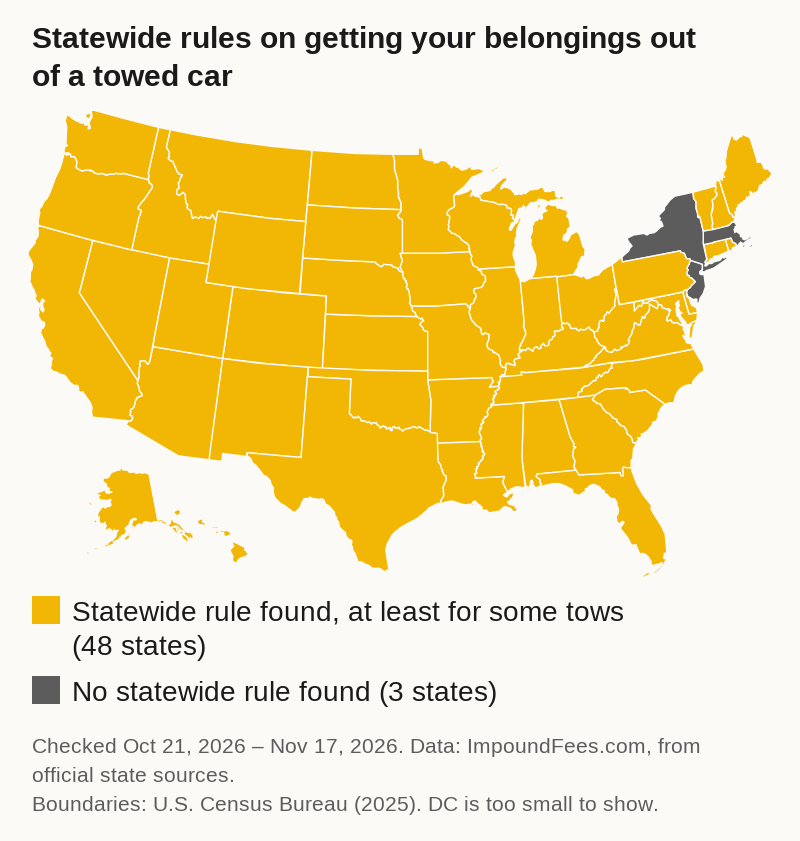
The map and the list below show what our verified data says for each state we publish, with a link to the official source. Some rules cover only certain tows, such as tows after a crash or tows ordered by the state police, so read the whole entry for your state.
Alabama — 1 item
State page: Alabama
We found no general statewide rule on getting personal belongings out of a towed vehicle. For a commercial motor vehicle towed at the Alabama Law Enforcement Agency's direction, freight and contents may not be held to secure towing and recovery charges, and the owner or its designee must have reasonable access to the vehicle during the business's normal operating hours. When an abandoned vehicle is sold at auction, personal property and items in it will be disposed of in a manner determined by the person or entity conducting the sale.[16]
- Alaska:
We found no Alaska law on getting personal belongings out of a towed or impounded vehicle, or on whether a fee may be charged for it. Ask the towing company and the agency that ordered the tow.[17]
Arizona — 1 item
State page: Arizona
After an accident tow, you (or someone you designate in writing) may inspect the vehicle and remove personal property during normal business hours without paying; vehicle parts and accessories do not count as personal property. DPS requires its contract tow companies to release all personal property on demand, without charge, during normal business hours. We found no statewide rule for private-property tows.[8]
Arkansas — 1 item
State page: Arkansas
The towing company's lien does not cover personal or legal documents, medications, child-restraint seats, wallets or purses and their contents, prescription glasses, prosthetics, cell phones, photographs and books; the company must release these to the owner or driver (or an authorized representative) without charge. To get them, give the company, within 45 days, proof that you are the registered owner or that the registered owner authorized you. The Board notes this does not apply to repossessed vehicles. For other contents of a personal vehicle, the owner may pay a fee of up to 5% of the towing and storage invoice to take them out without first paying the whole bill; the fee is credited toward the bill. When paying it you must give the company an assurance that you will pay the full bill, and whoever picks up the items must be insured and liable for any damage the pickup causes at the company's place of business.[18]
California — 1 item
State page: California
No lien attaches to personal property in or on the vehicle. It must be given to the registered owner or authorized agent on demand and at no charge during normal business hours (Mon-Fri 8 a.m.-5 p.m., excluding state holidays), before any towing/storage fees are paid. An after-hours gate fee of up to one-half the hourly tow rate may be charged for returning property outside business hours.[1]
Colorado — 1 item
State page: Colorado
You may ask for your personal property any time after the tow, up to 30 days after the owner notice. After a residential tow (Residential PPI) there is no charge. After a commercial-property tow or a law enforcement-ordered tow, the carrier may charge up to $102.28 per hour or part of an hour. Prescription medicines, medical equipment and devices, child restraint systems, state or federal ID, cell phones, and credit cards and cash needed to pay the tow must be handed over without payment and without extra charge: on demand during business hours, and within one hour's notice outside business hours during the first 24 hours after the tow. The rule says its provisions do not apply while the personal property is subject to a hold order issued by a court, district attorney, law enforcement agency or law enforcement officer.[12]
Connecticut — 1 item
State page: Connecticut
The tow company has no lien on the personal property in your vehicle and may not hold it for any reason. It must let you or someone you authorize take your belongings during its business hours, or within 4 hours of a request made outside those hours through its 24-hour phone line. Property essential to someone's health or welfare must be made available within 4 hours, at no charge, unless police have ordered the vehicle secured for a search warrant or other investigation. Statute does not say whether a fee may be charged for other after-hours access.[19]
Delaware — 1 item
State page: Delaware
After a tow without consent from a parking area, the storage lot must let the owner, lessee, lienholder or their authorized person collect personal items from the car at no fee during its normal business hours (it must have an office open 8 a.m. to 6 p.m. at least 5 days a week), on showing valid identification; refusing access makes the company liable for consequential damages. For police-ordered tows and lien sales, a towing or storage lien does not cover personal property not attached to or needed to operate the car, and that property must be returned if you claim it before the car is sold. When an owner or driver gives up custody of a car to a State Police trooper, the trooper prepares a storage form listing its contents and any damage.[20]
District of Columbia — 1 item
State page: District of Columbia
Before paying and before release, a towing company may not refuse a request by the owner to physically inspect the towed vehicle. On a public tow, the towing business is responsible for the vehicle and the property inside it from hook-up until release. The rules do not say whether you can take out personal belongings without paying, or whether a fee may be charged for that. Property left in a vehicle that is not reclaimed can be sold or disposed of with the vehicle.[21]
Florida — 1 item
State page: Florida
On presenting one of the accepted ownership documents, the owner, lienholder or their agent must be allowed to inspect the vehicle and take back all personal property that is not attached to it within 1 hour, during normal business hours at the storage site. When police order a tow from a crash scene, street or highway, the officer must first inventory the personal property in the vehicle, unless the owner or driver is present and goes with the vehicle. State law does not say whether a fee may be charged for access to personal property.[22]
Georgia — 1 item
State page: Georgia
State law says the towing company must let an owner retrieve personal property from a stored car for up to 30 days from the date the notice letter was sent; after that, items left in the car are treated as abandoned. Items attached to the car do not count. DPS says that, after a private-property tow, the owner should get at least one opportunity to retrieve personal items on showing proof of ownership. The DPS tariff lists no fee for this.[7]
Hawaii — 1 item
State page: Hawaii
We found no Hawaii law on getting your belongings out of a towed vehicle or on whether a fee may be charged. For a vehicle seized for unpaid weight tax, the storage facility must let you enter the vehicle to get its registration certificate. In Honolulu, an officer handling a police tow may take valuables such as a purse, wallet, money or jewelry as found property. Ask the towing company before you go.[23]
Idaho — 1 item
State page: Idaho
Tow companies may not hold a lien on personal property in or on a stored vehicle. On demand, they must give it to the registered owner, or an agent with a valid power of attorney, during reasonable business hours at no additional charge. The owner, an agent with power of attorney or an insurance representative may also inspect the vehicle during reasonable business hours at no additional charge. These rights do not apply to vehicles stored as part of a law enforcement investigation. ITD says items attached to the vehicle are not personal belongings. Once the vehicle has been disposed of, the company is not responsible for personal property left in it.[24]
Illinois — 1 item
State page: Illinois
Personal property in a vehicle subject to a tower's lien is also subject to that lien, except: child seats, eyeglasses, food, medicine, medical devices including hearing aids, perishables, driver's licenses, cash, cards, checks, wallets/purses with ID, textbooks, and property of someone else who proves ownership. Illinois Legal Aid says these items can be taken from the car without payment. After a crash, all personal property is exempt if the owner proves towing/storage insurance.[6]
Indiana — 1 item
State page: Indiana
A towing service or storage yard may not charge an owner, lienholder or insurance representative an inspection fee to inspect the vehicle or retrieve items from it. Another section says a retrieval fee may be charged only if it complies with that same rule. You have the right to inspect the vehicle during regular office hours before paying or accepting release. For police tows, the law enforcement agency's written towing policy or contract (if established, entered into, amended or renewed after June 30, 2025) must cover access to personal belongings in a stored vehicle.[25]
Iowa — 1 item
State page: Iowa
While a towing company holds an abandoned vehicle, the registered owner may collect personal property once during the 20-day reclaim period. Give the company a written list of the items; retrieval takes place during its normal business hours, and taking out belongings does not count as reclaiming the vehicle. The right covers items that can be reached without taking any part of the vehicle apart, such as prescription medicine, identification, credit or debit cards, a cell phone, medical equipment, child care items, work clothing and tools, a purse or wallet, eyeglasses, hearing aids and important documents. The law does not say whether a fee may be charged for this; ask the company. When police impound a vehicle for OWI, they must make an inventory of the property in it.[26]
Kansas — 1 item
State page: Kansas
Statewide, the towing company may keep personal property in the vehicle until its charges are paid or payment arrangements are made, except personal medical supplies, which must be released on request. Where a city ordinance or county resolution authorizes private-property tows, it must give the owner access to personal property in the vehicle for 48 hours after the tow and have that property released. After a court-ordered ignition-interlock impound, personal property may be retrieved before or during the impound. The tower is responsible only for reasonable care of the property; anything not returned is sold at the auction.[27]
Kentucky — 1 item
State page: Kentucky
Certain contents are not covered by the towing lien and must be released to the owner or the owner's designated agent on request, if the request is made within 45 days of the date the vehicle was towed. They include prescription medication in its proper container; personal medical supplies, equipment or records; documents, files and electronic devices that may store personal or work information; child restraint systems and booster seats; and checks, checkbooks, debit or credit cards, money orders, stocks or bonds. Before paying, the owner, a lienholder or the insurer's representative also has the right to physically inspect the vehicle during posted business hours. The law does not say whether a fee may be charged for retrieving these items.[13]
Louisiana — 1 item
State page: Louisiana
Free during normal business hours (8:00 a.m. to 5:00 p.m., Monday through Friday, exclusive of legal holidays): no towing or storage company may charge a fee for retrieving contents from a towed or stored vehicle then. Outside those hours the fee may not exceed $64.50. Removable personal items shall not be withheld. Anyone with picture identification who shows proof of ownership, or written authorization from the registered or legal owner, may inspect, photograph and view the vehicle and remove non-affixed personal property, including the license plate, without charge during normal business hours; items are released on request if there is no police hold on them. Since August 1, 2026, companies doing non-consensual private-property tows must make themselves available for the release of personal property or the vehicle outside normal business hours, exclusive of legal holidays and certain exempted hours.[9]
Maine — 1 item
State page: Maine
A person holding an abandoned vehicle, a vehicle towed at the owner's request or a vehicle stored at police request may keep the vehicle and its accessories, contents and equipment until reasonable towing and storage charges are paid, but not the registered owner's personal effects: medications, medical equipment, clothing, mail, child restraint systems and similar items. Except for child car seats, items attached to the vehicle and business equipment, machinery and tools are not personal effects and can be held. The statute itself only leaves personal effects out of what may be held until the charges are paid, for those three kinds of held vehicles; it does not separately state a right to collect them free of charge. The Attorney General's consumer guide says you have the right to get those items without paying the towing and storage charges. A lot may not hold the perishable cargo of a commercial vehicle when the cargo is not owned by the carrier or driver and proof of insurance covering the vehicle and its cargo is shown.[28]
Maryland — 1 item
State page: Maryland
A storage facility holding a vehicle towed from a parking lot must make it available to the owner, the owner's agent, the insurer of record or a secured party, under its supervision, for inspection or for retrieval of personal property that is not attached to the vehicle. The law does not say whether a fee may be charged for this.[29]
- Massachusetts: No statewide rule found in the official sources we checked.
- Michigan:
The custodian must let the owner inspect the vehicle and take out personal property without a fee on the first visit. Each later visit may cost up to $25.[10]
Minnesota — 1 item
State page: Minnesota
Any registered owner may get proof of identification, prescription medicine and durable medical equipment (such as wheelchairs, prosthetics, canes, crutches, walkers and braces) from the impounded vehicle, or the lot must retrieve them for the owner; the law does not say whether a fee may be charged for this. A registered owner who shows photo ID and documentation from a government or nonprofit agency or legal aid office that they are homeless, receive relief based on need, or are eligible for legal aid services has the right to retrieve all contents without charge, before the waiting period ends, whether or not they pay the charges or reclaim the vehicle. Such an owner is also not liable for cargo recovery, cargo storage or accident site cleanup charges unless their motor vehicle insurance covers them.[15]
Mississippi — 1 item
State page: Mississippi
For commercial vehicles of 15,000 pounds or more towed without consent, the towing company must give the owner, operator or owner's designee reasonable access to collect personal property in the vehicle, whether or not the towing charges have been paid. The committee's manual sets that access at Monday to Friday, 8 a.m. to 5 p.m., by appointment at the phone number on the invoice, with no access or gate fee during normal business hours. We found no statewide rule on personal property for cars and light trucks in the laws we could read.[30]
Missouri — 1 item
State page: Missouri
For vehicles removed at the direction of law enforcement, personal property inside 'need not be released to the owner thereof until the reasonable or agreed charges for such recovery, transportation or safekeeping have been paid', except that medication prescribed by a physician must be released on request. The company must either release the personal property or let the owner inspect it and give an itemized receipt, and it is 'strictly liable for the condition and safe return of the personal property'. Towing companies covered by RSMo 304.154 must let a customer view or retrieve items from a vehicle 'with no additional fees charged' during regular business hours.[5]
Montana — 1 item
State page: Montana
We found no Montana rule giving you free access to your belongings in a towed vehicle. If the vehicle belongs to an uninsured or underinsured person, no insurance claim was filed, or towing and storage coverage cannot be verified, the personal property inside can also be held under the towing and storage lien. These items are exempt from the lien: consumer food products and perishable goods not for resale, prescription items, original driver's licenses and other identifying documents, cash, credit and debit cards, checks and checkbooks, original personal, legal and business records, child safety items, and wallets or purses. Since October 1, 2025, bags and other containers are no longer on the exempt list.[31]
Nebraska — 1 item
State page: Nebraska
The tower's lien for towing and storage does not extend to the contents of the vehicle. For a tow from a posted restricted lot, whoever stores the vehicle is liable for reasonably foreseeable damage to the vehicle and its personal contents during storage. That rule is not applied to abandoned or trespassing vehicles removed under the abandoned-vehicle law, and for those the property owner and the state, county, city or village are not liable for loss or damage, including while the vehicle is held by a private towing service. Nebraska law does not set out how or when you can collect belongings from a towed car, or whether a fee may be charged; ask the towing company.[32]
Nevada — 1 item
State page: Nevada
A tow company may not hold your personal property or cargo as security for its charges, or for any reason other than a police instruction (cargo may be held only for the charges of cleaning up a cargo spill or of loading, transporting, securing or storing the cargo), and must protect it from theft and damage. Accessories and equipment of the vehicle count as part of the vehicle. Property still unclaimed 96 hours before the vehicle is finally disposed of may be sold or thrown away. The first visit to the stored vehicle is free, and so is the visit when you claim it; the company may charge for later visits and for opening after hours under its tariff.[33]
New Hampshire — 1 item
State page: New Hampshire
A company storing a towed vehicle may remove belongings that are not part of the vehicle and may hold them until the fees are paid, but it may never hold wallets, purses, essential clothing, mail, legal documents, car seats, eyeglasses, medicine, medical equipment or house keys. If the fees stay unpaid for 20 days (30 days from January 1, 2027), it may dispose of the items it held. Companies on the State Police rotation list also may not withhold contact lenses, license plates or business keys, must make reasonable arrangements for releasing belongings after hours once the State Police lift any hold and the towing and storage fees are paid or a payment arrangement is agreed (the essential items listed above can never be held), and must let you or your agent, with suitable identification, enter the yard under supervision to remove personal items. The law does not say whether the company may charge for access.[34]
- New Jersey: No statewide rule found in the official sources we checked.
New Mexico — 1 item
State page: New Mexico
Unless the police have ordered the vehicle held for investigation, the towing company must let the owner, the owner's agent or the lienholder inspect the vehicle, take out proof of ownership, and remove personal property (on showing proof of ownership) without charge during normal business hours (any eight hours between 8 a.m. and 5 p.m. on weekdays, except state holidays). Access after hours or on holidays is at the company's option, and the tariff allows the hourly after-hours response charge for after-hours requests to get into the vehicle. If the vehicle is held for investigation, nothing may be removed without the police agency's written authorization. The company is responsible for keeping the vehicle and its contents safe.[35]
- New York: No statewide rule found in the official sources we checked.
North Carolina — 1 item
State page: North Carolina
Wrecker services on the State Highway Patrol rotation list must return personal property in or with a vehicle when the owner asks, whether or not the towing, repair or storage fee has been paid. Any tower of a non-consent or police-ordered tow must promptly return commercial cargo to its owner on request. We found no statewide rule on personal property for other tows, or on whether a fee may be charged for access.[36]
- North Dakota:
We found no North Dakota law on collecting belongings from a towed vehicle or on whether a fee may be charged. Ask the towing company or the agency holding the vehicle.[37]
Ohio — 1 item
State page: Ohio
With proof of ownership, you may take your personal items out of the vehicle without paying the bill and without any fee. Items attached to the vehicle do not count. After a police tow, the lot may charge an after-hours fee (up to $150) if you collect items when it is closed, but only if it told you about the fee and its amount when you called. Items the police need for a criminal investigation stay with the vehicle.[3]
Oklahoma — 1 item
State page: Oklahoma
After a police-ordered tow, the wrecker operator must release all personal property in the vehicle to the registered owner (or a representative the owner names on the Department of Public Safety's form) or to the insurer that accepted liability. It may not make you pay the towing and storage charges first. Retrieval is free during normal business hours; an after-hours fee may be charged outside them. Personal property means everything except the vehicle, its attached equipment, keys and the spare tire and tools. After a private-property tow, the property owner and the wrecker driver must inventory the belongings together on the tow form.[38]
Oregon — 1 item
State page: Oregon
A tower holding your vehicle must let you collect all personal property of an emergency nature (for example prescription medication, eyeglasses, hearing aids, clothing, identification, a wallet, a purse, a credit card, a checkbook, cash, child safety car and booster seats) and the registration plates. It may not charge any fee for this except a gate fee between 6 p.m. and 8 a.m. on business days or on weekends and legal holidays. The law does not say whether a fee may be charged for other personal property.[14]
Pennsylvania — 1 item
State page: Pennsylvania
No statewide rule on getting personal items out of a towed car without paying was found. After an accident tow, the facility must give the owner reasonable access to the vehicle during posted hours for inspection and retrieval. For an abandoned vehicle, the owner may reclaim 'the vehicle and its contents' within 30 days, upon paying the charges.[39]
Rhode Island — 1 item
State page: Rhode Island
The Division's rule requires a certificated towing company to release personal items in a towed vehicle to the owner, or the person in control of the vehicle, immediately on request, whether or not the towing charges have been paid; the tower's lien covers only the vehicle and its plates. If an animal is in a towed vehicle, the tower must notify animal control or the police at once, and must release the animal immediately, without payment, if the owner is present at the tow. The rule does not say whether a fee may be charged for access to the vehicle.[40]
South Carolina — 1 item
State page: South Carolina
Under the law on towing directed by a law enforcement officer (§ 56-5-5635), once the vehicle is held by the towing company or storage facility, the owner, shown by the certificate of registration, has one opportunity to remove personal property not attached to the vehicle. Personal property that does not belong to the vehicle owner must be released to its owner. For Highway Patrol rotation tows, the company must immediately release personal items such as medicines, medical equipment, keys, clothing, tools of the trade, child restraint systems and perishable items at the request of the owner or the owner's designee. The law does not say whether a fee may be charged for access. Contact the towing company directly to get your belongings.[11]
South Dakota — 1 item
State page: South Dakota
The officer or towing company that takes custody has a lien on the vehicle's contents as well as the vehicle, but the lien on the contents may not exceed $500, and no lien attaches to tools and implements you use in your trade or business, or to clothing or food. We found no South Dakota law on when you may collect belongings or whether a fee may be charged; ask the towing company.[41]
Tennessee — 1 item
State page: Tennessee
We found no statewide statute on fees for retrieving belongings from a towed vehicle, except for firearms: a storage facility may remove and secure a firearm left in a stored vehicle, must notify the owner, and the notice must explain how to get the firearm back. For Tennessee Highway Patrol rotation tows, THP's manual says personal property or cargo is released to the owner on request (unless a THP officer orders otherwise), with no charge during normal business hours.[42]
Utah — 1 item
State page: Utah
Unless the vehicle is held as evidence, you may take out life essential items at any time during normal business hours without paying anything first: prescription medication, medical equipment, shoes, coats, food and water, child safety seats, government-issued photo ID, and human remains. Once you pay the towing fee, you may enter the vehicle during business hours and remove any other personal property not attached to it. At a state impound lot you must show your driver's license or other government ID (if it is inside the vehicle, the lot must get it for you) and sign a receipt for what you take.[43]
Vermont — 1 item
State page: Vermont
We found no Vermont law giving you a right to collect belongings from a towed car, free or otherwise. The Attorney General's 2024 report to the Legislature says towing companies decide whether to allow access to personal or commercial possessions once a car is impounded. Ask the company before you go, and if it refuses, contact the Attorney General's Consumer Assistance Program.[44]
Virginia — 1 item
State page: Virginia
A towing and recovery operator may not refuse to let the owner, with proof of ownership of the vehicle, access the vehicle and recover personal items without retrieving the vehicle and without paying any fee. If the vehicle is going to auction, the owner must claim the items at least two business days before the auction date; after that, the company may dispose of unclaimed personal property.[4]
Washington — 1 item
State page: Washington
For twenty days from the impound, the tow company must keep your personal belongings intact and return them during normal business hours when you ask and show a driver's license or other sufficient identification. Personal property must be released without charge between 8:00 a.m. and 5:00 p.m., except weekends and holidays. You can also remove your belongings and sign a personal belongings storage request form; the company must then store them at no cost for thirty days. If no storage request is signed, belongings not claimed within twenty days of the impound are considered abandoned. Anyone with proof of ownership or written authorization from the owner or insurer may view the vehicle without charge during normal business hours.[45]
West Virginia — 1 item
State page: West Virginia
After a third-party tow, the towing company must let the registered owner, or someone the owner designates, get personal property that is not attached to the vehicle, at no charge, during normal business hours, without paying all or part of the tow bill. The invoice must tell you about this right. This does not apply when police have placed a hold on the vehicle, and it does not cover attached items such as a stereo, battery or license plate, or cargo in a commercial vehicle. The invoice statement and these exceptions come from the Commission's towing rules; these Public Service Commission rules carry a sunset date and we found no renewal on the Secretary of State's rules site. The company does not have to release property after hours; if it agrees to, it may charge the $50 gate fee, which you must be told about in advance.[46]
Wisconsin — 1 item
State page: Wisconsin
Whoever has custody of a vehicle removed or stored at the request of police, a traffic officer, a parking enforcer, a property owner or the owner's agent, or a self-storage facility operator (as defined in s. 704.90) must release the personal property in the vehicle (property not mounted, attached or affixed to it) to the owner during regular office hours, when the owner shows proper identification. No charge may be assessed for removing or releasing the personal property. However, if you remove your personal property, the vehicle is deemed abandoned unless you sign a written agreement to pay the full towing and storage charges, and the custodian must tell you this before releasing the property. The towing and storage lien law repeats that no additional charge may be assessed for personal property in a vehicle towed or stored at the direction of a traffic officer. The law also says the personal property is subject to forfeiture under ss. 961.55 to 961.56 and 973.075 to 973.077.[47]
Wyoming — 1 item
State page: Wyoming
For a vehicle removed or stored at a police officer's request, the company holding it must release your belongings to you or your agent during regular office hours when you show proper identification, and no charge may be made for removing or releasing them. Be careful: when you take your belongings out of a police-requested tow, the company may warn you in writing that unless you sign a written agreement to pay the towing and storage charges, the vehicle can be treated as abandoned if it is left unclaimed for more than 10 days. Highway Patrol rotation carriers must release belongings on request unless a trooper orders otherwise, and may not charge for this during normal business hours. We found no statewide rule for belongings in a private-property tow.[48]
Deadlines: when things left in the car are lost
Don't leave your belongings in the car and plan to come back for them later. Several states set a time limit, after which the company may treat what's left as abandoned or get rid of it:
- Georgia: State law says the towing company must let an owner retrieve personal property from a stored car for up to 30 days from the date the notice letter was sent; after that, items left in the car are treated as abandoned.[7]
- Washington: If no storage request is signed, belongings not claimed within twenty days of the impound are considered abandoned.[45]
- Virginia: If the vehicle is going to auction, the owner must claim the items at least two business days before the auction date; after that, the company may dispose of unclaimed personal property.[4]
- Alabama: When an abandoned vehicle is sold at auction, personal property and items in it will be disposed of in a manner determined by the person or entity conducting the sale.[16]
If nobody pays for the car, it can be sold, and whatever is still inside may go with it. Our guide to the tow company lien process explains the notices and how much time you have.
Read before you sign
Getting your things back can come with paperwork, and a form can say more than you expect. Here is a rule where taking your belongings changes what happens to the car:
- Wisconsin: However, if you remove your personal property, the vehicle is deemed abandoned unless you sign a written agreement to pay the full towing and storage charges, and the custodian must tell you this before releasing the property.[47]
Ask the lot what any form means for the car, and keep a copy of everything you sign.
Where we found no statewide rule
For the states marked "No statewide rule found" in the list, we did not find a statewide rule in the official sources we checked. That is not the same as a rule that the company may keep your belongings. The answer may come from a city ordinance, the company's own policy or a court.
In that case, ask the company in writing what it will release, when, and at what cost. If it refuses, contact the police agency or property owner that ordered the tow, and keep notes of every call.
How to get your things back
- Call the lot first. Ask for its hours, the ID it wants, and whether it charges anything to reach the car.
- Bring the right papers. Photo ID and proof of ownership, or the owner's written permission if you are going for someone else. Your state page lists the documents its rules require, where it has a list.
- Look before you touch. Take photos of the inside of the car before you remove anything.
- Make a list. Write down what you take out. If something is missing or damaged, note it on the receipt before you leave and ask the lot to sign it.
- Ask for the rule. If the lot refuses, ask which law or policy it relies on, then contact the agency that ordered the tow.
Common mistakes
Waiting until you can pay the whole bill. In many states you can collect your things first. Go early, especially for medicine, glasses and ID.
Leaving things in the car "for now." Deadlines run from the tow or from a notice, and some states treat what's left as abandoned.
Trying to take parts. A car stereo, wheels or anything else attached to the vehicle usually stays with it.
Turning up after hours. You may find the gate closed, or pay an after-hours fee where the state allows one.
Signing a form without reading it. In at least one state, a signature can decide what happens to the car.
Not keeping proof. Photos, a list and a signed receipt are your evidence if something goes missing.
Questions people ask
Can a towing company charge you to get your stuff out of the car?
It depends on the state. Some ban the fee outright, some allow one only after hours, and some don't say:
- Texas: TDLR lists fees to access personal property as not allowed.[2]
- Ohio: After a police tow, the lot may charge an after-hours fee (up to $150) if you collect items when it is closed, but only if it told you about the fee and its amount when you called.[3]
- Florida: State law does not say whether a fee may be charged for access to personal property.[22]
Can someone else pick up my belongings for me?
Often, yes, with your written permission and their own ID. Some state rules name the owner's designee or agent:
- South Carolina: For Highway Patrol rotation tows, the company must immediately release personal items such as medicines, medical equipment, keys, clothing, tools of the trade, child restraint systems and perishable items at the request of the owner or the owner's designee.[11]
Do I have to pay the towing bill to get my phone or wallet back?
Usually not. Even where a company may hold belongings until it is paid, wallets, IDs and cards are often on the list of things it must hand over:
What if my belongings are damaged or missing?
Note it on the receipt before you leave, take photos and tell the company in writing. Some states make the company answer for what it holds:
- Missouri: The company must either release the personal property or let the owner inspect it and give an itemized receipt, and it is 'strictly liable for the condition and safe return of the personal property'.[5]
Can the police keep items from my car?
Yes, when they are needed for an investigation or held by a court order. The lot can't release those until the agency says so:
What about things that belong to someone else?
A passenger's or a friend's things don't become the company's because they were in your car. Some states say the owner of the item can claim it:
- South Carolina: Personal property that does not belong to the vehicle owner must be released to its owner.[11]
What if I can't afford to get the car out at all?
Get your belongings out first, then read our guide to the tow company lien process to see what happens to the car and to the bill. Some states also help people with low incomes:
- Minnesota: A registered owner who shows photo ID and documentation from a government or nonprofit agency or legal aid office that they are homeless, receive relief based on need, or are eligible for legal aid services has the right to retrieve all contents without charge, before the waiting period ends, whether or not they pay the charges or reclaim the vehicle.[15]
For what the whole bill can come to, see our guide on how much it costs to get a car out of impound.
Related state pages
- California towing & impound fees · City pages: Bakersfield, Clovis, Corona, Escondido, Fresno, Hayward, Huntington Beach, Los Angeles, Murrieta, Oakland, Rancho Cucamonga, Riverside, Roseville, Sacramento, San Bernardino, San Diego, San Francisco, Temecula
- Georgia towing & impound fees
- Ohio towing & impound fees · City pages: Cincinnati, Columbus, Toledo
- Texas towing & impound fees · City pages: Austin, Corpus Christi, Dallas, Irving, Pasadena
- Virginia towing & impound fees · City pages: Norfolk
- Wisconsin towing & impound fees · City pages: Madison
Related guides
-

Tow company lien process: when an unclaimed car is sold
The tow company lien process: a notice to the owner, a waiting period, then a sale. See each state's deadlines and what you may still owe after.
Updated
-
How much to get a car out of impound? Costs by state
How much to get a car out of impound: the tow, a daily storage charge and any release fees. See each state's limits and a worked example.
Updated
-
What is an impound lot? How it works and what it costs
An impound lot is a storage yard that holds towed cars until the owner pays. Here is who runs them, how storage is charged and each state's rules.
Updated
-
Private property towing: your rights and the limits
Private property towing is legal when state rules are followed: signs, notice to police and fee limits. See what it can cost and how to dispute a tow.
Updated
Sources (48)
- Cal. Veh. Code §22851(b) - no lien on personal property; free return on demand
- Tex. Occ. Code §2303.158 Access to glove compartment to establish identity or ownership
- R.C. 4513.601(G)(4) Personal items without fee
- Va. Code § 46.2-118(B)(19) Personal items without fee
- RSMo 304.155.9 Personal property may be held until charges are paid
- 625 ILCS 5/4-203(g)(4)
- O.C.G.A. 40-11-18(a) (HB 307, 2019) - personal property retrieval for 30 days
- A.R.S. 28-4847(M) No charge to remove personal property during business hours
- La. R.S. 32:1734(D) No fee for contents during business hours
- MCL 257.252a (19) first visit free
- S.C. Code § 56-5-5635(F) Personal property
- 4 CCR 723-6, Rule 6512(d) release of personal property - time limit
- KRS 376.275(2) Exempt contents released on request within 45 days (Lien on motor vehicles and contents for reasonable and applicable charges under KRS 281.920 to 281.936)
- ORS 98.858(1)(c) Emergency personal property and plates
- Minn. Stat. 168B.07, subd. 3a Identification, medicine, and medical equipment
- Ala. Code § 41-27-61 (a)(5) freight and contents
- AS 28.10.502(b) lien limited to towing and storage charges and mailing fees
- Act 1053 of 2007, § 11, Ark. Code § 27-50-1208(a)(2)(C) (listed items released without charge)
- C.G.S. 14-66a(b) no lien on personal property in the vehicle
- 21 Del. C. § 6906A(a)(3) Personal items free during business hours with valid ID
- D.C. Code § 50-2458(a) Sale or disposal of unclaimed vehicles
- Fla. Stat. §713.78(10) Release of personal property
- Act 73 (2026), S.B. 2697 C.D. 1, section 2 amending HRS 249-10
- Idaho Code 49-1814(4)(b) no lien on personal property
- IC 9-22-1-8(b) No inspection fee
- HF 2617 (2026) sec. 4, Iowa Code 321.89(3A)(b)(1): personal property once during the reclamation period
- K.S.A. 8-1103(a)(4) Towed motor vehicles, lien created thereon; procedure; personal property; notice of fee; city ordinance or county resolution
- 29-A M.R.S. §1861 vehicle and contents held until charges paid, except personal effects
- Md. Code, Transp. §21-10A-05(c)(3) Inspection and personal property
- SB 2635 (2024), Miss. Code Ann. 63-37-1 to 63-37-15 (commercial vehicles), Sec. 4(2), 63-37-7
- MCA 71-3-1201(2)(b) lien extends to personal property in an uninsured vehicle
- Neb. Rev. Stat. § 60-2410 (1) lien does not cover contents (Towing and storage fees; liability; lien; notice)
- NRS 706.4467 (5) personal property not held as security
- RSA 262:35-a III Storer may remove items that are not part of the vehicle
- 18.3.12.24(B)(1) NMAC (Towing Services)
- 14B NCAC 07A .0116(a)(23) Return of personal property
- NDCC 23.1-15-06(2) reclaim from a towing service on payment of towing and storage
- 47 O.S. § 955 (E) personal property released (Towing of vehicle from roadway - grounds)
- Act 110 of 2012 § 3(f) Access to the vehicle
- 815-RICR-50-05-1.13.2(B) Personal items released immediately on request, whether or not charges are paid
- SDCL 32-30-18 possessory lien for reasonable costs; contents lien up to $500
- Pub. Ch. 457 (2025), Tenn. Code Ann. § 55-31-105 Firearms left in stored vehicles
- Utah Code § 72-9-603(13)(e) life essential items released without payment
- Attorney General, Report to the Legislature on Towing Practices in Vermont (Jan. 30, 2024): storage fees and access to belongings
- RCW 46.55.090 (3) Personal belongings kept 20 days, returned with ID
- 150 CSR 9 r. 6.9.6: free access to retrieve personal property during business hours
- Wis. Stat. § 349.13(5)(b)2. scope (who must release personal property)
- W.S. 31-13-112(c) scope: vehicles removed or stored at police request
General information, not legal advice. See how we verify figures.