
Maine towing laws and impound fees
City pages for Maine: Auburn, Portland.
Informational only, not legal advice. Fees change and many are set by cities or counties. Confirm the current amount with the tow lot or the agency that ordered the tow.
On this page
At a glance
- Earliest lien sale
-
14 days after the date the Secretary of State sends its notices to the owner and lienholder (or the date the newspaper notice is published)
Sources: Maine Legislature - Office of the Revisor of Statutes, Maine Revised Statutes [48] [63] [64] [65] [66] [67] [44] [45] [69] [70] [71]; Maine Secretary of State - Bureau of Motor Vehicles [68] · verified Oct 28, 2026
We found no statewide limit on towing or storage fees in Maine's laws and official sources. Sources: [42] [43] [44] [45] [37] [38] [46] [47] [48] [31] [32] [9] [39] [40] [41] · verified Oct 28, 2026
We also found no statewide deadline to request a hearing. Sources: [79] [38] [80] [81] [69] [15] · verified Oct 28, 2026
Statewide fees that do apply are in the fee table below.
- Regulator
- No single statewide towing regulator found.
- Key laws
- 29-A M.R.S. §§1851 to 1863 Abandoned vehicles: which towed or left vehicles are covered, notice to the Secretary of State, abandonment after 14 days, title or letter of ownership, storage limits ($1,500 per 30 days), holding the vehicle and its contents, commercial-vehicle tows
- 29-A M.R.S. §1857 Limits: storage charges must be reasonable and may not exceed $1,500 for a 30-day period; only 14 days of storage if the Secretary of State is not notified on time
- 29-A M.R.S. §1861 Holding a vehicle and its accessories until reasonable towing and storage charges are paid; personal effects excluded
- 29-A M.R.S. §2069 Authority of police, the Department of Transportation and the Maine Turnpike Authority to remove improperly parked vehicles and vehicles connected with an arrest, summons or crime
- 29-A M.R.S. §§2421 and 2422 Forfeiture and impoundment of motor vehicles for operating under the influence (OUI)
- 29-A M.R.S. §754 State Police impoundment of vehicles with altered identification numbers or involved in a violation; disposal of unclaimed impounded vehicles (amended 2025)
- 29-A M.R.S. §1605-B Auto liability policies must cover up to $500 of towing and storage after an accident when police request the tow
- 10 M.R.S. §§3801 and 3802 Lien for repairs and for storage provided with the owner's consent; filing with the Secretary of State within 90 days
Estimate your bill in Maine
The most a lot can legally charge you under Maine's statewide rules, line by line. Where a fee is set locally, enter the rate the lot quoted.
Fees in Maine
| Fee | Applies to | Amount | Conditions and source |
|---|---|---|---|
| Police-ordered tow fee | Police / non-consent | No statewide figure foundNo statewide rule found | Maine law sets no dollar amount for a police-ordered tow. The holder may keep the vehicle until reasonable towing and storage charges are paid, and the State, towns and cities and the police are not liable for those charges. After an accident, an auto liability policy on a vehicle registered or principally garaged in Maine must cover up to $500 per accident of the reasonable towing and storage charges when the vehicle is towed at the request of a law enforcement officer (policies issued or renewed on or after July 1, 2024; not policies covering more than 4 vehicles or garage, sales, repair, service station or public parking policies). Ask the towing company for its rates in writing before you pay.Sources: Maine Legislature - Office of the Revisor of Statutes, Maine Revised Statutes [31] [32] [9] [39] [40]; Maine Legislature - chaptered law (LD 1661, 131st Legislature) [41]; Office of the Maine Attorney General - Consumer Protection Division [37] · verified Oct 28, 2026 |
| Private-property tow fee | Private property | No statewide figure foundNo statewide rule found | Maine law sets no dollar amount for a tow from private property. The law that lets a holder keep a vehicle until the towing and storage charges are paid names abandoned vehicles, vehicles towed at the owner's request and vehicles stored at police request; a vehicle counts as abandoned only if the owner or lienholder does not get it back and pay within 14 days after the Secretary of State's notices are sent. If the owner or lienholder pays the towing, storage and repair charges before a title or letter of ownership is issued to the holder, the holder must release the vehicle immediately. The Attorney General's office advises asking for the rates in writing and says that raising the price without your agreement after the tow may violate the Maine Unfair Trade Practices Act. For a commercial motor vehicle towed without consent, the towing facility must give a detailed itemized invoice before demanding payment, and the customer does not owe any charge that is not itemized.Sources: Maine Legislature - Office of the Revisor of Statutes, Maine Revised Statutes [42] [43] [44] [45] [46] [47] [48]; Office of the Maine Attorney General - Consumer Protection Division [37] [38] · verified Oct 28, 2026 |
| Daily storage fee | Police / non-consent, Private property | No statewide figure foundNo statewide rule found | No fixed daily rate: daily storage charges must be reasonable, and the total may not exceed $1,500 for a 30-day period. The Attorney General's consumer guide says that if a towing company demands more than an average of $50 a day for a vehicle stored more than a few days, it is likely breaking the law. If the holder notifies the Secretary of State more than 14 days after receiving the vehicle, or never notifies it, the holder may collect no more than 14 days of storage fees.Sources: Maine Legislature - Office of the Revisor of Statutes, Maine Revised Statutes [33] [51] [52]; Office of the Maine Attorney General - Consumer Protection Division [49] [50] · verified Oct 28, 2026 |
| Maximum total storage for a 30-day period | Police / non-consent, Private property | Up to $1,500Statewide maximum | Total storage charges for any vehicle covered by Maine's abandoned-vehicle law (vehicles towed at the owner's request, towed by police order, towed from or left on property without permission, or left after repair or at a storage facility) may not exceed $1,500 for a 30-day period, and daily charges must be reasonable. If the holder notifies the Secretary of State more than 14 days after receiving the vehicle, or not at all, only 14 days of storage may be collected. The Bureau of Motor Vehicles' forms put that 14-day limit at $700; the statute itself states it only in days.Sources: Maine Legislature - Office of the Revisor of Statutes, Maine Revised Statutes [33] [51] [52] [26] [27] [28]; Office of the Maine Attorney General - Consumer Protection Division [49]; Maine Secretary of State - Bureau of Motor Vehicles [53] · verified Oct 28, 2026 |
Local rates. No Maine statute sets towing rates or hands that job to towns and cities. Municipalities have general home-rule power to adopt ordinances on any matter the Legislature has not denied them, so some towns and cities may have their own towing rules. A 2026 report by the Secretary of State's Bureau of Motor Vehicles records the towing industry's statement that most towns and cities already have towing rotation lists, some with set rates. Ask the town or city police department or office where the car was towed. Sources: Maine Legislature - Office of the Revisor of Statutes, Maine Revised Statutes [82]; Maine Secretary of State - Bureau of Motor Vehicles [83] · verified Oct 28, 2026
Major cities (largest cities in the state, Census Bureau Vintage 2025 estimates): Portland, Lewiston, Bangor, South Portland, Auburn. Where a fee above is set locally, the city or the agency that ordered the tow sets the rate.
Cities we cover
- Auburn
- Portland · City / police tow (light-duty): $150 Source: City of Portland, Maine - Parking Division · verified Nov 19, 2026
Police tow vs. private-property tow
Police-ordered (non-consent) tow
A law enforcement officer, or employees or agents of the Department of Transportation or the Maine Turnpike Authority, may have a vehicle removed from a place where parking is not allowed to a place where it is. An officer may also have a vehicle removed to a suitable parking place, at the registered owner's expense, when it interferes with snow removal or normal traffic or is parked within the limits of a right-of-way, and may have a vehicle removed when it is connected with the arrest of its driver or owner, a summons for certain traffic infractions (such as an unregistered vehicle), a registration suspended or a right to drive suspended for unpaid tolls, or a crime. A vehicle removed for unpaid tolls is released only after the tolls, fees and penalties are paid and the registration or right to drive is restored. The State, towns and cities, the Turnpike Authority, the officer and the towing company acting for them are not liable for the towing or storage charges, and the abandoned-vehicle notice and payment rules apply to the vehicle. A vehicle used by someone arrested for operating under the influence (OUI), or for driving while suspended for OUI, may be seized and held in secure storage; it may be released after at least 8 hours and payment of the towing and storage fees. A vehicle of a sole owner-operator convicted of OUI together with operating after an OUI suspension is forfeited to the State after notice and a hearing; the State pays the storage of a seized vehicle that is not forfeited. The State Police may also impound a vehicle whose identification number appears fictitious, removed or altered, or that was involved in a violation of law, until the violation is cleared. If such a vehicle is unclaimed, the Secretary of State notifies the owner and lienholders by registered or certified mail within 10 days; they must take the vehicle back within 30 days of receiving the notice, or it becomes the Secretary of State's property and may be sold. Abandoning a vehicle on a public way carries a fine of at least $250, and the person who abandoned it pays the towing charges. Sources: Maine Legislature - Office of the Revisor of Statutes, Maine Revised Statutes [1] [2] [3] [4] [5] [6] [7] [8] [9] [10] [11] [12] [13] [14] [15] [16] [17] [18] [19] [20] [21] [22] [23] [24] [25] [26] · verified Oct 28, 2026
Private-property tow
Maine's abandoned-vehicle law covers a vehicle towed after being left on property without permission, and a vehicle left on property without the permission of the property owner or the person in charge. Whoever holds the vehicle must notify the Secretary of State in writing on the Secretary of State's form. The law that lets a holder keep a vehicle and its contents (but not the owner's personal effects) until reasonable towing and storage charges are paid names abandoned vehicles, vehicles towed at the owner's request and vehicles stored at police request; it does not expressly mention a vehicle towed from private property before it counts as abandoned. Storage must be reasonable and may not exceed $1,500 for 30 days. Removing such a vehicle, or any part of it, without the written consent of the property owner or person in charge is a traffic infraction, even for the vehicle's owner. A vehicle towed for snow removal is exempt from these rules for the 48 hours after the tow. We found no Maine statute on warning signs in private parking lots, and no statewide limit on private-property towing fees. The Attorney General's office advises asking the towing company for its rates in writing, and says that raising towing or storage prices without your agreement after taking your vehicle may be a deceptive practice under the Maine Unfair Trade Practices Act. Sources: Maine Legislature - Office of the Revisor of Statutes, Maine Revised Statutes [27] [28] [29] [30] [31] [32] [33] [34] [35] [36]; Office of the Maine Attorney General - Consumer Protection Division [37] [38] · verified Oct 28, 2026
How to get your car back, step by step
- Find out who has the car. If police had it removed, call the police agency; the abandoned-vehicle notice rules apply to police removals too. The company holding the car must notify the Secretary of State in writing, and the Secretary of State then writes to the registered owner and any lienholder by regular mail. Sources: Maine Legislature - Office of the Revisor of Statutes, Maine Revised Statutes [10] [29] [59] · verified Oct 28, 2026
- Ask the company for its towing and storage charges in writing. Storage must be reasonable and may not exceed $1,500 for 30 days, and if the company did not notify the Secretary of State within 14 days it may charge no more than 14 days of storage. Sources: Office of the Maine Attorney General - Consumer Protection Division [37]; Maine Legislature - Office of the Revisor of Statutes, Maine Revised Statutes [33] [51] · verified Oct 28, 2026
- If you only need belongings such as medications, medical equipment, clothing, mail or a child car seat, you can get them without paying the towing and storage charges. Sources: Maine Legislature - Office of the Revisor of Statutes, Maine Revised Statutes [31] [72]; Office of the Maine Attorney General - Consumer Protection Division [74] · verified Oct 28, 2026
- If the car was seized after an OUI arrest, it can be released only after at least 8 hours and payment of the towing and storage fees. If it was removed for unpaid tolls, pay the tolls, fees and penalties and get the registration or right to drive restored first. Sources: Maine Legislature - Office of the Revisor of Statutes, Maine Revised Statutes [14] [7] · verified Oct 28, 2026
- Pay the charges and take the car. Until a title or letter of ownership has been issued to the holder, it must release the car immediately when the charges are paid; refusing to release it once reasonable charges are paid is a crime. Sources: Maine Legislature - Office of the Revisor of Statutes, Maine Revised Statutes [44] [45] [69] · verified Oct 28, 2026
- Act quickly when the Secretary of State's letter arrives. Under the statute, the car is considered abandoned if you do not get it back and pay within 14 days after that letter is sent, and ownership can then pass to the company. Sources: Maine Legislature - Office of the Revisor of Statutes, Maine Revised Statutes [48] [60] · verified Oct 28, 2026
- If police had the car towed after an accident, check your auto insurance: most policies must cover up to $500 of the reasonable towing and storage charges. Sources: Maine Legislature - Office of the Revisor of Statutes, Maine Revised Statutes [39] [40] · verified Oct 28, 2026
- If you think the charges are unfair, complain to the company first, then file a complaint with the Attorney General's Consumer Mediation Service, or sue in small claims court for up to $10,000. Sources: Office of the Maine Attorney General - Consumer Protection Division [38] [79] [80] [81] · verified Oct 28, 2026
Documents to bring
No statewide document list found in the official sources we checked — this may be set locally. Check with your city, county or the tow lot.
Payment methods
We found no Maine rule requiring towing companies or storage lots to accept credit cards. Ask which payments the company takes, and ask for its rates in writing, before you go. Source: Office of the Maine Attorney General - Consumer Protection Division [37] · verified Oct 28, 2026
Getting your personal items out
A person holding an abandoned vehicle, a vehicle towed at the owner's request or a vehicle stored at police request may keep the vehicle and its accessories, contents and equipment until reasonable towing and storage charges are paid, but not the registered owner's personal effects: medications, medical equipment, clothing, mail, child restraint systems and similar items. Except for child car seats, items attached to the vehicle and business equipment, machinery and tools are not personal effects and can be held. The statute itself only leaves personal effects out of what may be held until the charges are paid, for those three kinds of held vehicles; it does not separately state a right to collect them free of charge. The Attorney General's consumer guide says you have the right to get those items without paying the towing and storage charges. A lot may not hold the perishable cargo of a commercial vehicle when the cargo is not owned by the carrier or driver and proof of insurance covering the vehicle and its cargo is shown. Sources: Maine Legislature - Office of the Revisor of Statutes, Maine Revised Statutes [31] [32] [72] [73] [76] [77] [78]; Office of the Maine Attorney General - Consumer Protection Division [74] [75] · verified Oct 28, 2026
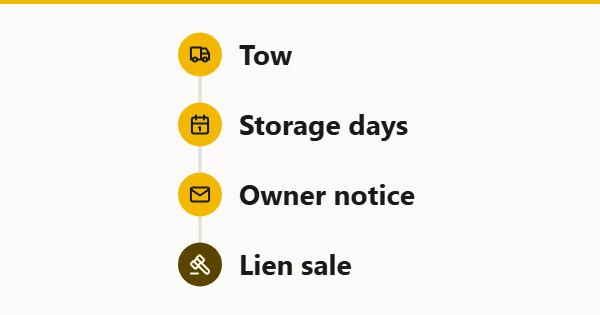
Deadlines: owner notice and lien sale
Notice to the owner
Maine law does not require the towing company to notify you directly. Whoever holds a towed or left vehicle must notify the Secretary of State in writing, on the Secretary of State's form, that it has the vehicle; the notice gives the vehicle's description and plates, the date it came into the holder's possession and how. If that notice is made more than 14 days after the holder received the vehicle, or not at all, the holder may collect no more than 14 days of storage fees (the Bureau of Motor Vehicles counts the 14 days by the postmark). Repair shops and storage facilities must notify the Secretary of State, and any lienholder shown on the title, within 14 days after the owner or lienholder first becomes responsible for unpaid repair or storage charges. The Secretary of State then writes to the owner and any lienholder, stating the charges they must pay to get the vehicle back and the date ownership will pass to the holder. Method: Holder to the Secretary of State: written notice on the Secretary of State's form (Bureau of Motor Vehicles form MVT-28). Secretary of State to owner and lienholder: regular mail. If the Secretary of State has no record of the vehicle, the holder must publish a notice once in a newspaper of general circulation in the county. Sources: Maine Legislature - Office of the Revisor of Statutes, Maine Revised Statutes [29] [30] [54] [52] [51] [56] [57] [58] [59] [60] [61]; Maine Secretary of State - Bureau of Motor Vehicles [55] [62] · verified Oct 28, 2026
When the vehicle can be sold
14 days after the date the Secretary of State sends its notices to the owner and lienholder (or the date the newspaper notice is published)
A vehicle is considered abandoned if the owner or lienholder does not get it back and pay all reasonable towing, storage and authorized repair charges within 14 days after the Secretary of State's notices are sent, or within 14 days after the newspaper notice is published. The last owner of record is presumed to be the owner who abandoned it. The holder may then obtain a certificate of title, or a letter of ownership (fee $5) for a vehicle that does not need a title, but the Secretary of State may not issue it until at least 21 days after the holder notified the Secretary of State. The Bureau of Motor Vehicles tells holders not to sell, part out or repair the vehicle until they have the title or letter of ownership. If the owner or lienholder pays the towing, storage and repair charges before the title or letter is issued, the holder must release the vehicle immediately; refusing to release it once reasonable charges are paid is a crime. Maine law sets no auction or sale procedure for these vehicles: ownership passes to the holder. Separately, a repair shop or storage provider working with the owner's consent has a lien for its reasonable charges, which ends unless it is filed with the Secretary of State within 90 days. Sources: Maine Legislature - Office of the Revisor of Statutes, Maine Revised Statutes [48] [63] [64] [65] [66] [67] [44] [45] [69] [70] [71]; Maine Secretary of State - Bureau of Motor Vehicles [68] · verified Oct 28, 2026
How storage days are counted
Maine law does not say how a storage day is counted. Daily storage charges must be reasonable and the total may not exceed $1,500 for a 30-day period. If the holder does not notify the Secretary of State within 14 days after receiving the vehicle, it may collect no more than 14 days of storage fees. Sources: Maine Legislature - Office of the Revisor of Statutes, Maine Revised Statutes [33] [51] [52] · verified Oct 28, 2026
How to dispute a tow or the fees
Where: Office of the Maine Attorney General, Consumer Protection Division (free mediation); Maine District Court (small claims)
Maine has no towing regulator and no hearing process for towing charges. The Attorney General's office offers a free Consumer Mediation Service for disputes between consumers and businesses, and says that raising towing or storage prices without your agreement after taking your vehicle may be a deceptive practice under the Maine Unfair Trade Practices Act. Claims of up to $10,000 can be brought in small claims court, a part of the Maine District Court. Refusing to release a vehicle once reasonable charges are paid is a crime. A vehicle forfeited for OUI is forfeited only after notice and a hearing in court. We found no deadline for filing a complaint. Sources: Office of the Maine Attorney General - Consumer Protection Division [79] [38] [80] [81]; Maine Legislature - Office of the Revisor of Statutes, Maine Revised Statutes [69] [15] · verified Oct 28, 2026
Official "find my towed car" lookups
- Maine Attorney General - Vehicle repair and towing charges (consumer guide)
- Maine Attorney General - Consumer complaints and the Consumer Mediation Service
- Bureau of Motor Vehicles - Abandoned vehicle instructions (form MVT-28A)
- Bureau of Motor Vehicles - Forms and applications (abandoned-vehicle forms MVT-24 to MVT-28A)
Conflicts and open questions
Where official sources disagree
We show both rather than picking one.
- How long you have after the Secretary of State's letter. The statute says a vehicle is considered abandoned if the owner or lienholder does not get it back and pay within 14 days after the Secretary of State's notices are sent, and no title may be issued until 21 days after the holder notified the Secretary of State. The Bureau of Motor Vehicles' instructions say the Secretary of State's letter gives the owner 21 days to pay and retrieve the vehicle, and the Attorney General's consumer guide counts the 14 days from the towing company's notice to the Secretary of State. Act by the earliest deadline: get the car back within 14 days of the date on the Secretary of State's letter, or sooner if you can. Sources: [48] [67] [84] [85] [86]
- Storage limits stated in dollars. The statute limits storage to 14 days of fees when the Secretary of State is notified late, and requires reasonable daily charges up to $1,500 per 30 days. The Bureau of Motor Vehicles' forms put the 14-day limit at $700, and the Attorney General's consumer guide says a demand for more than an average of $50 a day is likely unlawful. Those dollar figures are the agencies' readings; the statute itself does not set a daily rate. Sources: [51] [33] [53] [50]
Questions we have not answered from an official source yet
- Maine sets no statewide limit on towing fees, for police-ordered or private-property tows. Ask the towing company for its rates in writing before you pay, and keep the receipt.
- We found no Maine law requiring warning signs in private parking lots before a car is towed, and no rule that the tower must tell the police. If your car was towed from a private lot, call the local police and ask the property owner which company towed it.
- Maine law does not clearly say whether a towing company may hold a car towed from a private lot, before it counts as abandoned, until the charges are paid. In practice the company will usually ask for payment before release; if you dispute that, contact the Attorney General's Consumer Mediation Service.
- Maine law does not say what papers you must bring to get a towed car back. Call the company before you go and ask what to bring.
- We found no statewide online search for towed vehicles in Maine. Call the police department for the town where the car was parked, or the State Police.
- Maine law has no rule on release hours, after-hours or gate fees, or on how a storage day is counted. Ask the company about its hours and any extra fees before you go.
- Apart from the cases described above (arrest, OUI, certain traffic summonses, unpaid tolls, crimes and State Police vehicle-identification cases), we found no Maine law that impounds a vehicle for driving without insurance or for commercial out-of-service orders. Ask the police agency that took the car what it needs to release it.
Guides
-
What is an impound lot? How it works and what it costs
An impound lot is a storage yard that holds towed cars until the owner pays. Here is who runs them, how storage is charged and each state's rules.
Updated
-

Find my towed car: where to look first, state by state
Find my towed car: call the police non-emergency line or the number on the lot's tow-away sign, then try your state's official lookup if it has one.
Updated
-
How much to get a car out of impound? Costs by state
How much to get a car out of impound: the tow, a daily storage charge and any release fees. See each state's limits and a worked example.
Updated
Sources (86)
- 29-A M.R.S. §2069(1) removal of vehicles parked in violation
- 29-A M.R.S. §2069(2) removal at the registered owner's expense (snow removal, traffic)
- 29-A M.R.S. §2069(3) removal of vehicles connected with an arrest, summons or crime
- 29-A M.R.S. §2069(3)(A) arrest of the operator or owner
- 29-A M.R.S. §2069(3)(B) summons for certain traffic infractions
- 29-A M.R.S. §2069(3)(C) suspended registration or toll suspension
- 29-A M.R.S. §2069(3) toll cases: release only after tolls paid and registration reinstated
- 29-A M.R.S. §2069(3)(D) commission of a crime
- 29-A M.R.S. §2069(4) the State and police are not liable for towing or storage charges
- 29-A M.R.S. §2069(5) abandoned-vehicle notice and payment rules apply to police removals
- 29-A M.R.S. §2422(1) OUI impoundment: vehicle may be seized
- 29-A M.R.S. §2422(1)(B) operating after an OUI suspension
- 29-A M.R.S. §2422(2) secure storage
- 29-A M.R.S. §2422(3) release after at least 8 hours and payment of fees
- 29-A M.R.S. §2421(1) OUI forfeiture after notice and hearing
- 29-A M.R.S. §2421(1)(B)(2) OUI plus operating after an OUI suspension
- 29-A M.R.S. §2421(6) storage of seized vehicles; State pays storage if not forfeited
- 29-A M.R.S. §2421(1)(A) sole owner-operator
- 29-A M.R.S. §754(2) State Police impound for altered VIN or vehicle violations
- 29-A M.R.S. §754(4)(A) Secretary of State notice within 10 days
- 29-A M.R.S. §754(4) unclaimed impounded vehicles become Secretary of State property
- 29-A M.R.S. §754(4)(A) owner or lienholder must take possession within 30 days of the notice
- 29-A M.R.S. §754(4)(C) Secretary of State may dispose of or sell unclaimed impounded vehicles
- 29-A M.R.S. §1858 abandoning a vehicle on a public way: fine of at least $250
- 29-A M.R.S. §1858 person who abandoned the vehicle pays the towing charges
- 29-A M.R.S. §1851(2) Abandoned-vehicle subchapter covers vehicles towed by police order
- 29-A M.R.S. §1851(3) covers vehicles towed after being left on property without permission
- 29-A M.R.S. §1851(4) covers vehicles left on property without permission
- 29-A M.R.S. §1854(1) holder must notify the Secretary of State
- 29-A M.R.S. §1854(1) notice in writing on the Secretary of State's form
- 29-A M.R.S. §1861 vehicle and contents held until charges paid, except personal effects
- 29-A M.R.S. §1861 scope: abandoned, owner-requested and police-stored vehicles
- 29-A M.R.S. §1857 storage must be reasonable; $1,500 per 30 days
- 29-A M.R.S. §1859 removing a held vehicle or parts without written consent is a traffic infraction
- 29-A M.R.S. §1859 applies to everyone, including the vehicle owner
- 29-A M.R.S. §1851 snow-removal tows exempt for 48 hours
- Maine AG consumer guide: ask for the rates in writing
- Maine AG consumer guide: raising prices after the tow may violate the Unfair Trade Practices Act
- 29-A M.R.S. §1605-B auto policies cover up to $500 of police-requested accident tow and storage
- 29-A M.R.S. §1605-B exceptions (fleets of more than 4, garage policies)
- PL 2023, c. 395, Pt. A, §4 (LD 1661): towing coverage applies to policies from July 1, 2024
- 29-A M.R.S. §1852 when a vehicle counts as abandoned
- 29-A M.R.S. §1861 hold right: vehicles stored at police request
- 29-A M.R.S. §1856 owner who pays before title issues gets the vehicle back
- 29-A M.R.S. §1856 immediate release on payment
- 29-A M.R.S. §1863(2) itemized invoice for commercial-vehicle nonconsensual tows
- 29-A M.R.S. §1863(3) no liability for charges not itemized
- 29-A M.R.S. §1852 Abandonment defined: 14 days after the Secretary of State's notices
- Maine AG consumer guide: towing storage fees reasonable, never over $1,500 per 30 days
- Maine AG consumer guide: more than an average of $50 a day is likely unlawful
- 29-A M.R.S. §1857 late or missing notice limits storage to 14 days
- 29-A M.R.S. §1857 notice more than 14 days after receipt of the vehicle
- BMV form MVT-28A: late notice limits storage to 14 days ($700)
- 29-A M.R.S. §1854(2) contents of the notice
- BMV form MVT-28A: deadline counted by postmark
- 29-A M.R.S. §1854(1-A) applies to repair and storage facilities (vehicles under §1851(5) and (7))
- 29-A M.R.S. §1854(1-A) repair and storage facilities: notice within 14 days
- 29-A M.R.S. §1854(1-B) repair and storage facilities: notice to the lienholder within 14 days
- 29-A M.R.S. §1854(3) Secretary of State informs owner and lienholder by regular mail
- 29-A M.R.S. §1854(3) the letter states the charges and the date ownership passes
- 29-A M.R.S. §1854(4) newspaper notice when the Secretary of State has no record
- BMV Forms and Applications: abandoned-vehicle notice form MVT-28
- 29-A M.R.S. §1852 or 14 days after the newspaper notice
- 29-A M.R.S. §1852 presumption that the owner of record abandoned the vehicle
- 29-A M.R.S. §1853 premises owner may obtain a letter of ownership or title
- 29-A M.R.S. §1856(2)(A) $5 letter of ownership for untitled vehicles
- 29-A M.R.S. §1856(1) no title or letter of ownership until 21 days after the notice
- BMV form MVT-28A: no sale or parting out before title
- 29-A M.R.S. §1856 refusing release after payment is a Class E crime
- 10 M.R.S. §3801 lien for repair and storage furnished with the owner's consent
- 10 M.R.S. §3802 lien dissolved unless filed within 90 days
- 29-A M.R.S. §1861 personal effects defined
- 29-A M.R.S. §1861 attached items and business tools are not personal effects
- Maine AG consumer guide: personal effects retrieved without paying towing and storage
- Maine AG consumer guide: examples of personal effects
- 29-A M.R.S. §1861 perishable cargo of a commercial vehicle may not be held
- 29-A M.R.S. §1861 perishable cargo exception: conditions
- 29-A M.R.S. §1861 child restraint systems are personal effects even when attached
- Maine AG Consumer Mediation Service
- Maine AG: small claims court for claims up to $10,000
- Maine AG: small claims limit $10,000
- 30-A M.R.S. §3001 municipal home-rule ordinance power
- BMV towing working group report (2026): towing industry says most municipalities have towing rotations, some with set rates
- BMV form MVT-28A: Secretary of State's letter gives owner 21 days
- Maine AG consumer guide: 14-day period (first part)
- Maine AG consumer guide: 14-day period (second part)
Spotted an outdated figure? Tell us. See how we verify.