Every figure below comes from our verified state data and links to its official source.
Quick answer
An impound lot is a fenced storage yard where towed vehicles are kept until the owner pays to get them back. Police, a city or a towing company may run it. You pay for the tow plus a charge for every day the car sits there, and if nobody claims it, the law may let the lot sell it.
What is an impound lot?
It's where a car goes after a tow the owner didn't ask for. The vehicle stays behind a locked gate until someone with the right papers pays the bill. People also call it a tow yard, a storage lot or a vehicle storage facility; an "impounding lot" is the same thing.
Who runs it depends on who ordered the tow. A city, a county or a sheriff's office may run its own yard, or hire a private towing company to tow and store cars for it. Store owners and apartment managers use private towing companies, which keep the cars on their own lots.
To the person who owns the car, they all work the same way: find out where it is, bring ID and proof of ownership, pay, and drive away. What changes from place to place is the price, the opening hours and the deadlines.
Police impound lot or private tow lot?
A car ends up in a police lot when police or another public agency order the tow. Common reasons are a crash, an arrest, a car parked illegally on a public street, an abandoned car, or a car held as evidence. You deal with that agency first. If it placed a hold on the car, the lot can't release it until the agency says so.
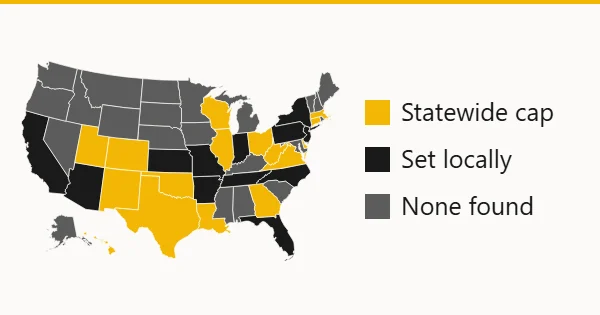
A private tow lot holds cars towed from private property at the request of the owner or manager: a store parking lot, an apartment complex, an office garage. The towing company sets its prices within whatever limits your state or city allows. Our private property towing guide covers that kind of tow in detail.
The difference matters for the bill. In many states the limits on what a lot can charge are different for these kinds of tow, and many leave police tow rates to the city or the agency's contract. Each state page lists both.
How storage is charged
Storage is charged for every day the car stays at the lot, on top of the tow. States count a day differently: some charge per calendar day, so a car dropped off late at night has already used one day by morning; others count full days from the moment the car arrived.
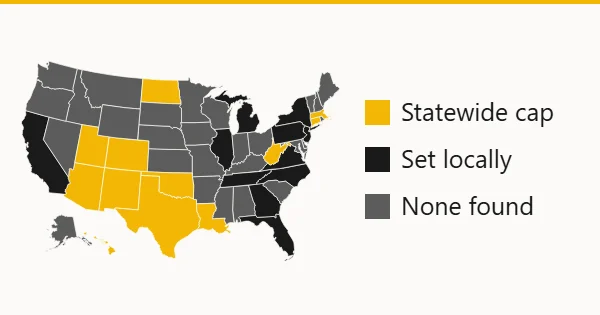
Where a state sets a statewide cap on daily storage after a police tow, the caps we have verified range from $20 / day[1] (District of Columbia) to $50 / day[2] (North Dakota). That's 13 of the 51 states we publish. In 11 more, the rate is set locally by a city, a county or the agency's contract, and the rest have no statewide figure.
A few states give you a short free period first, in some only after a private-property tow: 24 hours[3] (Georgia) to 48 hours[4] (Nevada), in 3 states. After that, the meter runs every day.
The simple lesson: the faster you collect the car, the less you pay. Our guide on how much to get a car out of impound walks through a full bill, and the towing and impound calculator does the math for your state.
How to get a vehicle out
First, find the car. If you don't know which lot has it, our guide to finding a towed car explains where to look.
Then call the lot before you go and ask about the total so far, the opening hours, the payment it accepts, and the documents it needs. Most lots ask for:
- a government-issued photo ID;
- proof that you own the car or may use it, such as the registration or title;
- payment for the tow, the storage and any fees your state allows;
- a release from the police, if the car was held by them.
Check the car before you drive away. Many states let you inspect it, and some require the lot to give you an itemized receipt. If something is damaged or a charge looks wrong, write it down and photograph it before you leave the lot.
What happens if nobody collects it
The bill keeps growing, and the lot starts a legal process that can end in a sale. The steps are similar everywhere, but the deadlines are not:
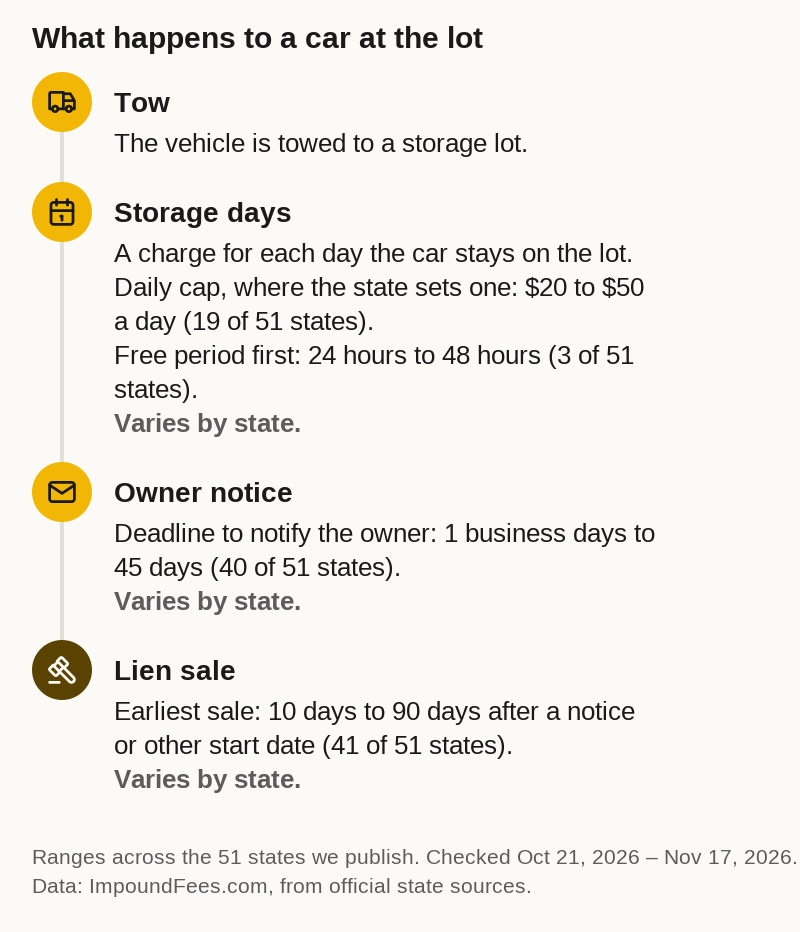
First, the lot or the agency sends a notice to the registered owner and any lender with a lien on the car. Where a state sets a deadline for that notice, it ranges from 1 business days[5] (Idaho) to 45 days[6] (South Dakota).
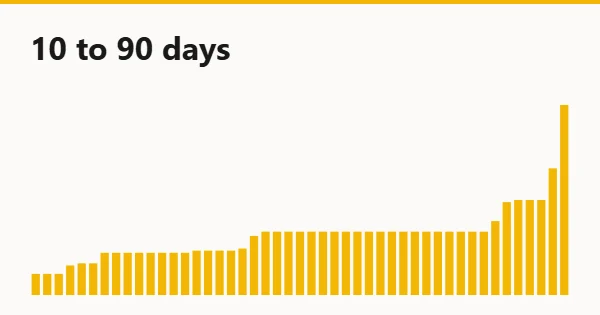
If the car is still there after the waiting period, the lot can usually sell it to cover the unpaid charges. The earliest sale ranges from 10 days[7] (Mississippi) to 90 days[8] (Nebraska), counted from a notice or another start date that each state sets. In some states, money left over after the charges are paid goes to the person entitled to it; the state page explains the rule where we found one.
Don't ignore the notice. Even if you can't pay right away, call the lot and ask what happens next, and check your state page for your rights.
Rules by state
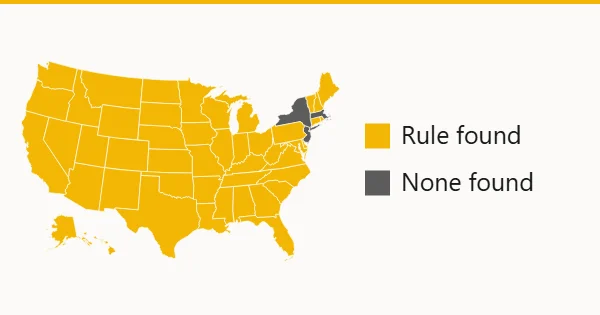
This table shows the daily storage figures and the earliest sale for each state we publish. "Set locally" means a city, a county or the towing agency sets the rate. "No statewide figure" means we found none in the official sources. Each figure links to its source.
| State | Storage, private tow | Storage, police tow | Earliest sale |
|---|---|---|---|
| Alabama | No statewide figure | No statewide figure | 30 days after the date the notice was sent to the owner and lienholder of record (after that the vehicle counts as abandoned; the auction also needs notice to the Department of Revenue at least 35 calendar days before the sale)[9] |
| Alaska | No statewide figure[10] | No statewide figure[10] | 20 days after the notice of sale, which may be given once the vehicle has been unclaimed for 30 days in the towing company's possession[11] |
| Arizona | Set locally[12] | $25 / day[13] | 30 days after the date on ADOT's notice of intent to transfer ownership[14] |
| Arkansas | No statewide figure | No statewide figure | 45 days after the date the towing lien is perfected (the company keeps the vehicle and has sent the certified-mail notice)[15] |
| California | Set locally[16] | Set locally[16] | Not found statewide[17] |
| Colorado | Up to $48.19 / day[18] | Up to $48.19 / day[18] | 30 days after the postmarked date of the notice to the owner (or the date the tow operator learns that no record exists for the vehicle)[19] |
| Connecticut | Up to $30 / day[20] | Up to $30 / day[20] | 30 days after the start of storage (start of the sale process)[21] |
| Delaware | Up to $50 / day[22] | No statewide figure | Not found statewide[23] |
| District of Columbia | Up to $20 / day[1] | Up to $20 / day[1] | 28 days after the impoundment notice[24] |
| Florida | Set locally[25] | Set locally[25] | 35 days after the date the vehicle was stored (57 days for a vehicle 3 model years old or newer)[26] |
| Georgia | Up to $33 / day[27] | Set locally[28] | Not found statewide[29] |
| Hawaii | Up to $25 / day[30] | Up to $25 / day[30] | 30 days after the mailing of the towing company's notice[31] |
| Idaho | No statewide figure | No statewide figure | 30 days after the first notice sent by the Idaho Transportation Department[32] |
| Illinois | Up to $45 / day[33] | Set locally[34] | 30 days after notice is given (conditions apply)[35] |
| Indiana | No statewide figure[36] | No statewide figure[36] | 20 days after the mailing of the owner notice[37] |
| Iowa | No statewide figure | No statewide figure | 20 days after the date the notice is mailed; an auction must also be advertised at least seven days ahead[38] |
| Kansas | No statewide figure | No statewide figure | 30 days after the tow; the notice of sale then gives 15 days to pay, and the auction must be advertised at least 7 days ahead[39] |
| Kentucky | No statewide figure | No statewide figure | 45 days after charges going unpaid (the statute does not say from which date)[40] |
| Louisiana | $34 / day[41] | $34 / day[41] | 15 days after the final notice is mailed (the final notice is sent after forty-five days in storage) (start of the sale process)[42] |
| Maine | No statewide figure | No statewide figure | 14 days after the date the Secretary of State sends its notices to the owner and lienholder (or the date the newspaper notice is published)[43] |
| Maryland | No statewide figure | No statewide figure | 21 days after the date of the police notice (abandoned vehicles in police custody)[44] |
| Massachusetts | Up to $35 / day[45] | Up to $35 / day[45] | 21 days after the garage's sale notice, which it may send once the vehicle has been unclaimed for sixty days[46] |
| Michigan | Set locally[47] | Set locally[47] | 20 days after the date of the Secretary of State's abandoned-vehicle notice (or the court's decision, if you requested a hearing)[48] |
| Minnesota | No statewide figure | No statewide figure | 45 days after the notice to the owner (unauthorized vehicles impounded other than by Minneapolis or St. Paul)[49] |
| Mississippi | No statewide figure[7] | No statewide figure[7] | 10 days after the mailing of the second certified letter, which may be sent only if the bill is still unpaid 30 days after the tow[7] |
| Missouri | No statewide figure | No statewide figure | 30 days after the date the towing company mails its certified-mail notice[50] |
| Montana | No statewide figure[51] | No statewide figure[51] | 30 days after the certified-mail notice (or the newspaper notice); 60 days when the vehicle was taken into custody after the driver's arrest[52] |
| Nebraska | No statewide figure | No statewide figure | 90 days after the date of the tow; a notice of the intended sale must also be mailed at least 30 days before it[8] |
| Nevada | No statewide figure | No statewide figure | 22 days after the first newspaper advertisement of the sale, which may run only after the payment deadline in the lien notice (at least 10 days after the notice)[53] |
| New Hampshire | No statewide figure | No statewide figure | 20 days (conditions apply)[54] |
| New Jersey | Set locally[55] | Set locally[55] | 30 days after the date of detention[56] |
| New Mexico | $10–$20 / day[57] | $10–$20 / day[57] | 44 days after the mailing date shown on the certified-mail receipt for the lien notice, not the date it was received (vehicles registered in New Mexico; 70 days for vehicles registered in another state)[58] |
| New York | Set locally[59] | Set locally[59] | Not found statewide[60] |
| North Carolina | Set locally[61] | Set locally[61] | 10 days after the date the towing and storage charges were due (start of the sale process)[61] |
| North Dakota | Up to $50 / day[2] | Up to $50 / day[2] | 30 days after receipt of the notice when a towing company holds the vehicle, or the date of the notice when a government agency holds it[62] |
| Ohio | Up to $22 / day[63] | No statewide figure[63] | 60 days after the date the owner notice is received (signed receipt) or the company learns it could not be delivered[64] |
| Oklahoma | Up to $23.94 / day[65] | Up to $23.94 / day[65] | 20 days after the lien arises (start of the sale process)[66] |
| Oregon | No statewide figure | No statewide figure | 30 days after the notice of foreclosure sale mailed to the owner (15 days for a vehicle appraised at $1,000 or less)[67] |
| Pennsylvania | Up to $25 / day[68] | Set locally[69] | 30 days after the date PennDOT mails the abandoned-vehicle notice (or publishes it)[70] |
| Rhode Island | No statewide figure | No statewide figure | 30 days after the mailing of the tower's first notice; a second, foreclosure notice must then give 10 more days before the sale[71] |
| South Carolina | No statewide figure | No statewide figure | 30 days after the written notice to the owner and lienholders[72] |
| South Dakota | No statewide figure[73] | No statewide figure[73] | 30 days after the date the towing company sent the notice; title then passes to the towing company (no auction)[74] |
| Tennessee | Set locally[75] | Set locally[75] | 20 days after the date the owner receives the notice[76] |
| Texas | Up to $22.85 / day[77] | Up to $22.85 / day[77] | 30 days after the second notice[78] |
| Utah | Up to $42 / day[79] | Up to $42 / day[79] | 30 days after the original notice of the impound (60 days for a vehicle seven model years old or newer)[80] |
| Vermont | No statewide figure | No statewide figure | 21 days after the DMV's second notice to the owner (for a vehicle with no identifiable plate or identification number, the DMV's receipt of the certification form)[81] |
| Virginia | Set locally[82] | Set locally[82] | 21 days after the company's notice of intent to sell to the DMV[83] |
| Washington | No statewide figure[84] | No statewide figure[84] | 15 days after the mailing of the notice of custody and sale[85] |
| West Virginia | Up to $27 / day[86] | Up to $27 / day[86] | 10 days after the date the owner or lienholder receives the abandoned-vehicle notice (or the date a newspaper notice is published)[87] |
| Wisconsin | Up to $25 / day[88] | No statewide figure | 20 days after the certified-mail notice of the sale or junking[89] |
| Wyoming | No statewide figure[90] | No statewide figure[90] | 30 days after the notice to the owner, for a police-impounded abandoned vehicle worth $2,000 or more (sheriff's auction)[91] |
Common mistakes
Waiting for the weekend. Every day adds storage. If the lot is open, go now.
Going without the right documents. Call first. A wasted trip can cost another day of storage.
Assuming the car will just sit there. It won't. After the notice period, the lot can begin the sale process.
Throwing away the notice. It tells you where the car is, what you owe and how long you have.
Not checking the bill. Compare each line with the limits on your state page, and ask for an itemized invoice.
Questions people ask
Can you buy cars from an impound lot?
Sometimes. Unclaimed cars are often sold at public auction once the notice period ends. Tennessee's rule is a typical example:
- Tennessee: Watch for the notice sent to the registered owner. You have 20 days after you receive it to reclaim the vehicle by paying the towing, preservation and storage charges; after that it may be sold at public auction.[76]
To find impound lot sales near you, ask the agency or towing company that holds the cars, or check your city, county or sheriff's office website.
When a car gets impounded, where does it go?
To the storage lot used by whoever ordered the tow. In a city, that may be a city impound lot run by the police or by a contractor. Elsewhere, it can be a county impound lot. Cars towed by the sheriff's office may go to a sheriff's impound lot. After a private-property tow, the car goes to the towing company's own yard.
Is there a way to locate my car?
Yes. Call the police non-emergency line for the area where you parked, or read the tow-away sign if you parked on private property. Our guide to finding a towed car lists the official online lookups we found.
How do I find my local impound lot?
Ask the police non-emergency line which lot the city uses, or search your city or county website for its towing or impound page. If a private company towed you, the sign at the lot names it.
Do tow trucks take your car home?
Only if you hired the tow yourself. A tow you didn't ask for goes to the company's storage lot. If you reach the car before the truck leaves, many states let you get it back on the spot for a reduced fee. Here is the Texas rule:
- Texas: If you return while the tow truck is still hooking up your car, you can keep it free of charge. If the car is fully hooked up but has not left the lot, you can keep it by paying the drop fee.[92]
Can I have an abandoned car towed from my property in California?
Yes, under conditions set by state law for vehicles parked without permission. Here is how our California data describes them:
- California: The property owner or person in lawful possession (including an HOA) has the vehicle removed under Vehicle Code §22658, e.g. where compliant 17x22-inch signs are posted at all entrances. The tow must be authorized in writing, the police must be notified, and towing/storage charges may not exceed the greater of the local police-agency tow rate or the operator's CHP-approved rate. The §22852 poststorage hearing does not apply.[93]
How to get a friend's car out of impound
Ask the lot what it needs from someone who isn't the owner. Usually that's written permission from the owner plus your own ID, and the owner's proof of ownership. Some states write this into the rules:
- New York: Pay the charges accrued to the day of release; the vehicle is then released to you or your lawfully designated representative. If the company takes cards in its normal business, it must accept them for towing and storage charges.[94]
How to get a totaled car out of impound
Call your insurer first. It may arrange to collect the car, and some state rules name insurers among the people the lot must release it to:
- North Carolina: If police are holding the vehicle as evidence after a crash, they can hold it for no more than 20 days without a court order. After that it must be released to the owner, insurer or lienholder once the towing and storage fees are paid.[95]
How to get a stolen car out of impound
Have your police report number ready. Some states waive or limit what you owe when a stolen car was towed:
- Virginia: If your car was stolen and then towed, give the storage facility the police report number and the name of the agency, plus a valid registration or other proof of ownership. If you remove the car within five business days after receiving written notice by certified mail, you are relieved of the towing, storage and recovery fees. This relief does not extend to an insurance company that has become the owner's successor in interest. If you do not remove the vehicle within five days of receiving the notice, you must pay the full costs to get it back, and you may then seek reimbursement from the state treasury.[96]
Related state pages
- California towing & impound fees · City pages: Bakersfield, Clovis, Corona, Escondido, Fresno, Hayward, Huntington Beach, Los Angeles, Murrieta, Oakland, Rancho Cucamonga, Riverside, Roseville, Sacramento, San Bernardino, San Diego, San Francisco, Temecula
- Florida towing & impound fees · City pages: Jacksonville
- New York towing & impound fees · City pages: New York City
- North Carolina towing & impound fees
- Texas towing & impound fees · City pages: Austin, Corpus Christi, Dallas, Irving, Pasadena
- Virginia towing & impound fees · City pages: Norfolk
Related guides
-

Find my towed car: where to look first, state by state
Find my towed car: call the police non-emergency line or the number on the lot's tow-away sign, then try your state's official lookup if it has one.
Updated
-
How much to get a car out of impound? Costs by state
How much to get a car out of impound: the tow, a daily storage charge and any release fees. See each state's limits and a worked example.
Updated
-
Private property towing: your rights and the limits
Private property towing is legal when state rules are followed: signs, notice to police and fee limits. See what it can cost and how to dispute a tow.
Updated
-
Tow company lien process: when an unclaimed car is sold
The tow company lien process: a notice to the owner, a waiting period, then a sale. See each state's deadlines and what you may still owe after.
Updated
-
Can a tow company keep my personal belongings? State rules
Can a tow company keep my personal belongings? What each state's law says about getting them back, which items are free and the deadlines.
Updated
Sources (96)
- 16 DCMR § 408.1 Maximum rates for public tows (lead-in)
- NDCC 23.1-15-06(3) storage charges may not exceed $50 per day
- O.C.G.A. 44-1-13(b)(1) as amended by HB 551 (2025) - no storage fee for first 24 hours
- NRS 706.4477 (6) no storage charge for the first 48 hours
- Idaho Code 49-1807(1) procedures apply to tows under 49-1803 to 49-1806
- SDCL 32-36-8 notice within 45 days of removal
- SB 2848 (2026), Sec. 1, Miss. Code Ann. 85-7-251, (1)(c)
- Neb. Rev. Stat. § 60-2410 (1) possession until paid; disposal after 90 days (Towing and storage fees; liability; lien; notice)
- Ala. Code § 32-13-1 (1) abandoned motor vehicle defined
- AS 28.10.502(b) storage drops out of the lien after 60 days without notice
- AS 28.10.502(c) sale after 30 days unclaimed, 20 days notice
- A.R.S. 28-4837(B) Owner liable for reasonable costs
- A.R.S. 28-3512(H) $25 daily storage for 28-3511 impoundments
- A.R.S. 28-4838(A) Abandoned vehicle report after ten days
- Act 1053 of 2007, § 12, Ark. Code § 27-50-1209(a)(1) (45 days to reclaim)
- Cal. Veh. Code §22658(i)(1)(A) - private-property tow/storage charge is excessive above the local police or CHP rate
- Cal. Civ. Code §3068.1(b) - low-value vehicles: lien sale within 15 days or storage stops accruing
- 4 CCR 723-6, Rule 6511(d)(I) storage maximums (2022 base amounts, weight classes)
- HB22-1314, Ch. 416 (2022), C.R.S. § 42-4-2105(1)(b)(II) - when the lien attaches
- C.G.S. 14-66d(d) the storage rates and after-hours fee apply to all nonconsensual tows
- PA 26-24, S. 37 (C.G.S. 14-150c(a)) lien for towing and storage
- 21 Del. C. § 6907A(c) Towing fee up to $250 and daily storage up to $50 (noncommercial and rental vehicles)
- 25 Del. C. § 3901(a) Lien for storing, safekeeping or towing vehicles
- D.C. Code § 50-2456(a) 28-day reclamation period
- Fla. Stat. §125.0103(1)(c) Counties must set maximum towing rates
- Fla. Stat. §713.78(6) Sale timing
- DPS Tariff No. 5 Sec. 2.B items 3-4 (daily storage, light and medium)
- O.C.G.A. 40-11-19(d)(2)(A) (HB 307, 2019) - daily storage rate per local agreement
- O.C.G.A. 40-11-19.1(a) (HB 307, 2019) - when the foreclosure petition may be filed
- HRS 290-11 Vehicles left unattended on private and public property
- HRS 290-11 Vehicles left unattended on private and public property
- Idaho Code 49-1807(1)(c)(iii) title or junk certificate to the tow company after 30 days
- 625 ILCS 5/18a-200 General powers and duties of Commission
- 625 ILCS 5/4-214(b) Violations of Section 4-201
- 625 ILCS 5/4-208(b) Disposal of unclaimed vehicles
- IC 24-14-8-1 Towing, clean-up, and storage fees
- IC 9-22-1-21.5(a) Towing lien
- HF 2617 (2026) sec. 2, Iowa Code 321.89(3)(e): hearing request or reclaim within the reclaiming period
- K.S.A. 8-1103(a)(2) Towed motor vehicles, lien created thereon; procedure; personal property; notice of fee; city ordinance or county resolution
- KRS 376.275(1)(a) Lien for towing and storage (Lien on motor vehicles and contents for reasonable and applicable charges under KRS 281.920 to 281.936)
- LPSC Schedule (eff. 4-1-2026), § II.C Storage rates
- La. R.S. 32:1728(A)(3) Permit to sell 15 days after final notice
- 29-A M.R.S. §1852 Abandonment defined: 14 days after the Secretary of State's notices
- Md. Code, Transp. §25-201(b)(3) Abandoned vehicle - private property
- M.G.L. c. 159B, § 6B ($35 maximum storage per 24-hour period)
- M.G.L. c. 159B, § 6B (storage facility lien; enforced under c. 255, § 39A)
- MCL 257.252a (6) contest and bond
- MCL 257.252a (18) public sale timing
- Minn. Stat. 168B.051, subd. 1 Sale after 15 days (junk or abandoned vehicles)
- RSMo 304.155.9 Lien of the person who removes abandoned property at police direction
- MCA 71-3-1201(2)(a) lien limited to the reasonable cost of towing or storage
- MCA 61-8-913(3) title request after 30 days unpaid
- NRS 108.270 (1) lien for towing and storage ordered by police
- RSA 262:33 I Reasonable removal and storage charges are a lien paid by the owner
- N.J.A.C. 13:45A-31.4(d) storage in full 24-hour periods [Division of Consumer Affairs posted copy of subchapter 31; no amendment history shown; match with the official current text unconfirmed (official N.J.A.C. not reachable)]
- N.J.S.A. 2A:44-21 Garage keeper liens; detention of vehicles; notice; priority - lien for towing and storage [source note: L.1951 (1st SS), c.344; amended 1961, c.121, s.4; 1998, c.122, s.1; 2023, c.132, s.2 (approved and effective Aug. 7, 2023)]
- New Mexico Statewide Wrecker Tariff (effective February 1, 2017), Rate table
- 18.3.12.26(B)(1) NMAC (Towing Services)
- N.Y. Veh. & Traf. Law §1640(a)(14) cities and villages: removal, storage and reasonable charges
- N.Y. Lien Law §201 notice of sale: payment deadline at least ten days
- N.C.G.S. 44A-2(d) Towing and storage lien
- NDCC 23.1-15-06(2) reclaim from a towing service within thirty days after receipt of the notice
- Ohio Adm.Code 4901:2-24-03(B)(1) Storage fee cap, GVWR under 10,001 lbs
- R.C. 4505.101(B)(2)-(3) Title for private tow-away zone vehicles
- 47 O.S. § 954A (G) no storage if notice rules not followed (Abandoned motor vehicle - removal (private property))
- 42 O.S. § 91 (A)(1)(b) police-directed and private-property tows follow § 91A (Lien on personal property for service thereon - foreclosure - notice)
- ORS 98.812(2) Tower's lien for just and reasonable charges
- 75 Pa.C.S. § 3353(c) Default storage maximum
- 75 Pa.C.S. § 6109(a)(22) Local authority power over removal and impounding
- 75 Pa.C.S. § 3353(c) Lien for removal and storage
- R.I. Gen. Laws § 39-12.1-6 Possessory lien on vehicle and plates, only if the notice sections were followed in full
- S.C. Code § 29-15-10(A)(3) Thirty days after notice before sale
- SDCL 32-30-18 possessory lien for reasonable costs; contents lien up to $500
- SDCL 32-36-9 title vests in the removal agency 30 days after notice
- Pub. Ch. 457 (2025), Tenn. Code Ann. § 55-31-207(e)(1) Fees tied to the THP district maximum
- Pub. Ch. 457 (2025), Tenn. Code Ann. § 55-31-301(d)(4) 20 days to reclaim
- 16 TAC §85.722(d)(1) Daily storage fee (adjusted)
- Tex. Occ. Code §2303.154(a) Vehicle considered abandoned
- Utah Code § 72-9-603(16)(a)(ii) UDOT sets maximum storage rates
- Utah Code § 41-6a-1406(10)(b) possessory lien
- 23 V.S.A. § 2154(a)(2) 21 days after the second notice to reclaim
- Va. Code § 46.2-118(B)(11) Excessive fees prohibited
- Va. Code § 46.2-644.01(B) Lien for towing and storage
- RCW 46.55.063 (1) Fee schedule filed with the department
- RCW 46.55.010 (1) Definition: abandoned vehicle
- 150 CSR 9 r. 6.4: inside storage only if stored inside a roofed building
- W. Va. Code 17-24A-4(a)(3): 10 days to reclaim on payment of towing, preservation and storage
- Wis. Admin. Code Trans 319.03(1) (intro) individual total amounts
- Wis. Stat. § 779.415(1g)(a) towing and storage lien; vehicle may be held until paid
- W.S. 29-7-102(e)(ii) storage fees limited to 180 days
- W.S. 31-13-104(e) title vests in the county 30 days after notice
- Consumer Information about Towing (not fully hooked up)
- Cal. Veh. Code §22658(a)(1) - private-property tow signage condition
- N.Y. Lien Law §184(2) release on full payment
- N.C.G.S. 20-166.3(a) Evidence hold after collision - 20 days
- Va. Code § 46.2-1209(C) Stolen vehicles: owner relieved of costs
General information, not legal advice. See how we verify figures.